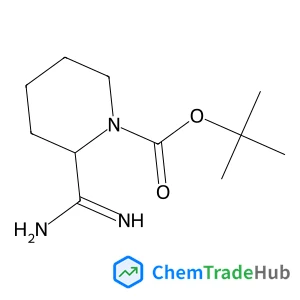
2-Methyl-2-propanyl 2-carbamimidoyl-1-piperidinecarboxylate
CAS Number:
1258640-98-0
Molecular Formula:
C11H21N3O2
Paulo Alliprandini Filho, Gustavo G. Dalkiranis, Raigna A. S. Z. Armond, Eralci M. Therézio, Ivan H. Bechtold, André A. Vieira, Rodrigo Cristiano, Hugo Gallardo, Osvaldo N. Oliveira, Jr.
The incorporation of dyes in liquid crystal matrices has been exploited to produce enhanced displays, but it can also be used to probe ordering in liquid crystals and to assess intermolecular interactions and dye aggregation. In this study, we investigated polarized absorption and emission of the luminescent dyes 4,7-bis(2-(4-(decyloxy)phenyl)ethynyl)-[2,1,3]-benzothiadiazole (1A) and 4,7-bis{2-[4-(4-decylpiperazin-1-yl)phenyl]ethynyl}-[2,1,3]-benzothiadiazole (5A) in the E7® liquid crystal. The electronic structures of both 1A and 5A dyes were affected by the matrix and by the analysis of the line shape of emission we could determine that the dyes form J aggregates. This achievement is significant because obtaining this type of information for small molecules requires ordered matrices, which is difficult to obtain for these dyes. Using emission ellipsometry we were able to determine the ordering of the E7 molecules, but this was possible only with the larger 5A dye. The smaller 1A was not entirely ordered in the E7 matrix and this calls for caution in other types of work where dopants are used as probes to infer the properties of the matrix. The emission ellipsometry data for the dyes allowed us to detect the enhanced birefringence in the matrix, thus confirming the theoretical prediction.
Jianjun Liang, Jin Yang, Chuandong Jia, Hongrui Zhang, Ning Tang, Christoph Janiak
DOI: 10.1039/B719019K
Marites A. Guino-o, Charles F. Campana, Karin Ruhlandt-Senge
DOI: 10.1039/B715701K
Zheming Wang
DOI: 10.1039/B800722E
Davide Pantarotto, Wesley R. Browne, Ben L. Feringa
DOI: 10.1039/B715310D
Iris Haas, Aharon Gedanken
DOI: 10.1039/B717670H
Fiorella L. Callari, Salvatore Sortino
DOI: 10.1039/B800132D
Hideyuki Yoshiyama, Norio Shibata, Takefumi Sato, Shuichi Nakamura, Takeshi Toru
DOI: 10.1039/B800918J
Ying-Feng Han, Yue-Jian Lin, Wei-Guo Jia, Guo-Liang Wang, Guo-Xin Jin
DOI: 10.1039/B717554J
Chuan-Feng Chen, Zhi-Tang Huang
DOI: 10.1039/B800258D
N-(4-Methoxybenzyl)-2-pyridinamine (CAS: 52818-63-0) is increasingly being used ...
When handling Ethyl 4-(2-chlorophenyl)-1,3-thiazole-2-carboxylate, appropriate p...
Diethyldiselane (CAS: 628-39-7) is classified under the Globally Harmonized Syst...
The market for oxocopper (CAS: 12053-18-8) is primarily driven by its use in cat...
The market for 5-{[(2-Methyl-2-propanyl)oxy]carbonyl}-5-azaspiro[2.4]heptane-7-c...
2-(1-Pyrrolidinyl)-4-pyridinamine is a chemical compound with the CAS number 359...
2-(3-Pyridinyl)-1-azabicyclo[2.2.2]octane (CAS: 91556-75-1) is a crystalline sol...
(S)-Alpha-allyl-proline hydrochloride is usually synthesized via a Wittig reacti...
3-Methyl-1,2-oxazole-5-carboxylic acid (CAS: 4857-42-5) is an organic compound w...
Lys-SMCC-DM1 is synthesized via a multi-step process involving the coupling of S...

Physical Chemistry Chemical Physics (PCCP) is an international journal co-owned by 19 physical chemistry and physics societies from around the world. This journal publishes original, cutting-edge research in physical chemistry, chemical physics and biophysical chemistry. To be suitable for publication in PCCP, articles must include significant innovation and/or insight into physical chemistry; this is the most important criterion that reviewers and Editors will judge against when evaluating submissions. The journal has a broad scope and welcomes contributions spanning experiment, theory, computation and data science. Topical coverage includes spectroscopy, dynamics, kinetics, statistical mechanics, thermodynamics, electrochemistry, catalysis, surface science, quantum mechanics, quantum computing and machine learning. Interdisciplinary research areas such as polymers and soft matter, materials, nanoscience, energy, surfaces/interfaces, and biophysical chemistry are welcomed if they demonstrate significant innovation and/or insight into physical chemistry. Joined experimental/theoretical studies are particularly appreciated when complementary and based on up-to-date approaches.