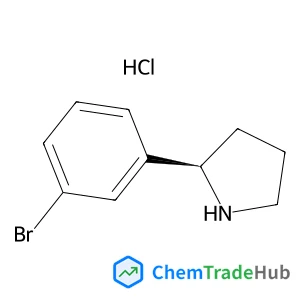
(2R)-2-(3-Bromophenyl)pyrrolidine hydrochloride (1:1)
CAS Number:
1391550-13-2
Molecular Formula:
C10H13BrClN
Ali Douaki, Annina Stuber, Julian Hengsteler, Dmitry Momotenko, David M. Rogers, Walter Rocchia, Jonathan D. Hirst, Nako Nakatsuka
Aptamer-based sensing of small molecules such as dopamine and serotonin in the brain, requires characterization of the specific aptamer sequences in solutions mimicking the in vivo environment with physiological ionic concentrations. In particular, divalent cations (Mg2+ and Ca2+) present in brain fluid, have been shown to affect the conformational dynamics of aptamers upon target recognition. Thus, for biosensors that transduce aptamer structure switching as the signal response, it is critical to interrogate the influence of divalent cations on each unique aptamer sequence. Herein, we demonstrate the potential of molecular dynamics (MD) simulations to predict the behaviour of dopamine and serotonin aptamers on sensor surfaces. The simulations enable molecular-level visualization of aptamer conformational changes that, in some cases, are significantly influenced by divalent cations. The correlations of theoretical simulations with experimental findings validate the potential for MD simulations to predict aptamer-specific behaviors on biosensors.
David Ruzafa, Lorena Varela, Ana I. Azuaga, Francisco Conejero-Lara, Bertrand Morel
DOI: 10.1039/C3CP54383H
Forrest S. Gittleson, Ryan C. Sekol, Marcelo Linardi, André D. Taylor
DOI: 10.1039/C3CP54555E
R. Pérez de Tudela, M. Menéndez, J. F. Castillo, F. J. Aoiz
DOI: 10.1039/C3CP54405B
Yue Wang, Wei Ji, Zhi Yu, Ran Li, Xu Wang, Wei Song, Weidong Ruan, Bing Zhao, Yukihiro Ozaki
DOI: 10.1039/C3CP54856B
Hong-Yan Wang, Jia Liu, Jiefang Zhu, Stenbjörn Styring, Sascha Ott, Anders Thapper
DOI: 10.1039/C3CP54500H
Xuebo Chen, Weihai Fang, Haobin Wang
DOI: 10.1039/C3CP55020F
DOI: 10.1039/C3CP54065K
Hong-Guang Xu, Wei-Jun Zheng, Jun Li
DOI: 10.1039/C3CP54478H
Hwankyu Lee, Hyun Ryoung Kim, Jae Chan Park
DOI: 10.1039/C3CP52639A
DOI: 10.1039/C3CP54300E
N-(4-Methoxybenzyl)-2-pyridinamine (CAS: 52818-63-0) is increasingly being used ...
When handling Ethyl 4-(2-chlorophenyl)-1,3-thiazole-2-carboxylate, appropriate p...
Diethyldiselane (CAS: 628-39-7) is classified under the Globally Harmonized Syst...
The market for oxocopper (CAS: 12053-18-8) is primarily driven by its use in cat...
The market for 5-{[(2-Methyl-2-propanyl)oxy]carbonyl}-5-azaspiro[2.4]heptane-7-c...
2-(1-Pyrrolidinyl)-4-pyridinamine is a chemical compound with the CAS number 359...
2-(3-Pyridinyl)-1-azabicyclo[2.2.2]octane (CAS: 91556-75-1) is a crystalline sol...
(S)-Alpha-allyl-proline hydrochloride is usually synthesized via a Wittig reacti...
3-Methyl-1,2-oxazole-5-carboxylic acid (CAS: 4857-42-5) is an organic compound w...
Lys-SMCC-DM1 is synthesized via a multi-step process involving the coupling of S...

ChemComm publishes urgent research which is of outstanding significance and interest to experts in the field, while also appealing to the journal’s broad chemistry readership. Our communication format is ideally suited to short, urgent studies that are of such importance that they require accelerated publication. Our scope covers all topics in chemistry, and research at the interface of chemistry and other disciplines (such as materials science, nanoscience, physics, engineering and biology) where there is a significant novelty in the chemistry aspects. Major topic areas covered include: Analytical Chemistry Catalysis Chemical Biology and medicinal chemistry Computational Chemistry and Machine Learning Energy and sustainable chemistry Environmental Chemistry Green Chemistry Inorganic Chemistry Materials Chemistry Nanoscience Organic Chemistry Physical Chemistry Polymer Chemistry Supramolecular Chemistry
![N-{15-[(2,5-Dioxo-1-pyrrolidinyl)oxy]-15-oxo-3,6,9,12-tetraoxapentadec-1-yl}-2-(2-propyn-1-yloxy)acetamide structure](https://static.chemtradehub.com/structs/210/2101206-92-0-2eb5.webp "N-{15-[(2,5-Dioxo-1-pyrrolidinyl)oxy]-15-oxo-3,6,9,12-tetraoxapentadec-1-yl}-2-(2-propyn-1-yloxy)acetamide structure")