












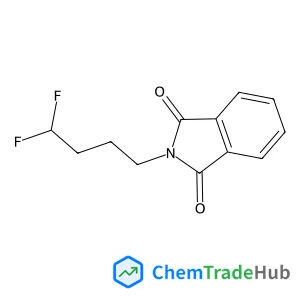
2-(4,4-Difluorobutyl)-1H-isoindole-1,3(2H)-dione
CAS Number:
1265341-14-7
Molecular Formula:
C12H11F2NO2
R. Pérez de Tudela, M. Menéndez, J. F. Castillo, F. J. Aoiz
We have performed ring polymer molecular dynamics (RPMD) calculations on the Cl + O3 → ClO + O2 reaction at temperatures ranging from 200 K to 400 K, and compared the results with previous theoretical studies and also with the available experimental data. This reaction presents a couple of features which makes it a particularly interesting and challenging case to be studied using RPMD. First, classically, this is essentially a barrierless reaction, with a saddle point located below the reactants. However, the free energy profiles along the reaction coordinate display small barriers due to the fact that the decrease in enthalpy from reactants to the TS is somewhat compensated by a decrease in entropy. To our knowledge this is the first time such a process is studied using this technique. Second, the transition state is located early in the reactant valley, therefore the inclusion of the recrossing correction in the RPMD calculations is crucial to determine rate coefficients. Regarding quantum effects, our calculations show that RPMD results are within the error bars of the purely classical ones. This implies that tunnelling is negligible in this reaction at the temperatures studied, not surprisingly for a system including oxygen and chlorine atoms, and that the zero point energies of reactants, transition state and products are practically the same. Finally, the rate coefficients presented in this work are in a fairly good agreement with the recommended experimental values, somewhat better than those obtained using other approaches.
Preston A. Chase, Titel Jurca, Douglas W. Stephan
DOI: 10.1039/B718598G
Ruth I. J. Amos, Brendon S. Gourlay, Brian F. Yates
DOI: 10.1039/B719570B
Curtis J. Rieder, Ryan J. Fradette, F. G. West
DOI: 10.1039/B800800K
Kazuhiro Matsumoto, Tetsufumi Yamaguchi, Tsutomu Katsuki
DOI: 10.1039/B719265G
Lidong Shao, Tsung-Wu Lin, Gerard Tobias, Malcolm L. H. Green
DOI: 10.1039/B800881G
Alejandro Díaz-Moscoso, Patricia Balbuena, Marta Gómez-García, Carmen Ortiz Mellet, Juan M. Benito, Loïc Le Gourriérec, Christophe Di Giorgio, Pierre Vierling, Antonino Mazzaglia, Norberto Micali, Jacques Defaye, José M. García Fernández
DOI: 10.1039/B718672J
Emanuela Berni, Joachim Garric, Corinne Lamit, Brice Kauffmann, Jean-Michel Léger, Ivan Huc
DOI: 10.1039/B719712H
Andrés de la Escosura, Martijn Verwegen, Friso D. Sikkema, Marta Comellas-Aragonès, Andrei Kirilyuk, Theo Rasing, Roeland J. M. Nolte, Jeroen J. L. M. Cornelissen
DOI: 10.1039/B800936H
Christopher Jones, Stuart H. Taylor, Andrew Burrows, Mandy J. Crudace, Christopher J. Kiely, Graham J. Hutchings
DOI: 10.1039/B800052M
Justin J. Richards, Robert W. Huigens III, T. Eric Ballard, Anne Basso, John Cavanagh, Christian Melander
DOI: 10.1039/B719802G
N-(4-Methoxybenzyl)-2-pyridinamine (CAS: 52818-63-0) is increasingly being used ...
When handling Ethyl 4-(2-chlorophenyl)-1,3-thiazole-2-carboxylate, appropriate p...
Diethyldiselane (CAS: 628-39-7) is classified under the Globally Harmonized Syst...
The market for oxocopper (CAS: 12053-18-8) is primarily driven by its use in cat...
The market for 5-{[(2-Methyl-2-propanyl)oxy]carbonyl}-5-azaspiro[2.4]heptane-7-c...
2-(1-Pyrrolidinyl)-4-pyridinamine is a chemical compound with the CAS number 359...
2-(3-Pyridinyl)-1-azabicyclo[2.2.2]octane (CAS: 91556-75-1) is a crystalline sol...
(S)-Alpha-allyl-proline hydrochloride is usually synthesized via a Wittig reacti...
3-Methyl-1,2-oxazole-5-carboxylic acid (CAS: 4857-42-5) is an organic compound w...
Lys-SMCC-DM1 is synthesized via a multi-step process involving the coupling of S...

Physical Chemistry Chemical Physics (PCCP) is an international journal co-owned by 19 physical chemistry and physics societies from around the world. This journal publishes original, cutting-edge research in physical chemistry, chemical physics and biophysical chemistry. To be suitable for publication in PCCP, articles must include significant innovation and/or insight into physical chemistry; this is the most important criterion that reviewers and Editors will judge against when evaluating submissions. The journal has a broad scope and welcomes contributions spanning experiment, theory, computation and data science. Topical coverage includes spectroscopy, dynamics, kinetics, statistical mechanics, thermodynamics, electrochemistry, catalysis, surface science, quantum mechanics, quantum computing and machine learning. Interdisciplinary research areas such as polymers and soft matter, materials, nanoscience, energy, surfaces/interfaces, and biophysical chemistry are welcomed if they demonstrate significant innovation and/or insight into physical chemistry. Joined experimental/theoretical studies are particularly appreciated when complementary and based on up-to-date approaches.
![N-{15-[(2,5-Dioxo-1-pyrrolidinyl)oxy]-15-oxo-3,6,9,12-tetraoxapentadec-1-yl}-2-(2-propyn-1-yloxy)acetamide structure](https://static.chemtradehub.com/structs/210/2101206-92-0-2eb5.webp "N-{15-[(2,5-Dioxo-1-pyrrolidinyl)oxy]-15-oxo-3,6,9,12-tetraoxapentadec-1-yl}-2-(2-propyn-1-yloxy)acetamide structure")





