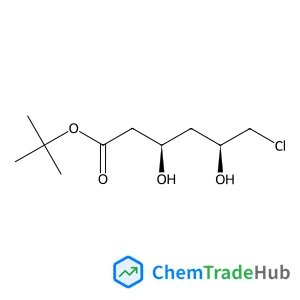
2-Methyl-2-propanyl (3R,5S)-6-chloro-3,5-dihydroxyhexanoate
CAS Number:
154026-93-4
Molecular Formula:
C10H19ClO4
Suitao Qi, Kevin J. Smith, Yiming Zhou
The catalytic dehydrogenation of perhydro-dibenzyltoluene (H18-DBT) to dibenzyltoluene (DBT) on a Pt/Al2O3 catalyst was investigated using 1H NMR spectroscopy and GC-MS. It has been found that the dehydrogenation of a cyclohexyl ring of H18-DBT is very rapid and that Hx-DBT species with partially dehydrogenated rings can be neglected. Four different dehydrogenation pathways of H18-DBT to DBT, based on the ring dehydrogenation sequence were considered, including side–middle–side order, middle–side–side order, side–side–middle order, and statistical dehydrogenation with no ring preference. The H18-DBT dehydrogenation proceeds with a high preference for the side–middle–side (SMS) sequence of ring dehydrogenation. Steric hindrance leads to one of the side rings of H18-DBT dehydrogenating first. Subsequent adsorption of the H12-DBT with one side ring dehydrogenated, via the phenyl ring on the Pt surface is more stable and stronger than that of the cyclohexyl ring, causing the middle ring to be more accessible to the Pt sites and to undergo dehydrogenation. Finally, the remaining side ring is dehydrogenated to complete the SMS dehydrogenation pathway.
X. He, Z. Q. Fan, Z. H. Zhang
DOI: 10.1039/D0CP04346J
Hans Geerlings, Pavel Trtik, Anders Kaestner
DOI: 10.1039/D0CP03414B
DOI: 10.1039/C9CP05583E
Angélique Marie, Bilel Said, Anne Galarneau, Timo Stettner, Andrea Balducci, Maxime Bayle, Bernard Humbert, Jean Le Bideau
DOI: 10.1039/D0CP03599H
Bojana Katana, Dóra Takács, Felix D. Bobbink, Paul J. Dyson, Nizar B. Alsharif, Matija Tomšič, Istvan Szilagyi
DOI: 10.1039/D0CP02805C
Weiwei Ju, Shuai Zhang, Caijuan Xia
DOI: 10.1039/C9CP05185F
Huiwen Wang, Linlu Song, Ting Zhou, Chen Zeng, Ya Jia, Yunjie Zhao
DOI: 10.1039/D0CP03662E
Lisette R. Warren, Colin R. Pulham, Carole A. Morrison
DOI: 10.1039/D0CP05172A
Waste containing 2-Ethyl-4-Methyl-1H-Imidazole-5-Carbaldehyde (CAS: 88634-80-4) ...
Triethoxy(octyl)silane (CAS: 1385031-14-0) is widely used in the pharmaceuticals...
Several alternatives to 3-iodo-7-nitro-1H-indazole (CAS: 864724-64-1) exist in t...
Yes, there are alternatives to Benzene, bis[(trimethoxysilyl)ethyl] (CAS: 266317...
Isothiazole-3-carbonitrile (CAS: 1452-17-1) is generally considered safe when us...
(3-Chlorophenyl)methanol (CAS: 873-63-2) is considered low to moderately toxic. ...
(2S,3S)-2-Hydroxy-3-({[(2-methyl-2-propanyl)oxy]carbonyl}amino)-3-(2-naphthyl)pr...
Proper handling of methyl 2-(bromomethyl)-5-methoxybenzoate requires the use of ...
6,8-Dibromoimidazo[1,2-a]pyridine-2-carboxylic acid (CAS: 904805-36-3) is an aro...
3-Amino-5-bromo-2-pyridinecarbonitrile is considered safe when handled under pro...

Reaction Chemistry & Engineering is an interdisciplinary journal reporting cutting-edge research focused on enhancing the understanding and efficiency of reactions. Reaction engineering leverages the interface where fundamental molecular chemistry meets chemical engineering and technology. Challenges in chemistry can be overcome by the application of new technologies, while engineers may find improved solutions for process development from the latest developments in reaction chemistry. Reaction Chemistry & Engineering is a unique forum for researchers whose interests span the broad areas of chemical engineering and chemical sciences to come together in solving problems of importance to wider society. All papers should be written to be approachable by readers across the engineering and chemical sciences. Papers that consider multiple scales, from the laboratory up to and including plant scale, are particularly encouraged.