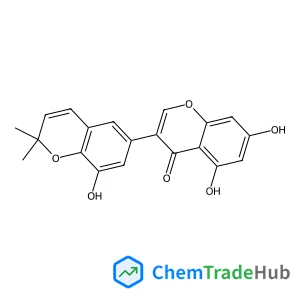
5,7,8'-Trihydroxy-2',2'-dimethyl-2'H,4H-3,6'-bichromen-4-one
CAS Number:
129280-33-7
Molecular Formula:
C20H16O6
X. He, Z. Q. Fan, Z. H. Zhang
Antimonene nanotubes, a class of important derivatives of the 2D counterpart (Sb monolayer), with transition metal (TM) atom adsorption were investigated systematically based on the first-principles calculations. For a stable geometry, the lengths of TM–Sb bonds on the tube surface strongly depend on their relative electronegativity. In particular, we find that the intrinsic magnetic moment magnitude of the TM atom plays a decisive role in inducing tube magnetism, and only TM atoms with a larger intrinsic magnetic moment (≥3.0 μB) can induce the magnetism for tubes. The strong interaction and coupling between the TM d-orbital and Sb p-orbital lead to variously favorable magnetic phases, such as the spin bipolar semiconductor and half-semiconductor, which is predicted to be stable beyond room temperature. In addition, the weakening or quenching of the magnetism for the adsorbed TM atom is intimately related to the expansion of the TM atom valence electron configuration and the charge transfer. Furthermore, the TM adsorption can also effectively regulate the tube carrier mobility to the difference of several orders of magnitude, and results in significant carrier polarity and spin polarity of mobility. A sensitive electric-magnetic coupling effect was also shown to cause continuous magnetic phase transition, providing more opportunity for obtaining magneto-electric materials.
A. Chaudhuri, D. C. Jackson, T. J. Lerotholi, Robert G. Jones, T.-L. Lee, B. Detlefs, D. P. Woodruff
DOI: 10.1039/B921281G
Daniel Irimia, Rob Kortekaas, Maurice H. M. Janssen
DOI: 10.1039/B822960K
Timothy J. Patey, Robert Büchel, Frank Krumeich, Jia-Zhao Wang, Hua-Kun Liu, Sotiris E. Pratsinis, Petr Novák
DOI: 10.1039/B821389P
Ran Liu, Jonathon Duay, Timothy Lane
DOI: 10.1039/B918589P
H. Takei, T. Yamaguchi
DOI: 10.1039/B924233N
Alvaro Cimas
DOI: 10.1039/B924025J
Alexandra Teleki, Sotiris E. Pratsinis
DOI: 10.1039/B821590A
Martin Kabeláč
DOI: 10.1039/B819350A
Waste containing 2-Ethyl-4-Methyl-1H-Imidazole-5-Carbaldehyde (CAS: 88634-80-4) ...
Triethoxy(octyl)silane (CAS: 1385031-14-0) is widely used in the pharmaceuticals...
Several alternatives to 3-iodo-7-nitro-1H-indazole (CAS: 864724-64-1) exist in t...
Yes, there are alternatives to Benzene, bis[(trimethoxysilyl)ethyl] (CAS: 266317...
Isothiazole-3-carbonitrile (CAS: 1452-17-1) is generally considered safe when us...
(3-Chlorophenyl)methanol (CAS: 873-63-2) is considered low to moderately toxic. ...
(2S,3S)-2-Hydroxy-3-({[(2-methyl-2-propanyl)oxy]carbonyl}amino)-3-(2-naphthyl)pr...
Proper handling of methyl 2-(bromomethyl)-5-methoxybenzoate requires the use of ...
6,8-Dibromoimidazo[1,2-a]pyridine-2-carboxylic acid (CAS: 904805-36-3) is an aro...
3-Amino-5-bromo-2-pyridinecarbonitrile is considered safe when handled under pro...

Physical Chemistry Chemical Physics (PCCP) is an international journal co-owned by 19 physical chemistry and physics societies from around the world. This journal publishes original, cutting-edge research in physical chemistry, chemical physics and biophysical chemistry. To be suitable for publication in PCCP, articles must include significant innovation and/or insight into physical chemistry; this is the most important criterion that reviewers and Editors will judge against when evaluating submissions. The journal has a broad scope and welcomes contributions spanning experiment, theory, computation and data science. Topical coverage includes spectroscopy, dynamics, kinetics, statistical mechanics, thermodynamics, electrochemistry, catalysis, surface science, quantum mechanics, quantum computing and machine learning. Interdisciplinary research areas such as polymers and soft matter, materials, nanoscience, energy, surfaces/interfaces, and biophysical chemistry are welcomed if they demonstrate significant innovation and/or insight into physical chemistry. Joined experimental/theoretical studies are particularly appreciated when complementary and based on up-to-date approaches.