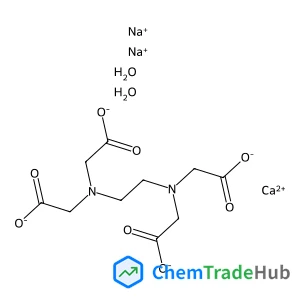
EthylenediaminetetraaceticacidcalciumDisodiumsalthydrate
CAS Number:
23411-34-9
Molecular Formula:
C10H16CaN2Na2O10
Tanchanok Wanjai, Natechanok Thinkumrob, Julianna Oláh, James R. Ketudat Cairns, Supa Hannongbua, Ulf Ryde, Jitrayut Jitonnom
Dihydropyrimidinase (DHPase) is a key enzyme in the pyrimidine pathway, the catabolic route for synthesis of β-amino acids. It catalyses the reversible conversion of 5,6-dihydrouracil (DHU) or 5,6-dihydrothymine (DHT) to the corresponding N-carbamoyl-β-amino acids. This enzyme has the potential to be used as a tool in the production of β-amino acids. Here, the reaction mechanism and origin of stereospecificity of DHPases from Saccharomyces kluyveri and Sinorhizobium meliloti CECT4114 were investigated and compared using a quantum mechanical cluster approach based on density functional theory. Two models of the enzyme active site were designed from the X-ray crystal structure of the native enzyme: a small cluster to characterize the mechanism and the stationary points and a large model to probe the stereospecificity and the role of stereo-gate-loop (SGL) residues. It is shown that a hydroxide ion first performs a nucleophilic attack on the substrate, followed by the abstraction of a proton by Asp358, which occurs concertedly with protonation of the ring nitrogen by the same residue. For the DHT substrate, the enzyme displays a preference for the L-configuration, in good agreement with experimental observation. Comparison of the reaction energetics of the two models reveals the importance of SGL residues in the stereospecificity of catalysis. The role of the conserved Tyr172 residue in transition-state stabilization is confirmed as the Tyr172Phe mutation increases the activation barrier of the reaction by ∼8 kcal mol−1. A detailed understanding of the catalytic mechanism of the enzyme could offer insight for engineering in order to enhance its activity and substrate scope.
Amit K. Tiwari, J. P. Goss, M. J. Rayson, P. R. Briddon, A. B. Horsfall
DOI: 10.1039/C6CP03775E
Jie Li, Nana Yu
DOI: 10.1039/C6CP03096C
DOI: 10.1039/C6CP03671F
Nurul Ain Manshor, Qamar Wali, Ka Kan Wong, Saifful Kamaluddin Muzakir, Lukas Schmidt-Mende, Rajan Jose
DOI: 10.1039/C6CP03600G
S. C. Perry, G. Denuault
DOI: 10.1039/C5CP04667J
Lokendra Poudel, V. Adrian Parsegian, Wai-Yim Ching
DOI: 10.1039/C6CP04357G
Lara Martinez-Fernandez, Yuyuan Zhang, Kimberly de La Harpe, Ashley A. Beckstead, Bern Kohler, Roberto Improta
DOI: 10.1039/C6CP04550B
Xukai Jiang, Guanjun Chen
DOI: 10.1039/C6CP02998A
Sherif Abdulkader Tawfik, X. Y. Cui, S. P. Ringer, C. Stampfl
DOI: 10.1039/C6CP02249A
Tony Pham, Katherine A. Forrest, Brian Space
DOI: 10.1039/C6CP02650H
Waste containing (6-Bromo-2-naphthyl)oxy](dimethyl)(2-methyl-2-propanyl)silane (...
7-Fluoro-4-isoquinolinecarboxylic acid can be synthesized via a multi-step proce...
2,3,5,6-Tetrabromothieno[3,2-b]thiophene is a crystalline compound with a high m...
1-[4-(Benzylamino)-7,8-dihydro-5H-pyrano[4,3-d]pyrimidin-2-yl]-2-methyl-1H-indol...
The market for imidazo[5,1-d]-1,2,3,5-tetrazine-8-carboxylic acid, 3,4-dihydro-3...
3-(Triisopropylsilyl)propiolaldehyde is a synthetic organic compound with the CA...
6-Nitro-2H-1,4-benzoxazin-3(4H)-one (CAS: 81721-87-1) is subject to various regu...
Waste containing (3-Fluorophenyl)(4-{[(2-methyl-2-propanyl)oxy]carbonyl}-1-piper...
N,N'-4,4'-Biphenyldiyldiisonicotinamide is a white crystalline solid with a mole...
6-Bromo-8-fluoro-2-quinazolinol is primarily used in the pharmaceutical industry...

Physical Chemistry Chemical Physics (PCCP) is an international journal co-owned by 19 physical chemistry and physics societies from around the world. This journal publishes original, cutting-edge research in physical chemistry, chemical physics and biophysical chemistry. To be suitable for publication in PCCP, articles must include significant innovation and/or insight into physical chemistry; this is the most important criterion that reviewers and Editors will judge against when evaluating submissions. The journal has a broad scope and welcomes contributions spanning experiment, theory, computation and data science. Topical coverage includes spectroscopy, dynamics, kinetics, statistical mechanics, thermodynamics, electrochemistry, catalysis, surface science, quantum mechanics, quantum computing and machine learning. Interdisciplinary research areas such as polymers and soft matter, materials, nanoscience, energy, surfaces/interfaces, and biophysical chemistry are welcomed if they demonstrate significant innovation and/or insight into physical chemistry. Joined experimental/theoretical studies are particularly appreciated when complementary and based on up-to-date approaches.