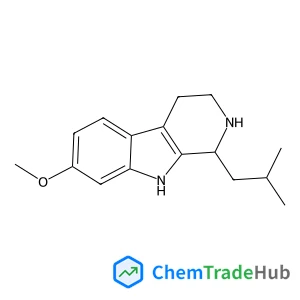
1-Isobutyl-7-methoxy-2,3,4,9-tetrahydro-1H-beta-carboline
CAS Number:
175975-76-5
Molecular Formula:
C16H22N2O
Khaleel I. Assaf, Abdussalam K. Qaroush, Ibrahim K. Okashah, Feda'a M. Al-Qaisi, Fatima Alsoubani, Ala'a F. Eftaiha
Herein, we explore the use of β-diketones for CO2 fixation and utilization based on their dual Brønsted acid/Lewis base character upon activation by 1,8-diazabicyclo[5.4.0]undec-7-ene (DBU) and zinc bromide (ZnBr2), respectively. The effect of tautomerization on the chemical fixation of CO2 was investigated using different β-diketone compounds, namely, acetylacetone (ACAC), dibenzoylmethane (DBM) and dimedone (DMD) dissolved in dimethyl sulfoxide and activated by DBU. Spectroscopic data demonstrated that the activated ACAC can capture atmospheric CO2 through the formation of both keto- and enol-carboxylated adducts, with the ability to evolve the enol form of the ionic organic carbonate adduct upon direct exposure to CO2. Meanwhile activated DBM and DMD showed the exclusive formation of the enol-organic carbonate adducts once bubbled with CO2. Volumetric uptake measurements indicated that the chemisorption capacities of ACAC and DBM (2.38 mmol CO2 per g sorbent) were higher than DMD (1.59 mmol CO2 per g sorbent). Additionally, the chemical fixation of CO2 into cyclic carbonates (CCs) was achieved by in situ complexation of the investigated β-diketones with a zinc ion. The catalytic systems were able to catalyze the transformation of several terminal oxiranes into the corresponding CCs under atmospheric CO2 pressure with excellent conversions. Interestingly, the catalytic system showed the ability to convert the naturally occurring pinene oxide into dimeric pinene carbonate.
Tao Li, Yu Chen, Chunbao Li
DOI: 10.1039/C8OB01505H
Michael Harding, Robert Hodgson, Tahir Majid, Kenneth J. McDowall
DOI: 10.1039/B208781B
Christophe Frixa, Mary F. Mahon, Andrew S. Thompson, Michael D. Threadgill
DOI: 10.1039/B209534C
Rhys B. Murphy, Duc-Truc Pham, Jonathan M. White, Stephen F. Lincoln, Martin R. Johnston
DOI: 10.1039/C8OB00944A
Talal F. Al-Azemi, Mickey Vinodh, Fatemeh H. Alipour, Abdirahman A. Mohamod
DOI: 10.1039/C8OB02074D
Nungruethai Yoswathananont, Kazuki Sada, Mikiji Miyata, Shigendo Akita, Kazunori Nakano
DOI: 10.1039/B210544F
Feng Li, Ziyan Wu, Jingjing Wang, Siyuan Zhang, Jiaxin Yu, Zhen Yuan, Jingya Liu, Renzeng Shen, Yao Zhou
DOI: 10.1039/D1QO01665B
Ming Yang, Xue-Cen Xu, Yue Gong, Yu-Long Zhao
DOI: 10.1039/D1QO01506K
Jennifer Frommer, Beatrice Karg, Klaus Weisz, Sabine Müller
DOI: 10.1039/C8OB02246A
Gregory Bar, Andrew F. Parsons, C. Barry Thomas
DOI: 10.1039/B209123B
N-(4-Methoxybenzyl)-2-pyridinamine (CAS: 52818-63-0) is increasingly being used ...
When handling Ethyl 4-(2-chlorophenyl)-1,3-thiazole-2-carboxylate, appropriate p...
Diethyldiselane (CAS: 628-39-7) is classified under the Globally Harmonized Syst...
The market for oxocopper (CAS: 12053-18-8) is primarily driven by its use in cat...
The market for 5-{[(2-Methyl-2-propanyl)oxy]carbonyl}-5-azaspiro[2.4]heptane-7-c...
2-(1-Pyrrolidinyl)-4-pyridinamine is a chemical compound with the CAS number 359...
2-(3-Pyridinyl)-1-azabicyclo[2.2.2]octane (CAS: 91556-75-1) is a crystalline sol...
(S)-Alpha-allyl-proline hydrochloride is usually synthesized via a Wittig reacti...
3-Methyl-1,2-oxazole-5-carboxylic acid (CAS: 4857-42-5) is an organic compound w...
Lys-SMCC-DM1 is synthesized via a multi-step process involving the coupling of S...

Reaction Chemistry & Engineering is an interdisciplinary journal reporting cutting-edge research focused on enhancing the understanding and efficiency of reactions. Reaction engineering leverages the interface where fundamental molecular chemistry meets chemical engineering and technology. Challenges in chemistry can be overcome by the application of new technologies, while engineers may find improved solutions for process development from the latest developments in reaction chemistry. Reaction Chemistry & Engineering is a unique forum for researchers whose interests span the broad areas of chemical engineering and chemical sciences to come together in solving problems of importance to wider society. All papers should be written to be approachable by readers across the engineering and chemical sciences. Papers that consider multiple scales, from the laboratory up to and including plant scale, are particularly encouraged.
![1-{3-[4-Amino-3-(4-phenoxyphenyl)-1H-pyrazolo[3,4-d]pyrimidin-1-yl]-1-piperidinyl}-2,3-dihydroxy-1-propanone structure](https://static.chemtradehub.com/structs/122/1226872-27-0-e037.webp "1-{3-[4-Amino-3-(4-phenoxyphenyl)-1H-pyrazolo[3,4-d]pyrimidin-1-yl]-1-piperidinyl}-2,3-dihydroxy-1-propanone structure")