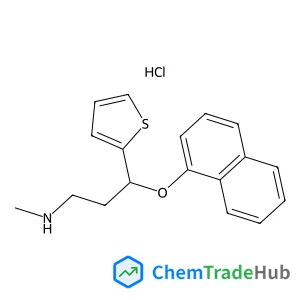
N-Methyl-3-(1-naphthyloxy)-3-(2-thienyl)-1-propanamine hydrochloride (1:1)
CAS Number:
1188266-11-6
Molecular Formula:
C18H20ClNOS
Yinan Dong, Bai Xu, Haiyu Hu, Jiashu Yang, Fengyu Li, Jian Gong, Zhongfang Chen
The notorious polysulfide shuttle effect is a crucial factor responsible for the degradation of Li-S batteries. A good way to suppress the shuttle effect is to effectively anchor dissoluble lithium polysulfides (LPSs, Li2Sn) on appropriate substrates. Previous studies have revealed that Li of Li2Sn is prone to interact with the N of N-containing materials to form Li–N bonds. In this work, by means of density functional theory (DFT) computations, we explored the possibility to form Li bonds on ten different N-containing monolayers, including BN, C2N, C2N6S3, C9N4, a covalent triazine framework (CTF), g-C3N4, p-C3N4, C3N5, S-N2S, and T-N2S, by examining the adsorption behavior of Li2Sn (n = 1, 2, 3, 4, 6, 8) on these two-dimensional (2D) anchoring materials (AMs), and investigated the performance of the formed Li bonds (if any) in inhibiting the shuttle effect. By comparing and analyzing the nitrogen content, the N-containing pore size, charge transfer, and Li bonds, we found that the N content and N-containing pore size correlate with the number of Li bonds, and the formed Li–N bonds between LPSs and AMs correspond well with the adsorption energies of the LPSs. The C9N4 and C2N6S3 monolayers were identified as promising AMs in Li-S batteries. From the view of Li bonds, this work provides guidelines for designing 2D N-containing materials as anchoring materials to reduce the shuttle effect in Li-S batteries, and thus improving the performance of Li-S batteries.
Bradley F. Parsons, Sean M. Sheehan, Terry A. Yen, Daniel M. Neumark, Nadine Wehres, Rainer Weinkauf
DOI: 10.1039/B703045B
DOI: 10.1039/B614121H
Daniel Friebel, Christian Schlaup, Peter Broekmann, Klaus Wandelt
DOI: 10.1039/B616586A
Jonathan P. K. Doye, Ard A. Louis, I-Chun Lin, Lucy R. Allen, Eva G. Noya, Alex W. Wilber, Hoong Chwan Kok, Rosie Lyus
DOI: 10.1039/B614955C
Sylwia Ptasińska, Léon Sanche
DOI: 10.1039/B616619A
Th. Emmler, I. Shenderovich, Y. Zeng, G. H. Findenegg, G. Buntkowsky
DOI: 10.1039/B617744A
Norbert Lümmen, Bjørn Kvamme
DOI: 10.1039/B703430J
Jason J. Pagano, Stephanie Thouvenel-Romans, Oliver Steinbock
DOI: 10.1039/B612982J
N-(4-Methoxybenzyl)-2-pyridinamine (CAS: 52818-63-0) is increasingly being used ...
When handling Ethyl 4-(2-chlorophenyl)-1,3-thiazole-2-carboxylate, appropriate p...
Diethyldiselane (CAS: 628-39-7) is classified under the Globally Harmonized Syst...
The market for oxocopper (CAS: 12053-18-8) is primarily driven by its use in cat...
The market for 5-{[(2-Methyl-2-propanyl)oxy]carbonyl}-5-azaspiro[2.4]heptane-7-c...
2-(1-Pyrrolidinyl)-4-pyridinamine is a chemical compound with the CAS number 359...
2-(3-Pyridinyl)-1-azabicyclo[2.2.2]octane (CAS: 91556-75-1) is a crystalline sol...
(S)-Alpha-allyl-proline hydrochloride is usually synthesized via a Wittig reacti...
3-Methyl-1,2-oxazole-5-carboxylic acid (CAS: 4857-42-5) is an organic compound w...
Lys-SMCC-DM1 is synthesized via a multi-step process involving the coupling of S...

Physical Chemistry Chemical Physics (PCCP) is an international journal co-owned by 19 physical chemistry and physics societies from around the world. This journal publishes original, cutting-edge research in physical chemistry, chemical physics and biophysical chemistry. To be suitable for publication in PCCP, articles must include significant innovation and/or insight into physical chemistry; this is the most important criterion that reviewers and Editors will judge against when evaluating submissions. The journal has a broad scope and welcomes contributions spanning experiment, theory, computation and data science. Topical coverage includes spectroscopy, dynamics, kinetics, statistical mechanics, thermodynamics, electrochemistry, catalysis, surface science, quantum mechanics, quantum computing and machine learning. Interdisciplinary research areas such as polymers and soft matter, materials, nanoscience, energy, surfaces/interfaces, and biophysical chemistry are welcomed if they demonstrate significant innovation and/or insight into physical chemistry. Joined experimental/theoretical studies are particularly appreciated when complementary and based on up-to-date approaches.
![N-{15-[(2,5-Dioxo-1-pyrrolidinyl)oxy]-15-oxo-3,6,9,12-tetraoxapentadec-1-yl}-2-(2-propyn-1-yloxy)acetamide structure](https://static.chemtradehub.com/structs/210/2101206-92-0-2eb5.webp "N-{15-[(2,5-Dioxo-1-pyrrolidinyl)oxy]-15-oxo-3,6,9,12-tetraoxapentadec-1-yl}-2-(2-propyn-1-yloxy)acetamide structure")