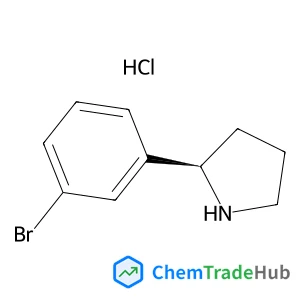
(2R)-2-(3-Bromophenyl)pyrrolidine hydrochloride (1:1)
CAS Number:
1391550-13-2
Molecular Formula:
C10H13BrClN
The atomic structure of a carbon nanotube can be defined by the chiral indices, (n,m), that specify its perimeter vector (chiral vector), with which the diameter and helicity are also determined. The fine electron beam available in a modern Transmission Electron Microscope (TEM) offers a unique and powerful probe to reveal the atomic structure of individual nanotubes. This article covers two aspects related to the use of the electron probe in the TEM for the study of carbon nanotubes: (i) to express the electron diffraction intensity distribution in the electron diffraction patterns of carbon nanotubes and (ii) to obtain the chiral indices (n,m) of carbon nanotubes from their electron diffraction patterns. For a nanotube of given chiral indices (n,m), the electron scattering amplitude from the carbon nanotube can be expressed analytically in closed form using the helical diffraction theory, from which its electron diffraction pattern can be calculated and understood. The reverse problem, i.e., assignment of the chiral indices (n,m) of a carbon nanotube from its electron diffraction pattern, is approached from the relationship between the electron diffraction intensity distribution and the chiral indices (n,m). The first method is to obtain indiscriminately the chiral indices (n,m) by reading directly the intensity distribution on the three principal layer lines, l1, l2, and l3, which have intensities proportional to the square of the Bessel functions of orders m, n, and n + m: Il1 ∝ |Jm (πdR)|2, Il2 ∝ |Jn (πdR)|2, and Il3 ∝ |Jn+m (πdR)|2. The second method is to obtain and use the ratio of the indices n/m = (2D1 − D2)/(2D2 − D1) in which D1 and D2 are the spacings of principal layer lines l1 and l2, respectively. Examples of using these methods are also illustrated in the determination of chiral indices of isolated individual single-walled carbon nanotubes, a bundle of single-walled carbon nanotubes, and multi-walled carbon nanotubes.

Saudi Pharmaceutical Journal

Journal of Saudi Chemical Society

Chemical Communications

Organic Process Research & Development

Chemistry Education Research and Practice

Crystallography Reports

Russian Chemical Bulletin

Russian Journal of Bioorganic Chemistry

Current Opinion in Colloid & Interface Science

Russian Journal of Applied Chemistry
Xiaoyan Yang, Haibao Jin, Xinfeng Tao, Binbin Xu, Shaoliang Lin
DOI: 10.1039/D1PY00984B
Wanan Cai, Zhicheng Wang, Zhaohui Shu, Wenbin Liu, Jun Wang, Jian Qiu
DOI: 10.1039/D1PY01451J
DOI: 10.1039/D1PY01079D
Shengfei Wang, Sen Zhang, Chun Feng, Guolin Lu, Xiaoyu Huang
DOI: 10.1039/D1PY01016F
Priscila Quiñonez-Angulo, Robin A. Hutchinson, Ángel Licea-Claveríe, Enrique Saldívar-Guerra, Iván Zapata-González
DOI: 10.1039/D1PY00750E
Jiraya Kiriratnikom, Xin-Chen Yue, Jia-Liang Yang, Ying Wang, Shuo-Hong Chen, Ke-Ke Zhang, Cheng-Jian Zhang, Munir Ullah Khan
DOI: 10.1039/D1PY01013A
Yoshihiko Kimura, Makoto Ouchi, Takaya Terashima
DOI: 10.1039/D0PY00685H
Antxon Martínez de Ilarduya, Sebastián Muñoz Guerra
DOI: 10.1039/D0PY00258E
Katya Kapilov-Buchman, Tslil Bialystocki, Danna Niezni, Luba Perry, Shulamit Levenberg, Michael S. Silverstein
DOI: 10.1039/D1PY01106E
N-(4-Methoxybenzyl)-2-pyridinamine (CAS: 52818-63-0) is increasingly being used ...
When handling Ethyl 4-(2-chlorophenyl)-1,3-thiazole-2-carboxylate, appropriate p...
Diethyldiselane (CAS: 628-39-7) is classified under the Globally Harmonized Syst...
The market for oxocopper (CAS: 12053-18-8) is primarily driven by its use in cat...
The market for 5-{[(2-Methyl-2-propanyl)oxy]carbonyl}-5-azaspiro[2.4]heptane-7-c...
2-(1-Pyrrolidinyl)-4-pyridinamine is a chemical compound with the CAS number 359...
2-(3-Pyridinyl)-1-azabicyclo[2.2.2]octane (CAS: 91556-75-1) is a crystalline sol...
(S)-Alpha-allyl-proline hydrochloride is usually synthesized via a Wittig reacti...
3-Methyl-1,2-oxazole-5-carboxylic acid (CAS: 4857-42-5) is an organic compound w...
Lys-SMCC-DM1 is synthesized via a multi-step process involving the coupling of S...

Physical Chemistry Chemical Physics (PCCP) is an international journal co-owned by 19 physical chemistry and physics societies from around the world. This journal publishes original, cutting-edge research in physical chemistry, chemical physics and biophysical chemistry. To be suitable for publication in PCCP, articles must include significant innovation and/or insight into physical chemistry; this is the most important criterion that reviewers and Editors will judge against when evaluating submissions. The journal has a broad scope and welcomes contributions spanning experiment, theory, computation and data science. Topical coverage includes spectroscopy, dynamics, kinetics, statistical mechanics, thermodynamics, electrochemistry, catalysis, surface science, quantum mechanics, quantum computing and machine learning. Interdisciplinary research areas such as polymers and soft matter, materials, nanoscience, energy, surfaces/interfaces, and biophysical chemistry are welcomed if they demonstrate significant innovation and/or insight into physical chemistry. Joined experimental/theoretical studies are particularly appreciated when complementary and based on up-to-date approaches.