













Renewable diesel blendstocks and bioprivileged chemicals distilled from algal biocrude oil converted via hydrothermal liquefaction
Literature Information
Publication Date
2020-07-24
DOI
10.1039/D0SE00903B
Impact Factor
6.367
Authors
View Original
Abstract
Hydrothermal liquefaction (HTL) has been demonstrated as a promising technology to convert algae into biocrude oil. However, the knowledge gaps of (1) biocrude oil upgrading and (2) process/energy optimization and design of an algal biorefinery producing valuable bioproducts need to be bridged. In this study, Spirulina (SP) was converted into biocrude oil via HTL. Next, fractional distillation was used to separate SP-derived biocrude oil. It was found that 62% of the viscous SP-derived biocrude oil can be separated into oil and water-soluble products at about 270 °C. Analyses of density, viscosity, acidity, elemental compositions, higher heating values and chemical compositions were carried out for the distillates separated from SP-derived biocrude oil. These analyses showed that 15% distillates could be used as renewable diesel because they have similar heating values (43–46 MJ kg−1) and carbon numbers (ranging from C8 to C18) to petroleum diesel. In addition, GC-MS analysis indicates that some distillates contain bioprivileged chemicals like aromatics, phenols and fatty nitriles that can be used as commodity chemicals. Energy efficiency analysis also demonstrates that the fractional distillation has a lower energy consumption ratio than other HTL biocrude oil upgrading methods. An algal biorefinery roadmap was proposed based on the analyses of different distillates from the SP-derived biocrude oil. Finally, fuel specification analysis was conducted with drop-in renewable diesel, which was prepared with 10 vol% (HTL10) distillates and 90 vol% petroleum diesel. According to the fuel specification analysis, HTL10 exhibited a comparable lubricity (<520 μm), acidity (<0.3 mg KOH per g) and oxidation stability (>6 h) to petroleum diesel. Ultimately, it is expected that this study can provide insights for potential application of algal biocrude oil converted via HTL and improve the process/energy efficiency of an algal biorefinery via HTL.
Related Literature
Thermodynamics and defect chemistry of substitutional and interstitial cation doping in layered α-V2O5
Kit McColl, Ian Johnson, Furio Corà
2018-05-11
Communication
DOI: 10.1039/C8CP02187B
Theoretical study on the optical and electronic properties of graphene quantum dots doped with heteroatoms
Jianguang Feng, Hongzhou Dong, Beili Pang, Feifei Shao, ChunKai Zhang, Liyan Yu
2018-05-02
Paper
DOI: 10.1039/C8CP01403E
Computational study of the carbonyl–ene reaction between formaldehyde and propylene encapsulated in coordinatively unsaturated metal–organic frameworks M3(btc)2 (M = Fe, Co, Ni, Cu and Zn)
Thana Maihom, Michael Probst, Jumras Limtrakul
2019-01-15
Paper
DOI: 10.1039/C8CP06841K
Model – free approach to quadrupole spin relaxation in solid 209Bi-aryl compounds
Danuta Kruk, Christian Goesweiner, Elzbieta Masiewicz, Evrim Umut, Carina Sampl, Hermann Scharfetter
2018-09-04
Paper
DOI: 10.1039/C8CP03848A
Elastic properties of liquid and glassy propane-based alcohols under high pressure: the increasing role of hydrogen bonds in a homologous family
E. L. Gromnitskaya, V. V. Brazhkin
2019-01-11
Paper
DOI: 10.1039/C8CP07588C
Significant effect of Mg-pressure-controlled annealing: non-stoichiometry and thermoelectric properties of Mg2−δSi1−xSbx
Kouta Iwasaki, Masahito Yoshino, Tomoaki Yamada, Takanori Nagasaki
2018-10-08
Paper
DOI: 10.1039/C8CP04839H
Influence of Ce3+ polarons on grain boundary space-charge in proton conducting Y-doped BaCeO3
Jonathan M. Polfus, Mehdi Pishahang, Rune Bredesen
2018-06-04
Paper
DOI: 10.1039/C8CP00168E
Electrocatalytic studies on imidazolium based ionic liquids: defining experimental conditions
Miguel A. Montiel, José Solla-Gullón, Vicente Montiel, Carlos M. Sánchez-Sánchez
2018-06-22
Paper
DOI: 10.1039/C8CP02662A
The evaporation kinetics of pure water droplets at varying drying rates and the use of evaporation rates to infer the gas phase relative humidity
Yong-yang Su, Rachael E. H. Miles, Zhi-ming Li, Jonathan P. Reid, Jiang Xu
2018-08-31
Paper
DOI: 10.1039/C8CP05250F
You might also like
Compound Q&A
Is 2-(2-chloroacetamido)-3-phenylpropanoic acid (CAS: 7765-11-9) safe?
2-(2-Chloroacetamido)-3-phenylpropanoic acid (CAS: 7765-11-9) is generally consi...
7765-11-92-(2-chloroacetamido...
Compound Q&A
Is 2-(Benzyloxy)-5-bromobenzoic acid (CAS: 62176-31-2) safe?
2-(Benzyloxy)-5-bromobenzoic acid can be handled safely if appropriate precautio...
62176-31-22-(Benzyloxy)-5-brom...
Compound Q&A
What is (4-Methyl-1,2,5-oxadiazol-3-yl)methanamine hydrochloride (CAS: 1159825-48-5)?
(4-Methyl-1,2,5-oxadiazol-3-yl)methanamine hydrochloride is a chemical compound ...
1159825-48-5(4-Methyl-1,2,5-oxad...
Compound Q&A
What is 2-(5-Hexylthiophen-2-yl)-4,4,5,5-tetramethyl-1,3,2-dioxaborolane (CAS: 917985-54-7)?
2-(5-Hexylthiophen-2-yl)-4,4,5,5-tetramethyl-1,3,2-dioxaborolane (CAS: 917985-54...
917985-54-72-(5-Hexylthiophen-2...
Compound Q&A
Are there alternatives to 4-(8-Methyl-9H-1,3-dioxolo[4,5-h][2,3]benzodiazepin-5-yl)benzenamine (CAS: 102771-26-6) in synthesis?
While 4-(8-Methyl-9H-1,3-dioxolo[4,5-h][2,3]benzodiazepin-5-yl)benzenamine (CAS:...
102771-26-64-(8-Methyl-9H-1,3-d...
Compound Q&A
What is the market or research trend for tert-butyl 3-hydroxy-4,5,7,8-tetrahydro-2H-pyrazolo[3,4-d]azepine-6-carboxylate (CAS: 851376-80-2)?
The market for tert-butyl 3-hydroxy-4,5,7,8-tetrahydro-2H-pyrazolo[3,4-d]azepine...
851376-80-2tert-butyl 3-hydroxy...
Compound Q&A
How should waste containing 3,5-Diamino-1H-pyrazole-4-carbonitrile (CAS: 6844-58-2) be handled?
Waste containing 3,5-Diamino-1H-pyrazole-4-carbonitrile (CAS: 6844-58-2) should ...
6844-58-23,5-Diamino-1H-pyraz...
Compound Q&A
How is (6-Fluoro-3-pyridinyl)boronic acid (CAS: 351019-18-6) typically synthesized?
(6-Fluoro-3-pyridinyl)boronic acid can be synthesized through the reaction of 6-...
351019-18-6(6-Fluoro-3-pyridiny...
Compound Q&A
What industries use Dibenzyl carbonimidoylbiscarbamate (CAS: 10065-79-9)?
Dibenzyl carbonimidoylbiscarbamate (CAS: 10065-79-9) finds applications in vario...
10065-79-9Dibenzyl carbonimido...
Compound Q&A
What is the market or research trend for (beta,beta,2,3,4,5,6-~2~H_7_)Phenylalanine (CAS: 74228-83-4)?
The market for (beta,beta,2,3,4,5,6-~2~H_7_)Phenylalanine (CAS: 74228-83-4) is g...
74228-83-4(beta,beta,2,3,4,5,6...
Source Journal
Recommended Compounds
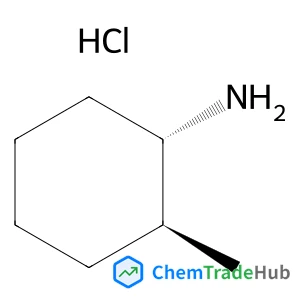
(1R,2R)-2-Methylcyclohexanamine hydrochloride (1:1)
CAS Number:
39558-31-1
Molecular Formula:
C7H16ClN
![N-[2,6-Di(9-anthryl)-4-oxido-8,9,10,11,12,13,14,15-octahydrodinaphtho[2,1-d:1',2'-f][1,3,2]dioxaphosphepin-4-yl]-1,1,1-trifluoromethanesulfonamide structure](https://static.chemtradehub.com/structs/122/1227374-64-2-cdb5.webp "N-[2,6-Di(9-anthryl)-4-oxido-8,9,10,11,12,13,14,15-octahydrodinaphtho[2,1-d:1',2'-f][1,3,2]dioxaphosphepin-4-yl]-1,1,1-trifluoromethanesulfonamide structure")
N-[2,6-Di(9-anthryl)-4-oxido-8,9,10,11,12,13,14,15-octahydrodinaphtho[2,1-d:1',2'-f][1,3,2]dioxaphosphepin-4-yl]-1,1,1-trifluoromethanesulfonamide
CAS Number:
1227374-64-2
Molecular Formula:
C49H37F3NO5PS
Recommended Suppliers







Disclaimer
This page provides academic journal information for reference and research purposes only. We are not affiliated with any journal publishers and do not handle publication submissions. For publication-related inquiries, please contact the respective journal publishers directly.
If you notice any inaccuracies in the information displayed, please contact us at support@chemtradehub.com. We will promptly review and address your concerns.