



Significant effect of Mg-pressure-controlled annealing: non-stoichiometry and thermoelectric properties of Mg2−δSi1−xSbx
Literature Information
Publication Date
2018-10-08
DOI
10.1039/C8CP04839H
Impact Factor
3.676
Authors
Kouta Iwasaki, Masahito Yoshino, Tomoaki Yamada, Takanori Nagasaki
View Original
Abstract
Non-stoichiometry related to such an element with high vapor pressure as Mg has been difficult to control, despite its significant influence on the thermoelectric properties of the material. Here, Mg non-stoichiometry and the thermoelectric properties of Mg2−δSi1−xSbx (0 ≤ x ≤ 0.60) are investigated systematically by tuning the Mg partial pressure during annealing. The range of Mg non-stoichiometry Δδ depends on x since the Sb dopant induces Mg vacancies, which are partly filled by Mg atoms in the gas phase according to an equilibrium reaction. The defect association between the Mg vacancies and the Sb dopant decreases Δδ at high Sb contents. The maximum Δδ of 0.016, which corresponds to a carrier concentration range Δn of 4.9 × 1020 cm−3, is obtained at x = 0.10. The Seebeck coefficient shows a universal relationship with the carrier concentration, which can be explained by the DFT-calculated band structure within the rigid band approximation. The carrier mobility is reduced significantly as a result of carrier scattering at the Mg-poor grain boundaries. The vacancy formation at the Mg-site, in addition to Si-site substitution for Sb, effectively suppresses the lattice thermal conductivity. The low thermal conductivity on the Mg-poor side increases the maximum zT, while a high energy conversion efficiency is obtained on the Mg-rich side, owing to the high electrical conductivity and resultant large zT at low temperatures. Mg non-stoichiometry is a key factor in tuning the thermoelectric properties of Mg2Si-based materials and thus its control is essential.
Recommended Journals

European Journal of Wood and Wood Products

Molecular Pharmacology

Israel Journal of Chemistry

Nature

Organic Preparations and Procedures International

Journal of Physics and Chemistry of Solids

Pharmacological Reviews

Journal of Medicinal Chemistry

Helvetica Chimica Acta

Proceedings of the National Academy of Sciences of the United States of America
Related Literature
Two desorption components of product CO2 in steady-state CO oxidation on Pd(110)
Paper
DOI: 10.1039/A903458G
Modelling of a fuel-rich premixed propene–oxygen–argon flame and comparison with experiments
H. Böhm, A. Lamprecht, B. Atakan, K. Kohse-Höinghaus
2000-10-06
Paper
DOI: 10.1039/B005252N
Continuum solvent effects on various isomers of bilirubin
Giuliano Alagona, Caterina Ghio, Susanna Monti
2000-09-01
Paper
DOI: 10.1039/B004476H
You might also like
Compound Q&A
What precautions should be taken when handling 4-(2-Furylmethyl)thiomorpholine 1,1-dioxide (CAS: 79206-94-3)?
When handling 4-(2-Furylmethyl)thiomorpholine 1,1-dioxide (CAS: 79206-94-3), it ...
79206-94-34-(2-Furylmethyl)thi...
Compound Q&A
What precautions should be taken when handling 4-Chloro-N-[2-(4-morpholinyl)ethyl]benzamide (CAS: 71320-77-9)?
When handling 4-Chloro-N-[2-(4-morpholinyl)ethyl]benzamide (CAS: 71320-77-9), it...
71320-77-94-Chloro-N-[2-(4-mor...
Compound Q&A
How should waste containing 2-[2-(2-Methoxyethoxy)ethoxy]ethyl 4-methylbenzenesulfonate (CAS: 62921-74-8) be handled?
Waste containing this compound (CAS: 62921-74-8) should be handled according to ...
62921-74-82-[2-(2-Methoxyethox...
Compound Q&A
How should waste containing (S)-Methyl 2-amino-3-cyclohexylpropanoate be handled?
Waste containing (S)-Methyl 2-amino-3-cyclohexylpropanoate should be collected i...
40056-18-6(S)-Methyl 2-amino-3...
Compound Q&A
How is 5-({4-[(2S,4R)-4-Hydroxy-2-methyltetrahydro-2H-pyran-4-yl]-2-thienyl}sulfanyl)-1-methyl-1,3-dihydro-2H-indol-2-one (CAS: 166882-70-8) typically synthesized?
This compound can be synthesized using a multi-step process involving the conjug...
166882-70-85-({4-[(2S,4R)-4-Hyd...
Compound Q&A
Are there alternatives to (2E)-3-(3,4-Dichlorophenyl)acrylic acid (CAS: 7312-27-8) in synthesis?
There are several alternatives to (2E)-3-(3,4-Dichlorophenyl)acrylic acid in syn...
7312-27-8(2E)-3-(3,4-Dichloro...
Compound Q&A
How should Ethyl 6-(2-nitrophenyl)imidazo[2,1-b][1,3]thiazole-3-carboxylate (CAS: 925437-84-9) be stored?
Ethyl 6-(2-nitrophenyl)imidazo[2,1-b][1,3]thiazole-3-carboxylate (CAS: 925437-84...
925437-84-9Ethyl 6-(2-nitrophen...
Compound Q&A
How should waste containing 2-(1,3-Thiazol-2-yl)ethanamine (CAS: 18453-07-1) be handled?
Waste containing 2-(1,3-Thiazol-2-yl)ethanamine (CAS: 18453-07-1) should be coll...
18453-07-12-(1,3-Thiazol-2-yl)...
Compound Q&A
How is Methyl 5-iodo-2-methylbenzoate (CAS: 103440-54-6) typically synthesized?
Methyl 5-iodo-2-methylbenzoate can be synthesized through the iodination of meth...
103440-54-6Methyl 5-iodo-2-meth...
Compound Q&A
How is 5-Chloro[1,2,4]triazolo[1,5-a]pyridine (CAS: 1427399-34-5) typically synthesized?
5-Chloro[1,2,4]triazolo[1,5-a]pyridine is commonly synthesized via the condensat...
1427399-34-55-Chloro[1,2,4]triaz...
Source Journal
Physical Chemistry Chemical Physics

CiteScore:
5.5
Self-citation Rate:
10.3%
Articles per Year:
3036
Physical Chemistry Chemical Physics (PCCP) is an international journal co-owned by 19 physical chemistry and physics societies from around the world. This journal publishes original, cutting-edge research in physical chemistry, chemical physics and biophysical chemistry. To be suitable for publication in PCCP, articles must include significant innovation and/or insight into physical chemistry; this is the most important criterion that reviewers and Editors will judge against when evaluating submissions. The journal has a broad scope and welcomes contributions spanning experiment, theory, computation and data science. Topical coverage includes spectroscopy, dynamics, kinetics, statistical mechanics, thermodynamics, electrochemistry, catalysis, surface science, quantum mechanics, quantum computing and machine learning. Interdisciplinary research areas such as polymers and soft matter, materials, nanoscience, energy, surfaces/interfaces, and biophysical chemistry are welcomed if they demonstrate significant innovation and/or insight into physical chemistry. Joined experimental/theoretical studies are particularly appreciated when complementary and based on up-to-date approaches.
Recommended Compounds
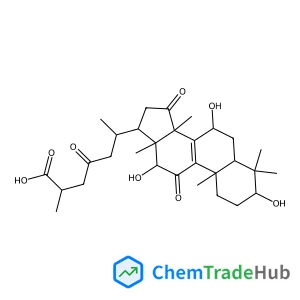
(3beta,7beta,12beta)-3,7,12-Trihydroxy-11,15,23-trioxolanost-8-en-26-oic acid
CAS Number:
98665-22-6
Molecular Formula:
C30H44O8
Recommended Suppliers






Disclaimer
This page provides academic journal information for reference and research purposes only. We are not affiliated with any journal publishers and do not handle publication submissions. For publication-related inquiries, please contact the respective journal publishers directly.
If you notice any inaccuracies in the information displayed, please contact us at support@chemtradehub.com. We will promptly review and address your concerns.