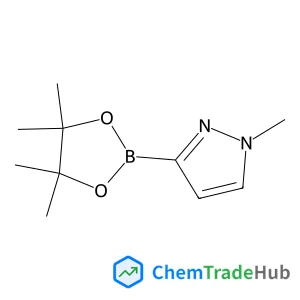
1-Methyl-3-(4,4,5,5-tetramethyl-1,3,2-dioxaborolan-2-yl)-1H-pyrazole
CAS Number:
1020174-04-2
Molecular Formula:
C10H17BN2O2
Jianguang Feng, Hongzhou Dong, Beili Pang, Feifei Shao, ChunKai Zhang, Liyan Yu
The effects of four heteroatoms (B, N, P, and S) with three doping patterns on graphene quantum dots (GQDs) are systematically investigated using time-dependent density functional theory (TD-DFT). The absorption spectra and HOMO–LUMO gaps are quantitatively analyzed to study the correlations between the optical properties and heteroatom doping of doped GQDs. Heteroatom doping can endow GQDs with various new optical and structural properties, depending on the dopants and doping configurations. Compared with the absorption spectra of pristine GQD, both N and S surface doping demonstrate a slight blue shift, whereas B and P doping lead to a blue shift for edge-doped GQDs with heteroatoms in a pentatomic ring. The absorption process is investigated along with excited state analysis, which includes the density of state, natural transition orbital, and charge difference density. The results indicate that large radius atoms assist charge transfer in the excited state and play an important role in recombining the electron density distribution in the doped GQDs.

Journal of Organometallic Chemistry

Israel Journal of Chemistry

Planta Medica

Pure and Applied Chemistry

Nature

Journal of Heterocyclic Chemistry

Proceedings of the National Academy of Sciences of the United States of America

Molecular Pharmacology

Russian Chemical Reviews

Journal of Physics and Chemistry of Solids
Yoshitaka Inaki, Hisao Yoshida, Koichi Kimura, Shinji Inagaki, Yoshiaki Fukushima, Tadashi Hattori
DOI: 10.1039/B002501L
DOI: 10.1039/A902914A
DOI: 10.1039/A902886B
When handling 4-(2-Furylmethyl)thiomorpholine 1,1-dioxide (CAS: 79206-94-3), it ...
When handling 4-Chloro-N-[2-(4-morpholinyl)ethyl]benzamide (CAS: 71320-77-9), it...
Waste containing this compound (CAS: 62921-74-8) should be handled according to ...
Waste containing (S)-Methyl 2-amino-3-cyclohexylpropanoate should be collected i...
This compound can be synthesized using a multi-step process involving the conjug...
There are several alternatives to (2E)-3-(3,4-Dichlorophenyl)acrylic acid in syn...
Ethyl 6-(2-nitrophenyl)imidazo[2,1-b][1,3]thiazole-3-carboxylate (CAS: 925437-84...
Waste containing 2-(1,3-Thiazol-2-yl)ethanamine (CAS: 18453-07-1) should be coll...
Methyl 5-iodo-2-methylbenzoate can be synthesized through the iodination of meth...
5-Chloro[1,2,4]triazolo[1,5-a]pyridine is commonly synthesized via the condensat...

Physical Chemistry Chemical Physics (PCCP) is an international journal co-owned by 19 physical chemistry and physics societies from around the world. This journal publishes original, cutting-edge research in physical chemistry, chemical physics and biophysical chemistry. To be suitable for publication in PCCP, articles must include significant innovation and/or insight into physical chemistry; this is the most important criterion that reviewers and Editors will judge against when evaluating submissions. The journal has a broad scope and welcomes contributions spanning experiment, theory, computation and data science. Topical coverage includes spectroscopy, dynamics, kinetics, statistical mechanics, thermodynamics, electrochemistry, catalysis, surface science, quantum mechanics, quantum computing and machine learning. Interdisciplinary research areas such as polymers and soft matter, materials, nanoscience, energy, surfaces/interfaces, and biophysical chemistry are welcomed if they demonstrate significant innovation and/or insight into physical chemistry. Joined experimental/theoretical studies are particularly appreciated when complementary and based on up-to-date approaches.
![[4-Amino-2-(methylsulfanyl)-5-pyrimidinyl]methanol structure](https://static.chemtradehub.com/structs/588/588-36-3-fc73.webp "[4-Amino-2-(methylsulfanyl)-5-pyrimidinyl]methanol structure")