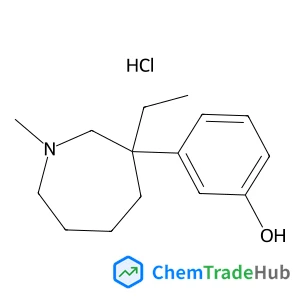
3-(3-Ethyl-1-methyl-3-azepanyl)phenol hydrochloride (1:1)
CAS Number:
59263-76-2
Molecular Formula:
C15H24ClNO
Thana Maihom, Michael Probst, Jumras Limtrakul
The carbonyl–ene reaction between encapsulated formaldehyde and propylene over the coordinatively unsaturated metal–organic frameworks M3(btc)2 (M = Fe, Co, Ni, Cu and Zn) has been investigated by means of density functional calculations. Zn3(btc)2 adsorbs formaldehyde strongest due to electron delocalization between Zn and the oxygen atom of the reactant molecule. The reaction is proposed to proceed in a single step involving proton transfer and carbon–carbon bond formation. We find the relative catalytic activity to be Zn3(btc)2 > Fe3(btc)2 ≥ Co3(btc)2 > Ni3(btc)2 > Cu3(btc)2, based on activation energy and turnover frequencies (TOF). The low activation energy for Zn3(btc)2 compared to the others can be explained by the delocalization of electron density between the carbonyl bond and the catalyst active sites, leading to a more stable transition state. The five MOFs are used to propose a descriptor for the relationship between activation energy on one side and electronic properties or adsorption energies on the other side in order to allow a quick screening of other catalytic materials for this reaction.
DOI: 10.1039/A902369K
Juha Linnanto, Jouko Korppi-Tommola
DOI: 10.1039/B004998K
Edwin K. L. Yeow, Paul J. Sintic, Nuno M. Cabral, Joost N. H. Reek, Maxwell J. Crossley, Kenneth P. Ghiggino
DOI: 10.1039/B003612I
DOI: 10.1039/A902553G
DOI: 10.1039/B005315P
J. M. Seddon, J. Robins, T. Gulik-Krzywicki, H. Delacroix
DOI: 10.1039/B004916F
DOI: 10.1039/A903331I
When handling 4-(2-Furylmethyl)thiomorpholine 1,1-dioxide (CAS: 79206-94-3), it ...
When handling 4-Chloro-N-[2-(4-morpholinyl)ethyl]benzamide (CAS: 71320-77-9), it...
Waste containing this compound (CAS: 62921-74-8) should be handled according to ...
Waste containing (S)-Methyl 2-amino-3-cyclohexylpropanoate should be collected i...
This compound can be synthesized using a multi-step process involving the conjug...
There are several alternatives to (2E)-3-(3,4-Dichlorophenyl)acrylic acid in syn...
Ethyl 6-(2-nitrophenyl)imidazo[2,1-b][1,3]thiazole-3-carboxylate (CAS: 925437-84...
Waste containing 2-(1,3-Thiazol-2-yl)ethanamine (CAS: 18453-07-1) should be coll...
Methyl 5-iodo-2-methylbenzoate can be synthesized through the iodination of meth...
5-Chloro[1,2,4]triazolo[1,5-a]pyridine is commonly synthesized via the condensat...

Physical Chemistry Chemical Physics (PCCP) is an international journal co-owned by 19 physical chemistry and physics societies from around the world. This journal publishes original, cutting-edge research in physical chemistry, chemical physics and biophysical chemistry. To be suitable for publication in PCCP, articles must include significant innovation and/or insight into physical chemistry; this is the most important criterion that reviewers and Editors will judge against when evaluating submissions. The journal has a broad scope and welcomes contributions spanning experiment, theory, computation and data science. Topical coverage includes spectroscopy, dynamics, kinetics, statistical mechanics, thermodynamics, electrochemistry, catalysis, surface science, quantum mechanics, quantum computing and machine learning. Interdisciplinary research areas such as polymers and soft matter, materials, nanoscience, energy, surfaces/interfaces, and biophysical chemistry are welcomed if they demonstrate significant innovation and/or insight into physical chemistry. Joined experimental/theoretical studies are particularly appreciated when complementary and based on up-to-date approaches.
![4-{2-[4-(2-Methyl-2-propanyl)phenyl]ethoxy}quinazoline structure](https://static.chemtradehub.com/structs/120/120928-09-8-d3db.webp "4-{2-[4-(2-Methyl-2-propanyl)phenyl]ethoxy}quinazoline structure")