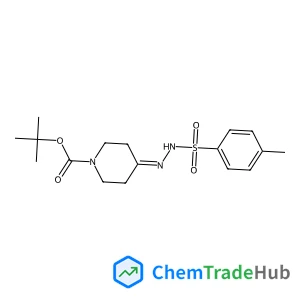
tert-Butyl 4-(2-(p-Tolylsulfonyl)hydrazono)piperidine-1-carboxylate
CAS Number:
1046478-89-0
Molecular Formula:
C17H25N3O4S
Bingkun Yan, Jiaqian Hou, Chao Wei, Yan Xiao, Meidong Lang, Farong Huang
The synthesis of block copolycarbonates is still a challenge because of the fast occurrence of intra- and intermolecular transesterification reactions during ring-opening polymerization. In this context, we report the synthesis of block copolycarbonates by delicately designing and taking advantage of the differences in polymerization between macrocyclic carbonates and small cyclic carbonates. Firstly, four macrocyclic carbonates containing different numbers of methylenes are prepared and subsequently polymerized by using a TBD/alcohol system, which shows an efficient activity at elevated temperatures and inefficient performance at room temperature. Inspired by this result, block copolycarbonates can be easily prepared by the sequential addition of monomers, polymerizing macrocyclic carbonates at 70 °C and subsequently polymerizing TMC at room temperature, as evidenced by 1H NMR and 13C NMR spectroscopy and DSC characterization. In particular, changing the polymerization temperature or monomer addition methods, such as polymerizing two monomers at 70 °C by sequential addition or polymerizing TMC at room temperature and subsequently polymerizing macrocyclic carbonates at 70 °C, only leads to the formation of random copolymers. Besides, the block copolycarbonates would gradually transform into random structures with an increase in reaction time due to the significantly increased rate of transesterification. These results highlight the key role of reaction conditions such as reaction temperature, monomer addition sequence and reaction time in the formation of block copolycarbonates.
Hongkun Li, Jian Wang, Jing Zhi Sun, Rongrong Hu, Anjun Qin
DOI: 10.1039/C2PY00586G
Xiaolong Wang, Feng Zhou
DOI: 10.1039/C2PY20148H
Bas G. P. van Ravensteijn, Robbert Duchateau, Johan P. A. Heuts
DOI: 10.1039/C2PY20195J
Tomohito Ogura, Yuta Saito, Tomoya Higashihara, Mitsuru Ueda
DOI: 10.1039/C2PY20093G
Peter J. Roth, Thomas P. Davis, Andrew B. Lowe
DOI: 10.1039/C2PY20204B
Fuji Sakai, Guosong Chen, Ming Jiang
DOI: 10.1039/C2PY00614F
Xiaodan Li, Yiqing Xia, Wenli Xu, Qichao Ran, Yi Gu
DOI: 10.1039/C2PY20133J
Erol Hasan, Steve Furzeland, Derek Atkins, Dave J. Adams, Jonathan V. M. Weaver
DOI: 10.1039/C2PY00564F
Maribel Hernández-Guerrero, Martina H. Stenzel
DOI: 10.1039/C1PY00219H
Samuel Aleksanian, Behnoush Khorsand, Rolf Schmidt, Jung Kwon Oh
DOI: 10.1039/C2PY20154B
When considering alternatives to 1-(4-Chlorophenyl)-N-hydroxymethanimine (CAS: 3...
This compound should be stored in a cool, dry place away from direct sunlight. I...
3-(4-Bromophenyl)-5-(2-fluorophenyl)-1,2,4-oxadiazole is synthesized through a m...
5-Chloro-2-(4-chlorophenyl)-4-methyl-6-[3-(1-piperidinyl)propoxy]pyrimidine (CAS...
2-Chloro-4-(difluoromethoxy)pyridine is used in the pharmaceutical industry for ...
3-Chloro-6-methylpyridazine (CAS: 1121-79-5) is classified under the Globally Ha...
Several alternatives can be used in the synthesis of Methyl 4,5-dimethyl-2-nitro...
Alternatives to (2E,2'E)-3,3'-(1,4-Phenylene)bisacrylaldehyde include other acry...
3-Amino-5-chloropyridin-2-ol hydrochloride is an organic compound with the CAS n...
When handling 6,7-Difluoro-2,3-dihydro-4H-chromen-4-one, it is essential to wear...

Polymer Chemistry welcomes submissions in all areas of polymer science that have a strong focus on macromolecular chemistry. Manuscripts may cover a broad range of fields, yet no direct application focus is required.