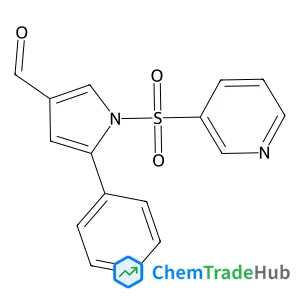
5-Phenyl-1-(pyridin-3-ylsulfonyl)-1H-pyrrole-3-carbaldehyde
CAS Number:
881676-90-0
Molecular Formula:
C16H12N2O3S
Xiaodan Li, Yiqing Xia, Wenli Xu, Qichao Ran, Yi Gu
Thermosetting terpolymer composed of benzoxazine (BA-a), cyanate ester (BADCy) and epoxy resin (E44) was prepared via co-curing reactions. The curing procedure for the ternary blend was studied by differential scanning calorimetry (DSC) and Fourier transform-infrared spectroscopy (FT-IR), and the thermal, mechanical and dielectric properties of the terpolymer were also characterized. The DSC results manifested a multiple curing pattern, suggesting the complexity of the reactions in the system. The FT-IR analysis further showed that the curing procedure involves several steps, firstly the cyclotrimerisation of cyanate ester after oxazine ring opening, followed by the isomerization of cyanurate and the reaction of isocyanurate with epoxy to form oxazolidinone, and finally the copolymerization of the remaining epoxy with benzoxazine and the self-polymerization of benzoxazine. Compared to the polybenzoxazine, the higher crosslinking density of the terpolymer led to the higher glass transition temperature (Tg), as well as the 5% and 10% weight loss temperatures (Td5 and Td10), indicating the better thermal stability of the terpolymer at service temperature. And the data for the mechanical and dielectric properties also showed that the terpolymer performs better than polybenzoxazine and the copolymer.
Yaqing Qu, Fei Huo, Quanlong Li, Xin He, Shentong Li, Wangqing Zhang
DOI: 10.1039/C4PY00510D
Takumi Sugimoto, Mitsuhiro Fukushima, Ryoma Teranishi, Aki Kotaka, Chiharu Shinde, Takayuki Kumei, Yasushi Sumida, Yuki Munekata, Kei-ichi Maruyama, Eiji Yuba, Atsushi Harada, Kenji Kono
DOI: 10.1039/C6PY01754A
Shinji Yamada, Akinori Takasu, Sadatsugu Takayama, Kazuhiko Kawamura
DOI: 10.1039/C4PY00639A
Yilin Zhang, Liguo Xu, Rongrong Hu, Kam Sing Wong, William A. Goddard, III
DOI: 10.1039/C7PY00154A
Jochen Willersinn, Anna Bogomolova, Marc Brunet Cabré, Bernhard V. K. J. Schmidt
DOI: 10.1039/C6PY02212J
Niklas Lucht, Steffen Eggers
DOI: 10.1039/C6PY01751G
Hui Zhou, Jiesheng Li, Ming Hui Chua, Hong Yan, Beng Zhong Tang, Jianwei Xu
DOI: 10.1039/C4PY00518J
Juxin He, Luyang Du, Cong Wang, Mingjian Jiang, Linlin Liu, Yueqi Mo, Zengqi Xie, Bing Yang, Yuguang Ma
DOI: 10.1039/C6PY01995A
Chen Gao, Liwei Wang, Xiaoyu Li
DOI: 10.1039/C4PY00389F
When considering alternatives to 1-(4-Chlorophenyl)-N-hydroxymethanimine (CAS: 3...
This compound should be stored in a cool, dry place away from direct sunlight. I...
3-(4-Bromophenyl)-5-(2-fluorophenyl)-1,2,4-oxadiazole is synthesized through a m...
5-Chloro-2-(4-chlorophenyl)-4-methyl-6-[3-(1-piperidinyl)propoxy]pyrimidine (CAS...
2-Chloro-4-(difluoromethoxy)pyridine is used in the pharmaceutical industry for ...
3-Chloro-6-methylpyridazine (CAS: 1121-79-5) is classified under the Globally Ha...
Several alternatives can be used in the synthesis of Methyl 4,5-dimethyl-2-nitro...
Alternatives to (2E,2'E)-3,3'-(1,4-Phenylene)bisacrylaldehyde include other acry...
3-Amino-5-chloropyridin-2-ol hydrochloride is an organic compound with the CAS n...
When handling 6,7-Difluoro-2,3-dihydro-4H-chromen-4-one, it is essential to wear...

Polymer Chemistry welcomes submissions in all areas of polymer science that have a strong focus on macromolecular chemistry. Manuscripts may cover a broad range of fields, yet no direct application focus is required.