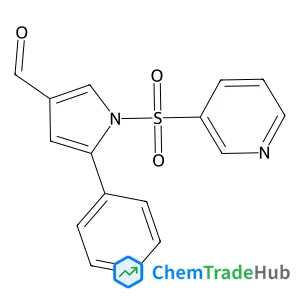
5-Phenyl-1-(pyridin-3-ylsulfonyl)-1H-pyrrole-3-carbaldehyde
CAS Number:
881676-90-0
Molecular Formula:
C16H12N2O3S
Maribel Hernández-Guerrero, Martina H. Stenzel
Among various structuring techniques, a water-driven ‘templating’ method for the fabrication of highly ordered porous membranes has been widely exploited for the past 17 years due to its versatility and robustness. This simple method relies on the formation of “breath figures” and the assembly of a polymer around them, resulting in the production of membranes with hexagonally arranged pores known as honeycomb structured porous polymer films/membranes. Herein, we present a review of relevant literature to stress on the advantages of this simple templating method compared with the wide range of conventional templating and lithographic techniques that have been previously used in the field. Furthermore, we present a comprehensive review on the progress in the field including the study of relevant variables, the materials that have been used, the combination of the method with other techniques, some current and potential applications for the membranes as well as characterization techniques.
Xiaohui Li, Zhijun Hu
DOI: 10.1039/C7PY00378A
Toyokazu Tsutsuba
DOI: 10.1039/C7PY00100B
Marco Albuszis, Peter J. Roth, Werner Pauer, Hans-Ulrich Moritz
DOI: 10.1039/C4PY00709C
Mariolino Carta, Matthew Croad, Johannes C. Jansen, Paola Bernardo, Gabriele Clarizia, Neil B. McKeown
DOI: 10.1039/C4PY00607K
Hui Zhou, Chuanguang Wu, Qiaolin Wu, Bixuan Guo, Wanting Liu, Guanghua Li, Ying Mu
DOI: 10.1039/C6PY01784C
Wei Wu, Qiujing Zhang, Jiantao Wang, Miao Chen, Shuai Li, Zaifu Lin, Jianshu Li
DOI: 10.1039/C4PY00575A
Matthew D. Green, Abbygail A. Foster, Chad T. Greco, Raghunath Roy, Rachel M. Lehr, Thomas H. Epps, III, Millicent O. Sullivan
DOI: 10.1039/C4PY00638K
DOI: 10.1039/C4PY00829D
Hongjun Yang, Zhongrui Wang, Yulei Zheng, Wenyan Huang, Xiaoqiang Xue, Bibiao Jiang
DOI: 10.1039/C7PY00174F
Hien The Ho, Sagrario Pascual, Véronique Montembault, Nathalie Casse, Laurent Fontaine
DOI: 10.1039/C4PY00585F
When considering alternatives to 1-(4-Chlorophenyl)-N-hydroxymethanimine (CAS: 3...
This compound should be stored in a cool, dry place away from direct sunlight. I...
3-(4-Bromophenyl)-5-(2-fluorophenyl)-1,2,4-oxadiazole is synthesized through a m...
5-Chloro-2-(4-chlorophenyl)-4-methyl-6-[3-(1-piperidinyl)propoxy]pyrimidine (CAS...
2-Chloro-4-(difluoromethoxy)pyridine is used in the pharmaceutical industry for ...
3-Chloro-6-methylpyridazine (CAS: 1121-79-5) is classified under the Globally Ha...
Several alternatives can be used in the synthesis of Methyl 4,5-dimethyl-2-nitro...
Alternatives to (2E,2'E)-3,3'-(1,4-Phenylene)bisacrylaldehyde include other acry...
3-Amino-5-chloropyridin-2-ol hydrochloride is an organic compound with the CAS n...
When handling 6,7-Difluoro-2,3-dihydro-4H-chromen-4-one, it is essential to wear...

Polymer Chemistry welcomes submissions in all areas of polymer science that have a strong focus on macromolecular chemistry. Manuscripts may cover a broad range of fields, yet no direct application focus is required.
![2-{[(1R,2S)-2-Aminocyclohexyl]amino}-4-{[3-(2H-1,2,3-triazol-2-yl)phenyl]amino}-5-pyrimidinecarboxamide structure](https://static.chemtradehub.com/structs/137/1370261-96-3-40df.webp "2-{[(1R,2S)-2-Aminocyclohexyl]amino}-4-{[3-(2H-1,2,3-triazol-2-yl)phenyl]amino}-5-pyrimidinecarboxamide structure")