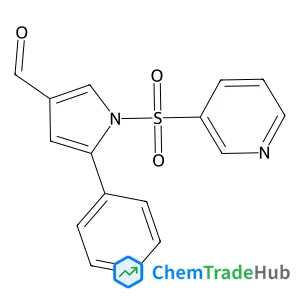
5-Phenyl-1-(pyridin-3-ylsulfonyl)-1H-pyrrole-3-carbaldehyde
CAS Number:
881676-90-0
Molecular Formula:
C16H12N2O3S
Samuel Aleksanian, Behnoush Khorsand, Rolf Schmidt, Jung Kwon Oh
Degradation of amphiphilic block copolymer (ABP) micelles in response to external stimuli (stimuli-responsive degradation) is a desired property in the design of controlled delivery vehicles. Here, a versatile methodology that combines facile carbodiimide coupling polycondensation with controlled radical polymerization to synthesize thiol-responsive degradable ABP micelles is described. These smart micelles consist of a hydrophobic degradable polyester block with disulfide linkages labeled repeatedly along the main chain; more importantly, in response to thiols they exhibit rapid and controlled degradation, thereby leading to enhanced release of encapsulated model drugs. Moreover, the proposed method allows for a facile bioconjugation of hydrophilic coronas using cell-targeting biomolecules during polymerization.
Mariolino Carta, Matthew Croad, Johannes C. Jansen, Paola Bernardo, Gabriele Clarizia, Neil B. McKeown
DOI: 10.1039/C4PY00607K
Chih-Chia Cheng, Jui-Hsu Wang, Wei-Tsung Chuang, Zhi-Sheng Liao, Jyun-Jie Huang, Shan-You Huang, Wen-Lu Fan
DOI: 10.1039/C7PY00684E
Siddharth Chanpuriya, Marc A. Hillmyer, Frank S. Bates
DOI: 10.1039/C4PY00614C
Y. Huang, M. A. Shaw, M. R. Warmin, E. S. Mullins, N. Ayres
DOI: 10.1039/C6PY00616G
Hongyan Yao, Na Zhang, Ningning Song, Kunzhi Shen, Pengfei Huo, Shiyang Zhu, Yunhe Zhang, Shaowei Guan
DOI: 10.1039/C6PY01814A
Matthew D. Green, Abbygail A. Foster, Chad T. Greco, Raghunath Roy, Rachel M. Lehr, Thomas H. Epps, III, Millicent O. Sullivan
DOI: 10.1039/C4PY00638K
Hui Zhou, Chuanguang Wu, Qiaolin Wu, Bixuan Guo, Wanting Liu, Guanghua Li, Ying Mu
DOI: 10.1039/C6PY01784C
Stephanie M. Barbon, Joe B. Gilroy
DOI: 10.1039/C6PY00441E
Takumi Sugimoto, Mitsuhiro Fukushima, Ryoma Teranishi, Aki Kotaka, Chiharu Shinde, Takayuki Kumei, Yasushi Sumida, Yuki Munekata, Kei-ichi Maruyama, Eiji Yuba, Atsushi Harada, Kenji Kono
DOI: 10.1039/C6PY01754A
Yingda Huang, Jianyun He, Zhanxiong Liu, Guilong Cai, Shaowen Zhang, Xiaofang Li
DOI: 10.1039/C6PY01859A
When considering alternatives to 1-(4-Chlorophenyl)-N-hydroxymethanimine (CAS: 3...
This compound should be stored in a cool, dry place away from direct sunlight. I...
3-(4-Bromophenyl)-5-(2-fluorophenyl)-1,2,4-oxadiazole is synthesized through a m...
5-Chloro-2-(4-chlorophenyl)-4-methyl-6-[3-(1-piperidinyl)propoxy]pyrimidine (CAS...
2-Chloro-4-(difluoromethoxy)pyridine is used in the pharmaceutical industry for ...
3-Chloro-6-methylpyridazine (CAS: 1121-79-5) is classified under the Globally Ha...
Several alternatives can be used in the synthesis of Methyl 4,5-dimethyl-2-nitro...
Alternatives to (2E,2'E)-3,3'-(1,4-Phenylene)bisacrylaldehyde include other acry...
3-Amino-5-chloropyridin-2-ol hydrochloride is an organic compound with the CAS n...
When handling 6,7-Difluoro-2,3-dihydro-4H-chromen-4-one, it is essential to wear...

Polymer Chemistry welcomes submissions in all areas of polymer science that have a strong focus on macromolecular chemistry. Manuscripts may cover a broad range of fields, yet no direct application focus is required.

![2-{[(1R,2S)-2-Aminocyclohexyl]amino}-4-{[3-(2H-1,2,3-triazol-2-yl)phenyl]amino}-5-pyrimidinecarboxamide structure](https://static.chemtradehub.com/structs/137/1370261-96-3-40df.webp "2-{[(1R,2S)-2-Aminocyclohexyl]amino}-4-{[3-(2H-1,2,3-triazol-2-yl)phenyl]amino}-5-pyrimidinecarboxamide structure")