












Ultrafast dynamics of exciton formation and decay in two-dimensional tungsten disulfide (2D-WS2) monolayers
Literature Information
Publication Date
2020-07-20
DOI
10.1039/D0CP03220D
Impact Factor
3.676
Authors
Zeynep Ezgi Eroglu, Olivia Comegys, Leo S. Quintanar, Nurul Azam, Salah Elafandi, Masoud Mahjouri-Samani, Abdelaziz Boulesbaa
View Original
Abstract
Excitons in two-dimensional transition metal dichalcogenide monolayers (2D-TMDs) are of essential importance due to their key involvement in 2D-TMD-based applications. For instance, exciton dissociation and exciton radiative recombination are indispensible processes in photovoltaic and light-emitting devices, respectively. These two processes depend drastically on the photogeneration efficiency and lifetime of excitons. Here, we incorporate femtosecond pump–probe spectroscopy to investigate the ultrafast dynamics of exciton formation and decay in a single crystal of monolayer 2D tungsten disulfide (WS2). Investigation of the formation dynamics of the lowest exciton (XA) indicated that the formation time linearly increases from ∼150 fs upon resonant excitation, to ∼500 fs following excitation that is ∼1.1 eV above the band-gap. This dependence is attributed to the time it takes highly excited electrons in the conduction band (CB) to relax to the CB minimum (CBM) and contribute to the formation of XA. This is confirmed by infrared measurements of electron intraband relaxation dynamics. Furthermore, pump–probe experiments suggested that the XA ground state depletion recovery dynamics depend on the excitation energy as well. The average recovery time increased from ∼10 ps in the case of resonant excitation to ∼50 ps following excitation well above the band-gap. Having the ability to control whether generating short-lived or long-lived electron–hole pairs in 2D-TMD monolayers opens a new horizon for the application of these materials. For instance, long-lived electron–hole pairs are appropriate for photovoltaic devices, but short-lived excitons are more beneficial for lasers with ultrashort pulses.
Recommended Journals
Related Literature
Design, synthesis and photovoltaic properties of two π-bridged cyclopentadithiophene-based polymers
Manjun Xiao, Xichang Bao, Liangliang Han, Ning Wang, Shuguang Wen, Weiguo Zhu, Renqiang Yang
2014-07-29
Paper
DOI: 10.1039/C4PY00881B
Light-mediated curing of CO2-based unsaturated polyethercarbonates via thiol–ene click chemistry
M. A. Subhani, B. Köhler, C. Gürtler, W. Leitner
2016-05-24
Paper
DOI: 10.1039/C6PY00458J
Synthesis and properties of a well-defined copolymer of chlorotrifluoroethylene and N-vinylpyrrolidone by xanthate-mediated radical copolymerization under 60Co γ-ray irradiation
Pucheng Wang, Jingwen Dai, Lei Liu, Qibao Dong, Hu Wang, Ruke Bai
2014-07-24
Paper
DOI: 10.1039/C4PY00902A
Synthesis of multi-hollow clay-armored latexes by surfactant-free emulsion polymerization of styrene mediated by poly(ethylene oxide)-based macroRAFT/Laponite complexes
Thaissa de Camargo Chaparro, Franck D'Agosto, Muriel Lansalot, Amilton Martins Dos Santos, Elodie Bourgeat-Lami
2014-07-16
Paper
DOI: 10.1039/C4PY00362D
A coacervate-forming biodegradable polyester with elevated LCST based on bis-(2-methoxyethyl)amine
J. P. Swanson, M. R. Martinez, M. A. Cruz, S. G. Mankoci, P. J. Costanzo, A. Joy
2016-06-01
Paper
DOI: 10.1039/C6PY00814C
Synthesis and multi-responsiveness of poly(N-vinylcaprolactam-co-acrylic acid) core–shell microgels via miniemulsion polymerization
Shen Tan, Zhengquan Lu, Jing Zhao, Jianan Zhang, Mingyuan Wu, Qingyun Wu, Jianjun Yang
2016-05-24
Paper
DOI: 10.1039/C6PY00544F
Spread and set silicone–boronic acid elastomers
Laura Zepeda-Velazquez, Benjamin Macphail, Michael A. Brook
2016-05-23
Paper
DOI: 10.1039/C6PY00492J
Synthesis of well-controlled graft polymers by living anionic polymerization towards exact graft polymers
Shotaro Ito, Raita Goseki, Takashi Ishizone
2014-07-21
Review Article
DOI: 10.1039/C4PY00584H
Indium-catalyzed polycyclotrimerization of diynes: a facile route to prepare regioregular hyperbranched polyarylenes
Zhe Wang, Yang Shi, Jian Wang, Lingzhi Li, Haiqiang Wu, Bicheng Yao, Jing Zhi Sun
2014-07-15
Communication
DOI: 10.1039/C4PY00859F
You might also like
Compound Q&A
Are there alternatives to 1-(4-Chlorophenyl)-N-hydroxymethanimine (CAS: 3848-36-0) in synthesis?
When considering alternatives to 1-(4-Chlorophenyl)-N-hydroxymethanimine (CAS: 3...
3848-36-01-(4-Chlorophenyl)-N...
Compound Q&A
How should (1R,9S,10S,12S,14E,16S,19R,20R,21S,22R)-3,9,21-Trihydroxy-5,10,12,14,16,20,22-heptamethyl-23,24-dioxatetracyclo[17.3.1.1~6,9~.0~2,7~]tetracosa-2,5,7,14-tetraen-4-one (CAS: 183202-73-5) be stored?
This compound should be stored in a cool, dry place away from direct sunlight. I...
183202-73-5(1R,9S,10S,12S,14E,1...
Compound Q&A
How is 3-(4-Bromophenyl)-5-(2-fluorophenyl)-1,2,4-oxadiazole (CAS: 419553-16-5) typically synthesized?
3-(4-Bromophenyl)-5-(2-fluorophenyl)-1,2,4-oxadiazole is synthesized through a m...
419553-16-53-(4-Bromophenyl)-5-...
Compound Q&A
How is 5-Chloro-2-(4-chlorophenyl)-4-methyl-6-[3-(1-piperidinyl)propoxy]pyrimidine (CAS: 1639220-19-1) typically synthesized?
5-Chloro-2-(4-chlorophenyl)-4-methyl-6-[3-(1-piperidinyl)propoxy]pyrimidine (CAS...
1639220-19-15-Chloro-2-(4-chloro...
Compound Q&A
What industries use 2-Chloro-4-(difluoromethoxy)pyridine (CAS: 1206978-15-5)?
2-Chloro-4-(difluoromethoxy)pyridine is used in the pharmaceutical industry for ...
1206978-15-52-Chloro-4-(difluoro...
Compound Q&A
What regulatory guidelines apply to 3-Chloro-6-methylpyridazine (CAS: 1121-79-5)?
3-Chloro-6-methylpyridazine (CAS: 1121-79-5) is classified under the Globally Ha...
1121-79-53-Chloro-6-methylpyr...
Compound Q&A
Are there alternatives to Methyl 4,5-dimethyl-2-nitrobenzoate in synthesis?
Several alternatives can be used in the synthesis of Methyl 4,5-dimethyl-2-nitro...
90922-74-0Methyl 4,5-dimethyl-...
Compound Q&A
Are there alternatives to (2E,2'E)-3,3'-(1,4-Phenylene)bisacrylaldehyde in synthesis?
Alternatives to (2E,2'E)-3,3'-(1,4-Phenylene)bisacrylaldehyde include other acry...
63405-68-5(2E,2'E)-3,3'-(1,4-P...
Compound Q&A
What is 3-Amino-5-chloropyridin-2-ol hydrochloride (CAS: 1261906-29-9)?
3-Amino-5-chloropyridin-2-ol hydrochloride is an organic compound with the CAS n...
1261906-29-93-Amino-5-chloropyri...
Compound Q&A
What precautions should be taken when handling 6,7-Difluoro-2,3-dihydro-4H-chromen-4-one (CAS: 1092349-93-3)?
When handling 6,7-Difluoro-2,3-dihydro-4H-chromen-4-one, it is essential to wear...
1092349-93-36,7-Difluoro-2,3-dih...
Source Journal
Physical Chemistry Chemical Physics

CiteScore:
5.5
Self-citation Rate:
10.3%
Articles per Year:
3036
Physical Chemistry Chemical Physics (PCCP) is an international journal co-owned by 19 physical chemistry and physics societies from around the world. This journal publishes original, cutting-edge research in physical chemistry, chemical physics and biophysical chemistry. To be suitable for publication in PCCP, articles must include significant innovation and/or insight into physical chemistry; this is the most important criterion that reviewers and Editors will judge against when evaluating submissions. The journal has a broad scope and welcomes contributions spanning experiment, theory, computation and data science. Topical coverage includes spectroscopy, dynamics, kinetics, statistical mechanics, thermodynamics, electrochemistry, catalysis, surface science, quantum mechanics, quantum computing and machine learning. Interdisciplinary research areas such as polymers and soft matter, materials, nanoscience, energy, surfaces/interfaces, and biophysical chemistry are welcomed if they demonstrate significant innovation and/or insight into physical chemistry. Joined experimental/theoretical studies are particularly appreciated when complementary and based on up-to-date approaches.
Recommended Compounds
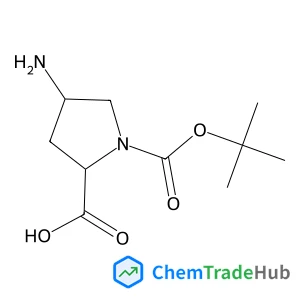
(2R,4R)-1-Boc-4-Aminopyrrolidine-2-carboxylic acid
CAS Number:
132622-98-1
Molecular Formula:
C10H18N2O4
Recommended Suppliers






Disclaimer
This page provides academic journal information for reference and research purposes only. We are not affiliated with any journal publishers and do not handle publication submissions. For publication-related inquiries, please contact the respective journal publishers directly.
If you notice any inaccuracies in the information displayed, please contact us at support@chemtradehub.com. We will promptly review and address your concerns.