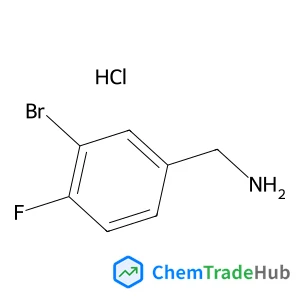
1-(3-Bromo-4-fluorophenyl)methanamine hydrochloride (1:1)
CAS Number:
202865-68-7
Molecular Formula:
C7H8BrClFN
Thaissa de Camargo Chaparro, Franck D'Agosto, Muriel Lansalot, Amilton Martins Dos Santos, Elodie Bourgeat-Lami
We report the surfactant-free emulsion polymerization of styrene mediated by a trithiocarbonate poly(ethylene oxide)-based macromolecular RAFT agent (PEO2K-TTC, Mn(PEO) = 2000 g mol−1) in the presence of Laponite clay platelets. Adsorption studies revealed high affinity of the macroRAFT for Laponite. The resulting macroRAFT/clay complexes were used to control the growth of polystyrene chains and generate clay-armored latexes. Undesirable effects observed under the same conditions in the absence of clay, such as rate retardation, a long induction period and loss of colloidal stability, were not observed when the macroRAFT was immobilized on the clay surface. A minimum amount of macroRAFT was necessary to ensure a good control of the polymerization and a narrow molar mass distribution while a too large amount led to similar effects as in the absence of clay due to partitioning of the free non-adsorbing PEO2K-TTC macroRAFT. By a careful selection of the macroRAFT and monomer concentrations, stable multi-hollow clay-armored composite latex particles containing embedded PEO and composed of polymer chains of controlled and narrowly distributed molar masses could be successfully obtained by this technique.

Russian Journal of Organic Chemistry

Saudi Pharmaceutical Journal

Journal of Natural Medicines

Crystallography Reports

Russian Journal of Coordination Chemistry

Current Opinion in Solid State & Materials Science

Current Opinion in Colloid & Interface Science

Nature Medicine

New Journal of Chemistry

Chemistry Education Research and Practice
Muruganathan Ramanathan, Lok Kumar Shrestha, Qingmin Ji
DOI: 10.1039/C3CP50620G
Shamon A. Walker, Devin T. Edwards, Ting Ann Siaw, Brandon D. Armstrong
DOI: 10.1039/C3CP51628H
Esther Rebollar, Javier R. Vázquez de Aldana, Ignacio Martín-Fabiani, Margarita Hernández, Daniel R. Rueda, Tiberio A. Ezquerra, Concepción Domingo, Pablo Moreno, Marta Castillejo
DOI: 10.1039/C3CP51523K
DOI: 10.1039/C3CP50907A
Juraj Sibik, Evgenyi Y. Shalaev, J. Axel Zeitler
DOI: 10.1039/C3CP51936H
S. Ramakumar, L. Satyanarayana, Sunkara V. Manorama, Ramaswamy Murugan
DOI: 10.1039/C3CP50991E
Jhenny F. Galan, Chi Ngong Tang, Shubhashis Chakrabarty, Zhiwei Liu, Vojislava Pophristic
DOI: 10.1039/C3CP50353D
DOI: 10.1039/C3CP50606A
Divya Nayar, Charusita Chakravarty
DOI: 10.1039/C3CP51114F
When considering alternatives to 1-(4-Chlorophenyl)-N-hydroxymethanimine (CAS: 3...
This compound should be stored in a cool, dry place away from direct sunlight. I...
3-(4-Bromophenyl)-5-(2-fluorophenyl)-1,2,4-oxadiazole is synthesized through a m...
5-Chloro-2-(4-chlorophenyl)-4-methyl-6-[3-(1-piperidinyl)propoxy]pyrimidine (CAS...
2-Chloro-4-(difluoromethoxy)pyridine is used in the pharmaceutical industry for ...
3-Chloro-6-methylpyridazine (CAS: 1121-79-5) is classified under the Globally Ha...
Several alternatives can be used in the synthesis of Methyl 4,5-dimethyl-2-nitro...
Alternatives to (2E,2'E)-3,3'-(1,4-Phenylene)bisacrylaldehyde include other acry...
3-Amino-5-chloropyridin-2-ol hydrochloride is an organic compound with the CAS n...
When handling 6,7-Difluoro-2,3-dihydro-4H-chromen-4-one, it is essential to wear...

Polymer Chemistry welcomes submissions in all areas of polymer science that have a strong focus on macromolecular chemistry. Manuscripts may cover a broad range of fields, yet no direct application focus is required.
![4-[(3-Chloro-2-fluorophenyl)amino]-7-methoxy-6-quinazolinyl acetate structure](https://static.chemtradehub.com/structs/740/740081-22-5-f58f.webp "4-[(3-Chloro-2-fluorophenyl)amino]-7-methoxy-6-quinazolinyl acetate structure")
![2-{[(1R,2S)-2-Aminocyclohexyl]amino}-4-{[3-(2H-1,2,3-triazol-2-yl)phenyl]amino}-5-pyrimidinecarboxamide structure](https://static.chemtradehub.com/structs/137/1370261-96-3-40df.webp "2-{[(1R,2S)-2-Aminocyclohexyl]amino}-4-{[3-(2H-1,2,3-triazol-2-yl)phenyl]amino}-5-pyrimidinecarboxamide structure")