












Kinetics of excited-state Cr(a5S2, a5DJ, a5GJ) depletion by simple hydrocarbons
Literature Information
Publication Date
DOI
10.1039/A902886B
Impact Factor
3.676
Authors
View Original
Abstract
The depletion kinetics of excited states of Cr(a5S2, a5DJ, a5GJ) upon interaction with simple hydrocarbons (CH4, C2H6, C3H8, cyclopropane, C2H2, C2H4, and propene) are studied in a discharged flow reactor at He pressures of 0.7 Torr. On interaction with alkanes, Cr(a5S2, a5DJ) show no depletion but an increase in their populations. The higher excited state, Cr(a5GJ), shows depletion upon interaction with alkanes. Good correlation was observed between the depletion rate constants for Cr(GJ) and the formation rate constants for Cr(a5S2, a5DJ), and it is suggested that collisional relaxation from Cr(a5GJ) to Cr(a5S2, a5DJ) is important for the interaction with alkanes. On the other hand, all excited states show depletion upon the interaction with unsaturated hydrocarbons. Among the three states, Cr(a5GJ) shows the most efficient depletion. Rate constants were almost the same as the gas kinetics ones, which suggest no or very small energy barriers for the interaction of this state with alkenes and acetylene. More efficient depletion of Cr(a5GJ) by alkenes and acetylene compared with alkanes is consistent with the presence of stable π-complexes on interaction potential surfaces of the former systems.
Related Literature
Reversible C–C bond formation: solid state structure of the aldol-like addition product of adamantanone to a 1,5-diazapentadienyllithium, and its solution state retro-aldol dissociation
Lee-Jon Ball, Anthony P. Dickie, Francis S. Mair, David A. Middleton, Robin G. Pritchard
2003-02-19
Communication
DOI: 10.1039/B211745B
Optical and electrical properties of the wide gap, n-type semiconductors: ZnBi2O6 and MgBi2O6
Hiroshi Mizoguchi, Nattamai S. P. Bhuvanesh, Patrick M. Woodward
2003-04-07
Communication
DOI: 10.1039/B300635B
Kumada–Corriu coupling of Grignard reagents, probed with a chiral Grignard reagent
Bettina Hölzer, Reinhard W. Hoffmann
2003-02-19
Communication
DOI: 10.1039/B300033H
A novel dry route to ortho-functionalized triarylbismuthanes that are difficult to access by conventional wet routes
Mika Urano, Shinobu Wada, Hitomi Suzuki
2003-04-22
Communication
DOI: 10.1039/B301983G
Palladium(0) catalyzed regioselective carbonyl propargylation across tetragonal tin(ii) oxidevia redox transmetallation
Moloy Banerjee, Sujit Roy
2003-01-15
Communication
DOI: 10.1039/B211555G
Controlled synthesis of homopolymers and block copolymers based on 2-(acetoacetoxy)ethyl methacrylatevia RAFT radical polymerisation
Theodora Krasia, Rémi Soula, Hans G. Börner, Helmut Schlaad
2003-01-27
Communication
DOI: 10.1039/B212634F
Zn-Proline catalyzed direct aldol reaction in aqueous media
Tamis Darbre, Miguel Machuqueiro
2003-03-31
Communication
DOI: 10.1039/B301117H
The diatropic σ ring currents of [π2s + π2s + π2s] pericyclic transition states
Leonardus W. Jenneskens, Patrick W. Fowler, Erich Steiner
2003-02-20
Communication
DOI: 10.1039/B212251K
Photoluminescent supramolecular networks from metal-mediated assembly of polythia conjugated dieneyne
Yuan-Te Fu, Vincent M. Lynch, Richard J. Lagow
2003-03-31
Communication
DOI: 10.1039/B212789J
You might also like
Compound Q&A
What precautions should be taken when handling 4-(2-Furylmethyl)thiomorpholine 1,1-dioxide (CAS: 79206-94-3)?
When handling 4-(2-Furylmethyl)thiomorpholine 1,1-dioxide (CAS: 79206-94-3), it ...
79206-94-34-(2-Furylmethyl)thi...
Compound Q&A
What precautions should be taken when handling 4-Chloro-N-[2-(4-morpholinyl)ethyl]benzamide (CAS: 71320-77-9)?
When handling 4-Chloro-N-[2-(4-morpholinyl)ethyl]benzamide (CAS: 71320-77-9), it...
71320-77-94-Chloro-N-[2-(4-mor...
Compound Q&A
How should waste containing 2-[2-(2-Methoxyethoxy)ethoxy]ethyl 4-methylbenzenesulfonate (CAS: 62921-74-8) be handled?
Waste containing this compound (CAS: 62921-74-8) should be handled according to ...
62921-74-82-[2-(2-Methoxyethox...
Compound Q&A
How should waste containing (S)-Methyl 2-amino-3-cyclohexylpropanoate be handled?
Waste containing (S)-Methyl 2-amino-3-cyclohexylpropanoate should be collected i...
40056-18-6(S)-Methyl 2-amino-3...
Compound Q&A
How is 5-({4-[(2S,4R)-4-Hydroxy-2-methyltetrahydro-2H-pyran-4-yl]-2-thienyl}sulfanyl)-1-methyl-1,3-dihydro-2H-indol-2-one (CAS: 166882-70-8) typically synthesized?
This compound can be synthesized using a multi-step process involving the conjug...
166882-70-85-({4-[(2S,4R)-4-Hyd...
Compound Q&A
Are there alternatives to (2E)-3-(3,4-Dichlorophenyl)acrylic acid (CAS: 7312-27-8) in synthesis?
There are several alternatives to (2E)-3-(3,4-Dichlorophenyl)acrylic acid in syn...
7312-27-8(2E)-3-(3,4-Dichloro...
Compound Q&A
How should Ethyl 6-(2-nitrophenyl)imidazo[2,1-b][1,3]thiazole-3-carboxylate (CAS: 925437-84-9) be stored?
Ethyl 6-(2-nitrophenyl)imidazo[2,1-b][1,3]thiazole-3-carboxylate (CAS: 925437-84...
925437-84-9Ethyl 6-(2-nitrophen...
Compound Q&A
How should waste containing 2-(1,3-Thiazol-2-yl)ethanamine (CAS: 18453-07-1) be handled?
Waste containing 2-(1,3-Thiazol-2-yl)ethanamine (CAS: 18453-07-1) should be coll...
18453-07-12-(1,3-Thiazol-2-yl)...
Compound Q&A
How is Methyl 5-iodo-2-methylbenzoate (CAS: 103440-54-6) typically synthesized?
Methyl 5-iodo-2-methylbenzoate can be synthesized through the iodination of meth...
103440-54-6Methyl 5-iodo-2-meth...
Compound Q&A
How is 5-Chloro[1,2,4]triazolo[1,5-a]pyridine (CAS: 1427399-34-5) typically synthesized?
5-Chloro[1,2,4]triazolo[1,5-a]pyridine is commonly synthesized via the condensat...
1427399-34-55-Chloro[1,2,4]triaz...
Source Journal
Physical Chemistry Chemical Physics

CiteScore:
5.5
Self-citation Rate:
10.3%
Articles per Year:
3036
Physical Chemistry Chemical Physics (PCCP) is an international journal co-owned by 19 physical chemistry and physics societies from around the world. This journal publishes original, cutting-edge research in physical chemistry, chemical physics and biophysical chemistry. To be suitable for publication in PCCP, articles must include significant innovation and/or insight into physical chemistry; this is the most important criterion that reviewers and Editors will judge against when evaluating submissions. The journal has a broad scope and welcomes contributions spanning experiment, theory, computation and data science. Topical coverage includes spectroscopy, dynamics, kinetics, statistical mechanics, thermodynamics, electrochemistry, catalysis, surface science, quantum mechanics, quantum computing and machine learning. Interdisciplinary research areas such as polymers and soft matter, materials, nanoscience, energy, surfaces/interfaces, and biophysical chemistry are welcomed if they demonstrate significant innovation and/or insight into physical chemistry. Joined experimental/theoretical studies are particularly appreciated when complementary and based on up-to-date approaches.
Recommended Compounds
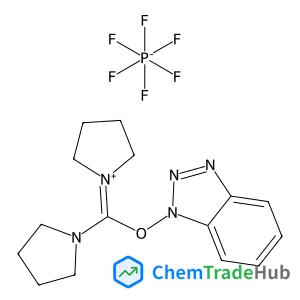
(1H-Benzotriazol-1-yloxy)(di-1-pyrrolidinyl)methylium hexafluorophosphate
CAS Number:
105379-24-6
Molecular Formula:
C15H21F6N5OP
![[4-Amino-2-(methylsulfanyl)-5-pyrimidinyl]methanol structure](https://static.chemtradehub.com/structs/588/588-36-3-fc73.webp "[4-Amino-2-(methylsulfanyl)-5-pyrimidinyl]methanol structure")
Recommended Suppliers





Disclaimer
This page provides academic journal information for reference and research purposes only. We are not affiliated with any journal publishers and do not handle publication submissions. For publication-related inquiries, please contact the respective journal publishers directly.
If you notice any inaccuracies in the information displayed, please contact us at support@chemtradehub.com. We will promptly review and address your concerns.