












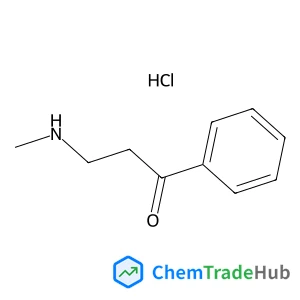
3-(Methylamino)-1-phenyl-1-propanone hydrochloride (1:1)
CAS Number:
2538-50-3
Molecular Formula:
C10H14ClNO
The photochemistry of ketoprofen in aqueous solutions is strongly influenced by its acid–base chemistry. While the acid form of ketoprofen behaves as a typical benzophenone chromophore, the ketoprofen carboxylate undergoes efficient photodecarboxylation involving a carbanion intermediate. In the present work we have conducted studies in organic solvent–water mixtures in attempts to establish the nature of the carbanion precursor. We find a dual photochemical behavior of ketoprofen depending on the protic state of the ground state absorbing species. The detection of both the ketoprofen triplet and the carbanion during the photolysis of ketoprofen in these mixtures, and the experimentally determined independence of both pathways indicates that the carbanion originates from the singlet state in the system under study.
Begoña Bazán, José L. Mesa, José L. Pizarro, Andrés T. Aguayo, María I. Arriortua, Teófilo Rojo
DOI: 10.1039/B210998K
Richard S. Grainger, Aslam Patel
DOI: 10.1039/B300815K
James D. Hoefelmeyer, François P. Gabbaï
DOI: 10.1039/B212127A
P. Bishop
DOI: 10.1039/B300037K
Iver Schmidt, Anna Carlsson, Søren Dahl, Michael Brorson, Claus J. H. Jacobsen
DOI: 10.1039/B212646J
Alex Ionkin, William Marshall
DOI: 10.1039/B211252C
Amitava Choudhury
DOI: 10.1039/B210037C
Kentaro Futatsugi, Akira Yanagisawa, Hisashi Yamamoto
DOI: 10.1039/B211523A
Joan Albert, J. Magali Cadena, Asensio González, Jaume Granell, Xavier Solans, Mercè Font-Bardia
DOI: 10.1039/B211808D
When handling 4-(2-Furylmethyl)thiomorpholine 1,1-dioxide (CAS: 79206-94-3), it ...
When handling 4-Chloro-N-[2-(4-morpholinyl)ethyl]benzamide (CAS: 71320-77-9), it...
Waste containing this compound (CAS: 62921-74-8) should be handled according to ...
Waste containing (S)-Methyl 2-amino-3-cyclohexylpropanoate should be collected i...
This compound can be synthesized using a multi-step process involving the conjug...
There are several alternatives to (2E)-3-(3,4-Dichlorophenyl)acrylic acid in syn...
Ethyl 6-(2-nitrophenyl)imidazo[2,1-b][1,3]thiazole-3-carboxylate (CAS: 925437-84...
Waste containing 2-(1,3-Thiazol-2-yl)ethanamine (CAS: 18453-07-1) should be coll...
Methyl 5-iodo-2-methylbenzoate can be synthesized through the iodination of meth...
5-Chloro[1,2,4]triazolo[1,5-a]pyridine is commonly synthesized via the condensat...

Physical Chemistry Chemical Physics (PCCP) is an international journal co-owned by 19 physical chemistry and physics societies from around the world. This journal publishes original, cutting-edge research in physical chemistry, chemical physics and biophysical chemistry. To be suitable for publication in PCCP, articles must include significant innovation and/or insight into physical chemistry; this is the most important criterion that reviewers and Editors will judge against when evaluating submissions. The journal has a broad scope and welcomes contributions spanning experiment, theory, computation and data science. Topical coverage includes spectroscopy, dynamics, kinetics, statistical mechanics, thermodynamics, electrochemistry, catalysis, surface science, quantum mechanics, quantum computing and machine learning. Interdisciplinary research areas such as polymers and soft matter, materials, nanoscience, energy, surfaces/interfaces, and biophysical chemistry are welcomed if they demonstrate significant innovation and/or insight into physical chemistry. Joined experimental/theoretical studies are particularly appreciated when complementary and based on up-to-date approaches.
![[4-Amino-2-(methylsulfanyl)-5-pyrimidinyl]methanol structure](https://static.chemtradehub.com/structs/588/588-36-3-fc73.webp "[4-Amino-2-(methylsulfanyl)-5-pyrimidinyl]methanol structure")




