












Rapid copolymerization of canola oil derived epoxide monomers with anhydrides and carbon dioxide (CO2)
Literature Information
Publication Date
2017-09-25
DOI
10.1039/C7PY01429E
Impact Factor
5.582
Authors
Liejiang Jin, Hongbo Zeng, Aman Ullah
View Original
Abstract
A canola oil derived monomer, 1-decene, was converted to 1,2-epoxydecane with >90% yield. The ring opening copolymerization of 1,2-epoxydecane with carbon dioxide (CO2) and different cyclic anhydrides including maleic, succinic, itaconic, phthalic and tetrahydrophthalic was carried out using a double metal cyanide (DMC) catalyst under microwave and conventional heating conditions. The microwave-assisted polymerizations were significantly faster than those observed under conventional heating conditions. The polycarbonates, copolymers with CO2, were synthesized within minutes (∼30 min) under microwave conditions with high conversions (up to 99%), carbonate linkage (∼88%) and molecular weight (Mw ∼ 15 kDa). The polyesters, copolymers with anhydrides, were synthesized in ∼60 min with high ester content (up to 90%) and Mw (up to 17 kDa). The synthesized copolymers were characterized by Fourier transform infrared spectroscopy (FTIR), proton nuclear magnetic resonance (1H NMR), gel permeation chromatography (GPC), differential scanning calorimetry (DSC) and thermal gravimetric analysis (TGA) techniques. The configuration of double bonds in unsaturated polyesters such as poly(1-decene-co-maleate) was completely isomerized through post polymerization modification to enhance its activity as an unsaturated polyester resin (UPR) for different potential applications.
Related Literature
How external perturbations affect the chemoselectivity of substrate activation by cytochrome P450 OleTJE
Abayomi S. Faponle
2020-11-05
Paper
DOI: 10.1039/D0CP05169A
Investigating charge carrier scattering processes in anisotropic semiconductors through first-principles calculations: the case of p-type SnSe
Anderson S. Chaves, Robert Luis González-Romero, Alex Antonelli
2020-12-08
Paper
DOI: 10.1039/D0CP05022A
A novel three-dimensional Fe3SnC/C hybrid nanofiber absorber for lightweight and highly-efficient microwave absorption
Guangguang Guan, Guojun Gao, Jun Xiang, Jingnan Yang, Xiaoqiang Li, Kaiyin Zhang
2020-11-02
Communication
DOI: 10.1039/D0CP04594B
Accurate equilibrium structure of 3-aminophthalimide from gas electron diffraction and coupled-cluster computations and diverse structural effects due to electron density transfer
Nina I. Giricheva, Georgiy V. Girichev
2020-11-12
Paper
DOI: 10.1039/D0CP04423G
Anchoring a bow-shaped boron single chain in binary Be6B7− cluster: hybrid octagonal ring, multifold π/σ aromaticity, and dual electronic transmutation
Lin-Yan Feng, Kang Wang, Hua-Jin Zhai
2020-11-09
Paper
DOI: 10.1039/D0CP05012A
The formation and migration of non-equivalent oxygen vacancies in PrBaCo2−xMxO6−δ, where M = Fe, Co, Ni and Cu
V. P. Zhukov, B. V. Politov, A. Yu. Suntsov, V. L. Kozhevnikov
2021-01-15
Paper
DOI: 10.1039/D0CP05497F
High mobility and enhanced photoelectric performance of two-dimensional ternary compounds NaCuX (X = S, Se, and Te)
Xinxin Jiang, Xuhui Xu, Ge Xu, Dongmei Li, Chong Li, Bin Cui
2020-12-22
Paper
DOI: 10.1039/D0CP05303A
Rational design of [e]-fusion induced high-performance DHP/CPD based photoswitches
Li Han, Heming Li, Xi Zuo, Quan Gao, Dongmei Li, Bin Cui, Changfeng Fang
2020-10-27
Paper
DOI: 10.1039/D0CP03827J
Electric field and charged impurity doping effects on the Schottky anomaly of β12-borophene
Luong V. Tung, Pham T. Vinh, Doan Q. Khoa
2020-12-17
Paper
DOI: 10.1039/D0CP05219A
You might also like
Compound Q&A
Are there alternatives to 1-(4-Chlorophenyl)-N-hydroxymethanimine (CAS: 3848-36-0) in synthesis?
When considering alternatives to 1-(4-Chlorophenyl)-N-hydroxymethanimine (CAS: 3...
3848-36-01-(4-Chlorophenyl)-N...
Compound Q&A
How should (1R,9S,10S,12S,14E,16S,19R,20R,21S,22R)-3,9,21-Trihydroxy-5,10,12,14,16,20,22-heptamethyl-23,24-dioxatetracyclo[17.3.1.1~6,9~.0~2,7~]tetracosa-2,5,7,14-tetraen-4-one (CAS: 183202-73-5) be stored?
This compound should be stored in a cool, dry place away from direct sunlight. I...
183202-73-5(1R,9S,10S,12S,14E,1...
Compound Q&A
How is 3-(4-Bromophenyl)-5-(2-fluorophenyl)-1,2,4-oxadiazole (CAS: 419553-16-5) typically synthesized?
3-(4-Bromophenyl)-5-(2-fluorophenyl)-1,2,4-oxadiazole is synthesized through a m...
419553-16-53-(4-Bromophenyl)-5-...
Compound Q&A
How is 5-Chloro-2-(4-chlorophenyl)-4-methyl-6-[3-(1-piperidinyl)propoxy]pyrimidine (CAS: 1639220-19-1) typically synthesized?
5-Chloro-2-(4-chlorophenyl)-4-methyl-6-[3-(1-piperidinyl)propoxy]pyrimidine (CAS...
1639220-19-15-Chloro-2-(4-chloro...
Compound Q&A
What industries use 2-Chloro-4-(difluoromethoxy)pyridine (CAS: 1206978-15-5)?
2-Chloro-4-(difluoromethoxy)pyridine is used in the pharmaceutical industry for ...
1206978-15-52-Chloro-4-(difluoro...
Compound Q&A
What regulatory guidelines apply to 3-Chloro-6-methylpyridazine (CAS: 1121-79-5)?
3-Chloro-6-methylpyridazine (CAS: 1121-79-5) is classified under the Globally Ha...
1121-79-53-Chloro-6-methylpyr...
Compound Q&A
Are there alternatives to Methyl 4,5-dimethyl-2-nitrobenzoate in synthesis?
Several alternatives can be used in the synthesis of Methyl 4,5-dimethyl-2-nitro...
90922-74-0Methyl 4,5-dimethyl-...
Compound Q&A
Are there alternatives to (2E,2'E)-3,3'-(1,4-Phenylene)bisacrylaldehyde in synthesis?
Alternatives to (2E,2'E)-3,3'-(1,4-Phenylene)bisacrylaldehyde include other acry...
63405-68-5(2E,2'E)-3,3'-(1,4-P...
Compound Q&A
What is 3-Amino-5-chloropyridin-2-ol hydrochloride (CAS: 1261906-29-9)?
3-Amino-5-chloropyridin-2-ol hydrochloride is an organic compound with the CAS n...
1261906-29-93-Amino-5-chloropyri...
Compound Q&A
What precautions should be taken when handling 6,7-Difluoro-2,3-dihydro-4H-chromen-4-one (CAS: 1092349-93-3)?
When handling 6,7-Difluoro-2,3-dihydro-4H-chromen-4-one, it is essential to wear...
1092349-93-36,7-Difluoro-2,3-dih...
Source Journal
Polymer Chemistry

CiteScore:
8.6
Self-citation Rate:
7.3%
Articles per Year:
457
Polymer Chemistry welcomes submissions in all areas of polymer science that have a strong focus on macromolecular chemistry. Manuscripts may cover a broad range of fields, yet no direct application focus is required.
Recommended Compounds
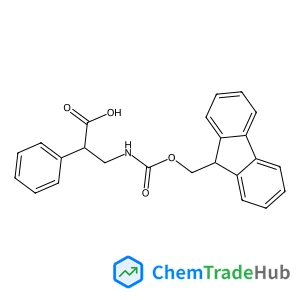
(S)-3-((((9H-Fluoren-9-yl)methoxy)carbonyl)amino)-2-phenylpropanoic acid
CAS Number:
1217663-60-9
Molecular Formula:
C24H21NO4
Recommended Suppliers




Disclaimer
This page provides academic journal information for reference and research purposes only. We are not affiliated with any journal publishers and do not handle publication submissions. For publication-related inquiries, please contact the respective journal publishers directly.
If you notice any inaccuracies in the information displayed, please contact us at support@chemtradehub.com. We will promptly review and address your concerns.