


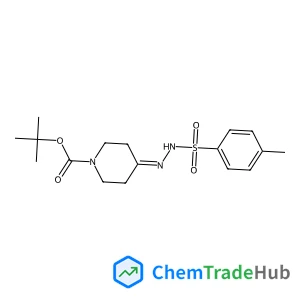
tert-Butyl 4-(2-(p-Tolylsulfonyl)hydrazono)piperidine-1-carboxylate
CAS Number:
1046478-89-0
Molecular Formula:
C17H25N3O4S
Lin-Yan Feng, Kang Wang, Hua-Jin Zhai
Elemental boron clusters do not form linear chain or monocyclic ring structures, which is in contrast to carbon. Based on computer global searches and quantum chemical calculations, we report on the viability of a curved boron single chain in binary Be6B7− cluster. The boron motif assumes a bow shape, being anchored on a Be6 prism. Such a motif, which appears to be highly strained in its free-standing form, is exotic in boron-based clusters and nanostructures. Chemically, the cluster is analogous to a “clam-and-pearl-chain” system at the nanoscale (about 1 nm in size), in which a Be6 clam moderately opens its mouth, except that a B7 pearl chain is too large to be encapsulated inside. The picture differs from a three-layered sandwich. This cluster features a hybrid Be2B7 monocyclic ring, which is octagonal in nature and supports double 10π/6σ aromaticity. The number of π bonds substantially surpasses that in bare boron clusters of similar sizes. Two Be3 rings in the prism are also σ aromatic, albeit with effective 1σ/1σ electron-counting only. The unique multifold 1σ/10π/6σ/1σ aromaticity governs the geometry of the Be6B7− cluster, which can also be rationalized using the concept of dual electronic transmutation.

Journal of Natural Medicines

Current Opinion in Colloid & Interface Science

Current Opinion in Solid State & Materials Science

Journal of Saudi Chemical Society

Nature Medicine

Russian Chemical Bulletin

Chemistry Education Research and Practice

Chemical Communications

Organic Process Research & Development

New Journal of Chemistry
Kevin Yurkerwich, Daniela Buccella, Jonathan G. Melnick, Gerard Parkin
DOI: 10.1039/B803037E
Tzofit Kehat, Moshe Portnoy
DOI: 10.1039/B703016A
Roberto Ballini, Alessandro Palmieri, Luciano Barboni
DOI: 10.1039/B800941D
P. Kanthi Senanayake, Alan M. Kenwright, David Parker, Susanna K. van der Hoorn
DOI: 10.1039/B705844F
Yanhua Zhang, Jiaqi He, Jin-Pei Cheng
DOI: 10.1039/B703591H
Victor A. Streltsov, Joseph N. Varghese
DOI: 10.1039/B803911A
Jean-Philippe Goddard, Catherine Gomez, Franck Brebion, Sophie Beauvière, Louis Fensterbank, Max Malacria
DOI: 10.1039/B705284G
Jong Won Chung, Byeong-Kwan An, Ji Whan Kim, Jang-Joo Kim, Soo Young Park
DOI: 10.1039/B802749H
Anatoly Chernyshev, Todd Fleischmann, Eric M. Koehn, Scott A. Lesley, Amnon Kohen
DOI: 10.1039/B700977A
Richard J. Spandl, Hèléne Rudyk, David R. Spring
DOI: 10.1039/B807278G
When considering alternatives to 1-(4-Chlorophenyl)-N-hydroxymethanimine (CAS: 3...
This compound should be stored in a cool, dry place away from direct sunlight. I...
3-(4-Bromophenyl)-5-(2-fluorophenyl)-1,2,4-oxadiazole is synthesized through a m...
5-Chloro-2-(4-chlorophenyl)-4-methyl-6-[3-(1-piperidinyl)propoxy]pyrimidine (CAS...
2-Chloro-4-(difluoromethoxy)pyridine is used in the pharmaceutical industry for ...
3-Chloro-6-methylpyridazine (CAS: 1121-79-5) is classified under the Globally Ha...
Several alternatives can be used in the synthesis of Methyl 4,5-dimethyl-2-nitro...
Alternatives to (2E,2'E)-3,3'-(1,4-Phenylene)bisacrylaldehyde include other acry...
3-Amino-5-chloropyridin-2-ol hydrochloride is an organic compound with the CAS n...
When handling 6,7-Difluoro-2,3-dihydro-4H-chromen-4-one, it is essential to wear...

Physical Chemistry Chemical Physics (PCCP) is an international journal co-owned by 19 physical chemistry and physics societies from around the world. This journal publishes original, cutting-edge research in physical chemistry, chemical physics and biophysical chemistry. To be suitable for publication in PCCP, articles must include significant innovation and/or insight into physical chemistry; this is the most important criterion that reviewers and Editors will judge against when evaluating submissions. The journal has a broad scope and welcomes contributions spanning experiment, theory, computation and data science. Topical coverage includes spectroscopy, dynamics, kinetics, statistical mechanics, thermodynamics, electrochemistry, catalysis, surface science, quantum mechanics, quantum computing and machine learning. Interdisciplinary research areas such as polymers and soft matter, materials, nanoscience, energy, surfaces/interfaces, and biophysical chemistry are welcomed if they demonstrate significant innovation and/or insight into physical chemistry. Joined experimental/theoretical studies are particularly appreciated when complementary and based on up-to-date approaches.
![4-[(3-Chloro-2-fluorophenyl)amino]-7-methoxy-6-quinazolinyl acetate structure](https://static.chemtradehub.com/structs/740/740081-22-5-f58f.webp "4-[(3-Chloro-2-fluorophenyl)amino]-7-methoxy-6-quinazolinyl acetate structure")
![2-{[(1R,2S)-2-Aminocyclohexyl]amino}-4-{[3-(2H-1,2,3-triazol-2-yl)phenyl]amino}-5-pyrimidinecarboxamide structure](https://static.chemtradehub.com/structs/137/1370261-96-3-40df.webp "2-{[(1R,2S)-2-Aminocyclohexyl]amino}-4-{[3-(2H-1,2,3-triazol-2-yl)phenyl]amino}-5-pyrimidinecarboxamide structure")




