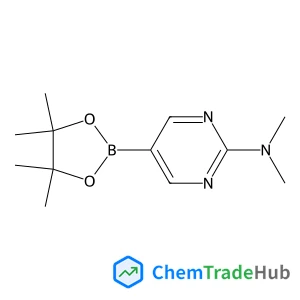
N,N-Dimethyl-5-(4,4,5,5-tetramethyl-1,3,2-dioxaborolan-2-yl)-2-pyrimidinamine
CAS Number:
1032759-30-0
Molecular Formula:
C12H20BN3O2
Li Han, Heming Li, Xi Zuo, Quan Gao, Dongmei Li, Bin Cui, Changfeng Fang
We report an effective strategy for improving the electronic transport and switching behaviors of dimethyldihydropyrene/cyclophanediene (DHP/CPD)-based molecular devices, an intriguing photoswitch that can be triggered by ultraviolet/visible (UV-vis) light irradiation. Aiming to obtain molecular devices with high on–off ratios, we assess a series of molecular designs formed by [e]-fusing different arenes on a conjugated macrocycle to modulate the photochemical and electronic properties. Here, the switching mechanism and transport properties of [e]-fused DHP/CPD-based nanojunctions are theoretically investigated by first-principles calculations. As a result, the large diversity in electrical conductance between the closed and open forms certifies the substantial switching behavior observed in these sandwich structures. The maximum on–off ratios in all designed photoswitches are greater than 102. Further analysis confirms the improvement of switching performance caused by [e]-fusion. Notably, in the benzo-fused molecular junctions, the maximum on–off ratio is up to 103, which is 55 times larger than that of the un-fused one. We also find that the position of the switch core can remarkably affect the performance of photoswichable nanodevices.
Lisbeth Grøndahl, Edeline Wentrup-Byrne
DOI: 10.1039/B803223H
Mathieu Mével, Cécile Neveu, Cristine Gonçalves, Jean-Jacques Yaouanc, Chantal Pichon, Paul-Alain Jaffrès, Patrick Midoux
DOI: 10.1039/B805226C
Fabrice Goubard, Pierre-Henri Aubert, Kada Boukerma, Emmanuel Pauthe, Claude Chevrot
DOI: 10.1039/B800754C
Masao Morita, Yasushi Obora, Yasutaka Ishii
DOI: 10.1039/B702293J
Anatoly Chernyshev, Todd Fleischmann, Eric M. Koehn, Scott A. Lesley, Amnon Kohen
DOI: 10.1039/B700977A
Patricia Horcajada, Suzy Surblé, Christian Serre, Do-Young Hong, You-Kyong Seo, Jong-San Chang, Jean-Marc Grenèche, Irene Margiolaki, Gérard Férey
DOI: 10.1039/B704325B
Sophia A. Solomon, Christopher A. Muryn, Richard A. Layfield
DOI: 10.1039/B803364A
Søren Bertelsen, Rasmus L. Johansen, Karl Anker Jørgensen
DOI: 10.1039/B806418K
Delphine Moraleda, David Gatineau, David Martin, Laurent Giordano, Gérard Buono
DOI: 10.1039/B802817F
When considering alternatives to 1-(4-Chlorophenyl)-N-hydroxymethanimine (CAS: 3...
This compound should be stored in a cool, dry place away from direct sunlight. I...
3-(4-Bromophenyl)-5-(2-fluorophenyl)-1,2,4-oxadiazole is synthesized through a m...
5-Chloro-2-(4-chlorophenyl)-4-methyl-6-[3-(1-piperidinyl)propoxy]pyrimidine (CAS...
2-Chloro-4-(difluoromethoxy)pyridine is used in the pharmaceutical industry for ...
3-Chloro-6-methylpyridazine (CAS: 1121-79-5) is classified under the Globally Ha...
Several alternatives can be used in the synthesis of Methyl 4,5-dimethyl-2-nitro...
Alternatives to (2E,2'E)-3,3'-(1,4-Phenylene)bisacrylaldehyde include other acry...
3-Amino-5-chloropyridin-2-ol hydrochloride is an organic compound with the CAS n...
When handling 6,7-Difluoro-2,3-dihydro-4H-chromen-4-one, it is essential to wear...

Physical Chemistry Chemical Physics (PCCP) is an international journal co-owned by 19 physical chemistry and physics societies from around the world. This journal publishes original, cutting-edge research in physical chemistry, chemical physics and biophysical chemistry. To be suitable for publication in PCCP, articles must include significant innovation and/or insight into physical chemistry; this is the most important criterion that reviewers and Editors will judge against when evaluating submissions. The journal has a broad scope and welcomes contributions spanning experiment, theory, computation and data science. Topical coverage includes spectroscopy, dynamics, kinetics, statistical mechanics, thermodynamics, electrochemistry, catalysis, surface science, quantum mechanics, quantum computing and machine learning. Interdisciplinary research areas such as polymers and soft matter, materials, nanoscience, energy, surfaces/interfaces, and biophysical chemistry are welcomed if they demonstrate significant innovation and/or insight into physical chemistry. Joined experimental/theoretical studies are particularly appreciated when complementary and based on up-to-date approaches.
![(2S)-2-{[(9H-Fluoren-9-ylmethoxy)carbonyl]amino}-4-(methylselanyl)butanoic acid structure](https://static.chemtradehub.com/structs/121/1217852-49-7-f252.webp "(2S)-2-{[(9H-Fluoren-9-ylmethoxy)carbonyl]amino}-4-(methylselanyl)butanoic acid structure")