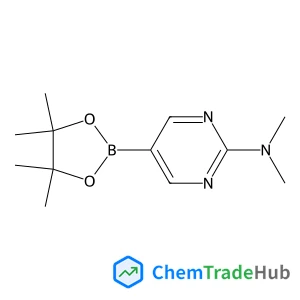
N,N-Dimethyl-5-(4,4,5,5-tetramethyl-1,3,2-dioxaborolan-2-yl)-2-pyrimidinamine
CAS Number:
1032759-30-0
Molecular Formula:
C12H20BN3O2
Abayomi S. Faponle
Cytochrome P450 enzymes are versatile biocatalysts found in most forms of life. Generally, the cytochrome P450s react with dioxygen and hence are haem-based mono-oxygenases; however, in specific isozymes, H2O2 rather than O2 is used and these P450s act as peroxygenases. The P450 OleTJE is a peroxygenase that binds long to medium chain fatty acids and converts them to a range of products originating from Cα-hydroxylation, Cβ-hydroxylation, Cα–Cβ desaturation and decarboxylation of the substrate. There is still controversy regarding the details of the reaction mechanism of P450 OleTJE; how the products are formed and whether the product distributions can be influenced by external perturbations. To gain further insights into the structure and reactivity of P450 OleTJE, we set up a range of large active site model complexes as well as full enzymatic structures and did a combination of density functional theory studies and quantum mechanics/molecular mechanics calculations. In particular, the work focused on the mechanisms leading to these products under various reaction conditions. Thus, for a small cluster model, we find a highly selective Cα-hydroxylation pathway that is preferred over Cβ–H hydrogen atom abstraction by at least 10 kcal mol−1. Introduction of polar residues to the model, such as an active site protonated histidine residue or through external electric field effects, lowers the Cβ–H hydrogen atom abstraction barriers are lowered, while a full QM/MM model brings the Cα–H and Cβ–H hydrogen atom abstraction barriers within 1 kcal mol−1. Our studies; therefore, implicate that environmental effects in the second-coordination sphere can direct and guide selectivities in enzymatic reaction mechanisms.

Crystallography Reports

Saudi Pharmaceutical Journal

Drug Discovery Today

New Journal of Chemistry

Chemistry Education Research and Practice

Chemical Communications

Russian Journal of Coordination Chemistry

Russian Chemical Bulletin

Journal of Saudi Chemical Society

Current Opinion in Colloid & Interface Science
Céline Olivier, Sylvie Choua, Philippe Turek, Daniel Touchard, Stéphane Rigaut
DOI: 10.1039/B704241H
Ana Sousa-Herves, Eduardo Fernandez-Megia, Ricardo Riguera
DOI: 10.1039/B805208E
C. V. Ramana, Challa Nageswara Reddy, Rajesh G. Gonnade
DOI: 10.1039/B801755G
Claudia Caltagirone, Philip A. Gale, Jennifer R. Hiscock, Simon J. Brooks, Michael B. Hursthouse, Mark E. Light
DOI: 10.1039/B806238B
Yang-Guang Li, Yong-Hui Wang, Xin-Long Wang, En-Bo Wang, Zhong-Min Su, Lin Xu
DOI: 10.1039/B700511C
Sophia A. Solomon, Christopher A. Muryn, Richard A. Layfield
DOI: 10.1039/B803364A
P. Kanthi Senanayake, Alan M. Kenwright, David Parker, Susanna K. van der Hoorn
DOI: 10.1039/B705844F
Jinho Kim, Sukbok Chang
DOI: 10.1039/B804637A
Montserrat Latorre, Pablo Peñalver, Julia Revuelta, Juan Luis Asensio, Eduardo García-Junceda, Agatha Bastida
DOI: 10.1039/B704785A
Ann M. Chippindale, Laura E. Head, Simon J. Hibble
DOI: 10.1039/B803500H
When considering alternatives to 1-(4-Chlorophenyl)-N-hydroxymethanimine (CAS: 3...
This compound should be stored in a cool, dry place away from direct sunlight. I...
3-(4-Bromophenyl)-5-(2-fluorophenyl)-1,2,4-oxadiazole is synthesized through a m...
5-Chloro-2-(4-chlorophenyl)-4-methyl-6-[3-(1-piperidinyl)propoxy]pyrimidine (CAS...
2-Chloro-4-(difluoromethoxy)pyridine is used in the pharmaceutical industry for ...
3-Chloro-6-methylpyridazine (CAS: 1121-79-5) is classified under the Globally Ha...
Several alternatives can be used in the synthesis of Methyl 4,5-dimethyl-2-nitro...
Alternatives to (2E,2'E)-3,3'-(1,4-Phenylene)bisacrylaldehyde include other acry...
3-Amino-5-chloropyridin-2-ol hydrochloride is an organic compound with the CAS n...
When handling 6,7-Difluoro-2,3-dihydro-4H-chromen-4-one, it is essential to wear...

Physical Chemistry Chemical Physics (PCCP) is an international journal co-owned by 19 physical chemistry and physics societies from around the world. This journal publishes original, cutting-edge research in physical chemistry, chemical physics and biophysical chemistry. To be suitable for publication in PCCP, articles must include significant innovation and/or insight into physical chemistry; this is the most important criterion that reviewers and Editors will judge against when evaluating submissions. The journal has a broad scope and welcomes contributions spanning experiment, theory, computation and data science. Topical coverage includes spectroscopy, dynamics, kinetics, statistical mechanics, thermodynamics, electrochemistry, catalysis, surface science, quantum mechanics, quantum computing and machine learning. Interdisciplinary research areas such as polymers and soft matter, materials, nanoscience, energy, surfaces/interfaces, and biophysical chemistry are welcomed if they demonstrate significant innovation and/or insight into physical chemistry. Joined experimental/theoretical studies are particularly appreciated when complementary and based on up-to-date approaches.