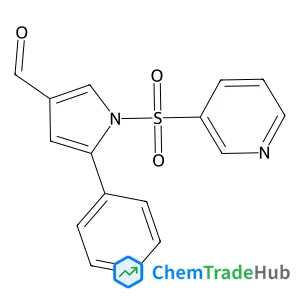
5-Phenyl-1-(pyridin-3-ylsulfonyl)-1H-pyrrole-3-carbaldehyde
CAS Number:
881676-90-0
Molecular Formula:
C16H12N2O3S
Anderson S. Chaves, Robert Luis González-Romero, Alex Antonelli
Efficient ab initio computational methods for the calculation of the thermoelectric transport properties of materials are of great interest for energy harvesting technologies. The constant relaxation time approximation (CRTA) has been largely used to efficiently calculate thermoelectric coefficients. However, CRTA usually does not hold for real materials. Here we go beyond the CRTA by incorporating realistic k-dependent relaxation time models of the temperature dependence of the main scattering processes, namely, screened polar and nonpolar scattering by optical phonons, scattering by acoustic phonons, and scattering by ionized impurities with screening. Our relaxation time models are based on a smooth Fourier interpolation of Kohn–Sham eigenvalues and its derivatives, taking into account non-parabolicity (beyond the parabolic or Kane models), degeneracy and multiplicity of the energy bands on the same footing, within very low computational cost. In order to test our methodology, we calculated the anisotropic thermoelectric transport properties of the low temperature phase (Pnma) of intrinsic p-type and hole-doped tin selenide (SnSe). Our results are in quantitative agreement with experimental data, regarding the evolution of the anisotropic thermoelectric coefficients with both temperature and chemical potential. Hence, from this picture, we also obtained the evolution and understanding of the main scattering processes of the overall thermoelectric transport in p-type SnSe.

Current Opinion in Colloid & Interface Science

Chemical Communications

Saudi Pharmaceutical Journal

Journal of Peptide Science

Crystallography Reports

Russian Chemical Bulletin

Russian Journal of Coordination Chemistry

Journal of Saudi Chemical Society

Russian Journal of Applied Chemistry

Drug Discovery Today
Neng-Fang She, Xiang-Gao Meng, Meng Gao, An-Xin Wu, Lyle Isaacs
DOI: 10.1039/B800785C
P. Kanthi Senanayake, Alan M. Kenwright, David Parker, Susanna K. van der Hoorn
DOI: 10.1039/B705844F
Eunji Lee, Ja-Hyoung Ryu, Myoung-Hwan Park, Myongsoo Lee, Kyung-Hee Han, Yeon-Wook Chung, Byoung-Ki Cho
DOI: 10.1039/B706989H
Jeremiah A. Johnson, Jeremy M. Baskin, Jeffrey T. Koberstein
DOI: 10.1039/B803043J
Pengfei Li, Yongcan Wang, Jinxing Ye
DOI: 10.1039/B804540B
Shinzo Kobayashi, Ken Itomi, Kazuhide Morino, Hiroki Iida, Eiji Yashima
DOI: 10.1039/B806343E
Delphine Moraleda, David Gatineau, David Martin, Laurent Giordano, Gérard Buono
DOI: 10.1039/B802817F
C. V. Ramana, Challa Nageswara Reddy, Rajesh G. Gonnade
DOI: 10.1039/B801755G
Giulio Gasparini, Bruno Vitorge, Paolo Scrimin, Damien Jeannerat, Leonard J. Prins
DOI: 10.1039/B803074J
Yajun Tian, Huaixin Yang, Shuanglin Zhan, Yunfa Chen
DOI: 10.1039/B801966E
When considering alternatives to 1-(4-Chlorophenyl)-N-hydroxymethanimine (CAS: 3...
This compound should be stored in a cool, dry place away from direct sunlight. I...
3-(4-Bromophenyl)-5-(2-fluorophenyl)-1,2,4-oxadiazole is synthesized through a m...
5-Chloro-2-(4-chlorophenyl)-4-methyl-6-[3-(1-piperidinyl)propoxy]pyrimidine (CAS...
2-Chloro-4-(difluoromethoxy)pyridine is used in the pharmaceutical industry for ...
3-Chloro-6-methylpyridazine (CAS: 1121-79-5) is classified under the Globally Ha...
Several alternatives can be used in the synthesis of Methyl 4,5-dimethyl-2-nitro...
Alternatives to (2E,2'E)-3,3'-(1,4-Phenylene)bisacrylaldehyde include other acry...
3-Amino-5-chloropyridin-2-ol hydrochloride is an organic compound with the CAS n...
When handling 6,7-Difluoro-2,3-dihydro-4H-chromen-4-one, it is essential to wear...

Physical Chemistry Chemical Physics (PCCP) is an international journal co-owned by 19 physical chemistry and physics societies from around the world. This journal publishes original, cutting-edge research in physical chemistry, chemical physics and biophysical chemistry. To be suitable for publication in PCCP, articles must include significant innovation and/or insight into physical chemistry; this is the most important criterion that reviewers and Editors will judge against when evaluating submissions. The journal has a broad scope and welcomes contributions spanning experiment, theory, computation and data science. Topical coverage includes spectroscopy, dynamics, kinetics, statistical mechanics, thermodynamics, electrochemistry, catalysis, surface science, quantum mechanics, quantum computing and machine learning. Interdisciplinary research areas such as polymers and soft matter, materials, nanoscience, energy, surfaces/interfaces, and biophysical chemistry are welcomed if they demonstrate significant innovation and/or insight into physical chemistry. Joined experimental/theoretical studies are particularly appreciated when complementary and based on up-to-date approaches.
![4-[(3-Chloro-2-fluorophenyl)amino]-7-methoxy-6-quinazolinyl acetate structure](https://static.chemtradehub.com/structs/740/740081-22-5-f58f.webp "4-[(3-Chloro-2-fluorophenyl)amino]-7-methoxy-6-quinazolinyl acetate structure")
![(2S)-2-{[(9H-Fluoren-9-ylmethoxy)carbonyl]amino}-4-(methylselanyl)butanoic acid structure](https://static.chemtradehub.com/structs/121/1217852-49-7-f252.webp "(2S)-2-{[(9H-Fluoren-9-ylmethoxy)carbonyl]amino}-4-(methylselanyl)butanoic acid structure")