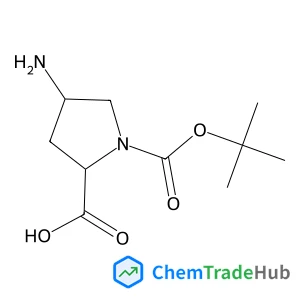
(2R,4R)-1-Boc-4-Aminopyrrolidine-2-carboxylic acid
CAS Number:
132622-98-1
Molecular Formula:
C10H18N2O4
V. P. Zhukov, B. V. Politov, A. Yu. Suntsov, V. L. Kozhevnikov
The ab initio calculated defect formation energies are used for assessment of high-temperature thermodynamic functions that govern the appearance of oxygen vacancies in PrBaCo2−xMxO6−δ, where M = Fe, Co, Ni and Cu. The free energy of oxygen vacancy formation is shown to depend on the dopant and total oxygen content in the cobaltite. The experimentally observed trend for the oxygen vacancy concentration to increase with the atomic number of 3d dopants from Fe to Cu is explained as a result of the decrease of bond strength. The preferable location of oxygen vacancies near impurity atoms is accompanied by an anisotropic redistribution of electronic charge density. The most pronounced development of this effect in the case of iron doping leads to a low probability of tetrahedrally coordinated iron to exist in the layered cobaltites. It is shown that the calculated enthalpies of defect formation satisfactorily explain the experimentally observed changes of oxygen non-stoichiometry in the doped cobaltite. The energy barriers for oxygen jumps are found to vary only weakly at the doping thus suggesting rather insignificant dependence of the oxygen ion conductivity on 3d dopant nature. The earlier findings and results in the present work are indicative of promising properties combination in PrBaCo2−xNixO6−δ for the application as an electrode material in IT-SOFCs.

Russian Journal of Organic Chemistry

Russian Journal of Bioorganic Chemistry

Acta Materialia

Chemistry Education Research and Practice

Crystallography Reports

New Journal of Chemistry

Russian Chemical Bulletin

Russian Journal of Applied Chemistry

Journal of Natural Medicines

Russian Journal of General Chemistry
Jian-Rong Li, Qun Yu, E. Carolina Sañudo, Ying Tao, Xian-He Bu
DOI: 10.1039/B702988H
Lixia Sun, Qianwang Chen, Yan Tang, Ying Xiong
DOI: 10.1039/B704689H
Rong-Tang Liao, Woei-Chyuan Yang, P. Thanasekaran, Chen-Chuan Tsai, M. Sathiyendiran, Yen-Hsiang Liu, T. Rajendran, Hsiu-Mei Lin, Tien-Wen Tseng, Kuang-Lieh Lu
DOI: 10.1039/B802777C
Kyung-Soo Moon, Eunji Lee, Myongsoo Lee
DOI: 10.1039/B801108G
Nikhil Kumar Singha, Amalin Kavitha, Prodip Sarker, Stephen Rimmer
DOI: 10.1039/B801149D
Shelli R. Waetzig, Jon A. Tunge
DOI: 10.1039/B806949B
Yan Yan, Fuqiang Zhang, Yan Meng, Bo Tu, Dongyuan Zhao
DOI: 10.1039/B702232H
When considering alternatives to 1-(4-Chlorophenyl)-N-hydroxymethanimine (CAS: 3...
This compound should be stored in a cool, dry place away from direct sunlight. I...
3-(4-Bromophenyl)-5-(2-fluorophenyl)-1,2,4-oxadiazole is synthesized through a m...
5-Chloro-2-(4-chlorophenyl)-4-methyl-6-[3-(1-piperidinyl)propoxy]pyrimidine (CAS...
2-Chloro-4-(difluoromethoxy)pyridine is used in the pharmaceutical industry for ...
3-Chloro-6-methylpyridazine (CAS: 1121-79-5) is classified under the Globally Ha...
Several alternatives can be used in the synthesis of Methyl 4,5-dimethyl-2-nitro...
Alternatives to (2E,2'E)-3,3'-(1,4-Phenylene)bisacrylaldehyde include other acry...
3-Amino-5-chloropyridin-2-ol hydrochloride is an organic compound with the CAS n...
When handling 6,7-Difluoro-2,3-dihydro-4H-chromen-4-one, it is essential to wear...

Physical Chemistry Chemical Physics (PCCP) is an international journal co-owned by 19 physical chemistry and physics societies from around the world. This journal publishes original, cutting-edge research in physical chemistry, chemical physics and biophysical chemistry. To be suitable for publication in PCCP, articles must include significant innovation and/or insight into physical chemistry; this is the most important criterion that reviewers and Editors will judge against when evaluating submissions. The journal has a broad scope and welcomes contributions spanning experiment, theory, computation and data science. Topical coverage includes spectroscopy, dynamics, kinetics, statistical mechanics, thermodynamics, electrochemistry, catalysis, surface science, quantum mechanics, quantum computing and machine learning. Interdisciplinary research areas such as polymers and soft matter, materials, nanoscience, energy, surfaces/interfaces, and biophysical chemistry are welcomed if they demonstrate significant innovation and/or insight into physical chemistry. Joined experimental/theoretical studies are particularly appreciated when complementary and based on up-to-date approaches.
![2-{[(1R,2S)-2-Aminocyclohexyl]amino}-4-{[3-(2H-1,2,3-triazol-2-yl)phenyl]amino}-5-pyrimidinecarboxamide structure](https://static.chemtradehub.com/structs/137/1370261-96-3-40df.webp "2-{[(1R,2S)-2-Aminocyclohexyl]amino}-4-{[3-(2H-1,2,3-triazol-2-yl)phenyl]amino}-5-pyrimidinecarboxamide structure")