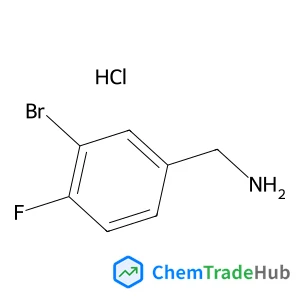
1-(3-Bromo-4-fluorophenyl)methanamine hydrochloride (1:1)
CAS Number:
202865-68-7
Molecular Formula:
C7H8BrClFN
Xinxin Jiang, Xuhui Xu, Ge Xu, Dongmei Li, Chong Li, Bin Cui
Two-dimensional (2D) materials have attracted great interest in the field of optoelectronics in recent years due to their atomically thin structure and various electronic properties. Based on the first-principles calculations combined with the non-equilibrium Green's function (NEGF) method, we predict a set of new 2D ternary materials, sodium copper chalcogenides (NaCuX, X = S, Se, and Te). These materials not only have direct band gaps ranging from 1.2 to 1.6 eV, but also possess relatively small carrier effective masses (0.1–0.2m0) at the band edges thus high carrier mobilities (103–104 cm2 V−1 s−1), which collectively imply that they are suitable for optical-electronic applications in the visible (even in the infrared) light region. Moreover, based on the high photo responsivity (Rph), e.g., up to 0.105 A W−1 for NaCuTe, we design a series of NaCuX monolayer based high performance optoelectronic junctions. These properties indicate that NaCuX monolayers are promising candidate materials for photodetectors and photovoltaic units.
Jen-Chieh Hsieh, Chien-Hong Cheng
DOI: 10.1039/B801870G
Yuya Oaki, Shinichiro Hayashi, Hiroaki Imai
DOI: 10.1039/B704129B
Claudia Caltagirone, Philip A. Gale, Jennifer R. Hiscock, Simon J. Brooks, Michael B. Hursthouse, Mark E. Light
DOI: 10.1039/B806238B
Roberto Ballini, Alessandro Palmieri, Luciano Barboni
DOI: 10.1039/B800941D
Hiroshi Shimizu, Masahiro Murakami
DOI: 10.1039/B704105E
Kevin Yurkerwich, Daniela Buccella, Jonathan G. Melnick, Gerard Parkin
DOI: 10.1039/B803037E
Stefano Crotti, Ferruccio Bertolini, Franco Macchia, Mauro Pineschi
DOI: 10.1039/B803693D
Anatoly Chernyshev, Todd Fleischmann, Eric M. Koehn, Scott A. Lesley, Amnon Kohen
DOI: 10.1039/B700977A
Sarita Sitaula, Marilyn R. Mackiewicz, Scott M. Reed
DOI: 10.1039/B801525B
When considering alternatives to 1-(4-Chlorophenyl)-N-hydroxymethanimine (CAS: 3...
This compound should be stored in a cool, dry place away from direct sunlight. I...
3-(4-Bromophenyl)-5-(2-fluorophenyl)-1,2,4-oxadiazole is synthesized through a m...
5-Chloro-2-(4-chlorophenyl)-4-methyl-6-[3-(1-piperidinyl)propoxy]pyrimidine (CAS...
2-Chloro-4-(difluoromethoxy)pyridine is used in the pharmaceutical industry for ...
3-Chloro-6-methylpyridazine (CAS: 1121-79-5) is classified under the Globally Ha...
Several alternatives can be used in the synthesis of Methyl 4,5-dimethyl-2-nitro...
Alternatives to (2E,2'E)-3,3'-(1,4-Phenylene)bisacrylaldehyde include other acry...
3-Amino-5-chloropyridin-2-ol hydrochloride is an organic compound with the CAS n...
When handling 6,7-Difluoro-2,3-dihydro-4H-chromen-4-one, it is essential to wear...

Physical Chemistry Chemical Physics (PCCP) is an international journal co-owned by 19 physical chemistry and physics societies from around the world. This journal publishes original, cutting-edge research in physical chemistry, chemical physics and biophysical chemistry. To be suitable for publication in PCCP, articles must include significant innovation and/or insight into physical chemistry; this is the most important criterion that reviewers and Editors will judge against when evaluating submissions. The journal has a broad scope and welcomes contributions spanning experiment, theory, computation and data science. Topical coverage includes spectroscopy, dynamics, kinetics, statistical mechanics, thermodynamics, electrochemistry, catalysis, surface science, quantum mechanics, quantum computing and machine learning. Interdisciplinary research areas such as polymers and soft matter, materials, nanoscience, energy, surfaces/interfaces, and biophysical chemistry are welcomed if they demonstrate significant innovation and/or insight into physical chemistry. Joined experimental/theoretical studies are particularly appreciated when complementary and based on up-to-date approaches.
![6-Bromo-2,3-dihydro-1H-pyrido[2,3-b][1,4]oxazine structure](https://static.chemtradehub.com/structs/120/1203499-17-5-b4d1.webp "6-Bromo-2,3-dihydro-1H-pyrido[2,3-b][1,4]oxazine structure")
![(2S)-2-{[(9H-Fluoren-9-ylmethoxy)carbonyl]amino}-4-(methylselanyl)butanoic acid structure](https://static.chemtradehub.com/structs/121/1217852-49-7-f252.webp "(2S)-2-{[(9H-Fluoren-9-ylmethoxy)carbonyl]amino}-4-(methylselanyl)butanoic acid structure")