


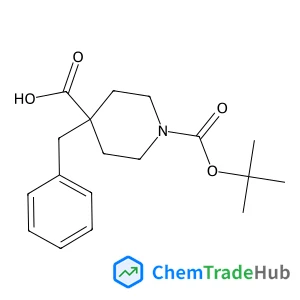
4-Benzyl-1-(tert-butoxycarbonyl)piperidine-4-carboxylic acid
CAS Number:
170838-87-6
Molecular Formula:
C18H25NO4
Andrés Arango-Restrepo, Daniel Barragán, J. Miguel Rubi
We propose a model to show the formation of Liesegang rings under non-isothermal conditions. The model formulates reaction–diffusion equations for all components intervening in the process together with an evolution equation for the temperature. The reactive parts in these equations follow from the analysis of the non-equilibrium self-assembly (NESA) process undergone by the meso-particles which make up the patterns. The solution of these equations enables us to know the concentration of each component, the spherical structures diameter, and the system temperature as a function of time and radial position. The values found for the structures diameter and the rings position are in agreement with the experiments. The results for the system temperature with peaks at the rings positions suggest that heat accumulates at these positions as a consequence of the dissipation inherent to the NESA process. Our model enables us to rationalize how from non-homogeneous initial conditions a transient self-organization process involving formation of self-assembled structures may produce macroscopic patterns. It can, in general, be used to analyze pattern formation due to diffusion–reaction–precipitation processes with potential applications in the design of advanced materials.

Advances in Colloid and Interface Science

Chemistry of Natural Compounds

Australian Journal of Chemistry

Bulletin of the Chemical Society of Japan

Canadian Metallurgical Quarterly

Ferroelectrics

Chemical Reviews

Accounts of Chemical Research

Anti-Corrosion Methods and Materials

Journal of the American Chemical Society
Zhouen Zhang, Takashi Niwa, Yasuyoshi Watanabe
DOI: 10.1039/C8OB02049C
Luisa Lempenauer, Aline Soupart, Elisabet Duñach, Gilles Lemière
DOI: 10.1039/C8OB01559G
Pei-Qian Wu, Yi-Fan Yu, Ye Zhao, Chun-Xue Yu, De-Juan Zhi, Feng-Ming Qi
DOI: 10.1039/C8OB02319K
Fen Li, Xiaohui Li, Xin Zhang
DOI: 10.1039/C8OB01944D
Caiyang Zhang, You Zhou, Jintao Huang, Canhui Tu, Xiaoai Zhou, Guodong Yin
DOI: 10.1039/C8OB01758A
Kajal Mal, Barnali Naskar, Animesh Mondal, Sanchita Goswami, Chandraday Prodhan, Keya Chaudhuri, Chhanda Mukhopadhyay
DOI: 10.1039/C8OB01411F
Limin Yang, Yunbo Lv, Fei Wang, Guofu Zhong
DOI: 10.1039/C8OB90095G
Jake C. Spiteri, Sergey A. Denisov, Gediminas Jonusauskas, Sylwia Klejna, Konrad Szaciłowski, Nathan D. McClenaghan, David C. Magri
DOI: 10.1039/C8OB00485D
This compound is mainly used as an intermediate in the synthesis of antipsychoti...
Waste containing 1-(D-Ribofuranosyl)-1,4-dihydro-3-pyridinecarboxamide (CAS: 191...
2-Methyl-2-propanyl 3-bromo-3-(hydroxymethyl)-1-azetidinecarboxylate (CAS: 20079...
N-(4-Chloro-2-pyridinyl)acetamide (CAS: 245056-66-0) is a chemical compound with...
5-Chloro-2-hydroxybenzoic acid, also known as 5-chlorosalicylic acid, is an arom...
When handling 1,1-Dichloro-1-fluoroethane (CAS: 1717-00-6), it is important to u...
Fmoc-(2S,3R)-3-phenylpyrrolidine-2-carboxylic acid is a white crystalline solid ...
4-Amino-5-bromo-2-pyridinecarboxylic acid is primarily used as a precursor in th...
Handling this compound should be done with personal protective equipment (PPE) i...
When handling 8-bromo-2,2-dimethyl-3,4-dihydro-2H-1,4-benzoxazin-3-one, use prop...

Physical Chemistry Chemical Physics (PCCP) is an international journal co-owned by 19 physical chemistry and physics societies from around the world. This journal publishes original, cutting-edge research in physical chemistry, chemical physics and biophysical chemistry. To be suitable for publication in PCCP, articles must include significant innovation and/or insight into physical chemistry; this is the most important criterion that reviewers and Editors will judge against when evaluating submissions. The journal has a broad scope and welcomes contributions spanning experiment, theory, computation and data science. Topical coverage includes spectroscopy, dynamics, kinetics, statistical mechanics, thermodynamics, electrochemistry, catalysis, surface science, quantum mechanics, quantum computing and machine learning. Interdisciplinary research areas such as polymers and soft matter, materials, nanoscience, energy, surfaces/interfaces, and biophysical chemistry are welcomed if they demonstrate significant innovation and/or insight into physical chemistry. Joined experimental/theoretical studies are particularly appreciated when complementary and based on up-to-date approaches.
![6-Benzyl-4,5,6,7-tetrahydro-1H-pyrazolo[3,4-c]pyridin-3(2H)-one structure](https://static.chemtradehub.com/structs/909/909187-64-0-f54f.webp "6-Benzyl-4,5,6,7-tetrahydro-1H-pyrazolo[3,4-c]pyridin-3(2H)-one structure")






