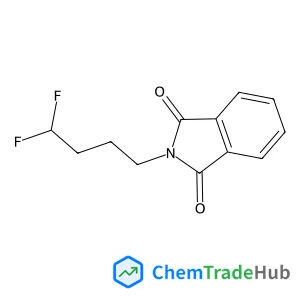
2-(4,4-Difluorobutyl)-1H-isoindole-1,3(2H)-dione
CAS Number:
1265341-14-7
Molecular Formula:
C12H11F2NO2
Kajal Mal, Barnali Naskar, Animesh Mondal, Sanchita Goswami, Chandraday Prodhan, Keya Chaudhuri, Chhanda Mukhopadhyay
In this study, a new molecular organic probe has been designed and synthesized by using recyclable, inexpensive and non-toxic polyethylene glycol (PEG-400) as a promoting reaction medium in water under environmentally benevolent conditions. The probe has been explored as a potential chemosensor to detect Al3+ ions using a HEPES buffer (pH = 7.4) solution. Investigations of the fluorescence behaviour of this sensor in DMSO/H2O (2 : 8, v/v) solution displayed a dramatic switch-on response only in the presence of Al3+, while other metal ions, like Li+, Na+, K+, Ag+, Ca2+, Mg2+, Mn2+, Ba2+, Cu2+, Ni2+, Co2+, Fe2+, Zn2+, Cd2+, Hg2+, Pb2+, Sr2+, Fe3+ or Cr3+, have almost no influence on the fluorescence behaviour. Various common anions, such as ClO4−, Cl−, or NO3− in the form of Al3+ salts [e.g. Al(ClO4)3, AlCl3 or Al(NO3)3], had no influence on the fluorescence behaviour of the sensors. The detection limit for Al3+ is in the order of 10−6 M in DMSO/H2O (2 : 8, v/v) HEPES buffer (pH = 7.4) solution. Notably, this is the first report of a dihydroindeno[1,2-b]pyrrole moiety acting as a sensor for the selective detection of Al3+ ions through an off–on fluorescence response. The potential of the probe was also confirmed by employing it for fluorescence bio-imaging with Al3+ on HepG2 cells.
Michael J. Pilling, Alex Henderson, Jonathan H. Shanks, Michael D. Brown, Noel W. Clarke, Peter Gardner
DOI: 10.1039/C6AN02224C
Aamar F. Khan, Dale A. C. Brownson, Christopher W. Foster, Graham C. Smith, Craig E. Banks
DOI: 10.1039/C7AN00323D
Guolan Tian, Lan Chen, Renxiao Liu, Guanglu Ge
DOI: 10.1039/C8AN01068D
Qin-Yin Shi, Vicki Schlegel
DOI: 10.1039/C8AN01452C
G. R. Lloyd, J. Nallala, M. Isabelle, L. M. Almond, N. A. Shepherd, C. A. Kendall, A. C. Shore, N. Stone
DOI: 10.1039/C6AN01871H
DOI: 10.1039/C8AN01270A
Do Hyun Kang, Keesung Kim, Younghwan Son, Pahn-Shick Chang, Ho-Sup Jung
DOI: 10.1039/C8AN01097H
Peng Wang, Jing Zhang, Hong-Wen Liu, Xiao-Xiao Hu, Xia Yin, Xiao-Bing Zhang
DOI: 10.1039/C7AN00229G
Paweł M. Nowak, Michał Woźniakiewicz
DOI: 10.1039/C8AN01191E
H. T. Mohamed
DOI: 10.1039/C6AN01951J
N-(4-Methoxybenzyl)-2-pyridinamine (CAS: 52818-63-0) is increasingly being used ...
When handling Ethyl 4-(2-chlorophenyl)-1,3-thiazole-2-carboxylate, appropriate p...
Diethyldiselane (CAS: 628-39-7) is classified under the Globally Harmonized Syst...
The market for oxocopper (CAS: 12053-18-8) is primarily driven by its use in cat...
The market for 5-{[(2-Methyl-2-propanyl)oxy]carbonyl}-5-azaspiro[2.4]heptane-7-c...
2-(1-Pyrrolidinyl)-4-pyridinamine is a chemical compound with the CAS number 359...
2-(3-Pyridinyl)-1-azabicyclo[2.2.2]octane (CAS: 91556-75-1) is a crystalline sol...
(S)-Alpha-allyl-proline hydrochloride is usually synthesized via a Wittig reacti...
3-Methyl-1,2-oxazole-5-carboxylic acid (CAS: 4857-42-5) is an organic compound w...
Lys-SMCC-DM1 is synthesized via a multi-step process involving the coupling of S...

Organic & Biomolecular Chemistry (OBC) publishes original and high impact research and reviews in organic chemistry. We welcome research that shows new or significantly improved protocols or methodologies in total synthesis, synthetic methodology or physical and theoretical organic chemistry as well as research that shows a significant advance in the organic chemistry or molecular design aspects of chemical biology, catalysis, supramolecular and macromolecular chemistry, theoretical chemistry, mechanism-oriented physical organic chemistry, medicinal chemistry or natural products. Articles published in the journal should report new work which makes a highly-significant impact in the field. Routine and incremental work is generally not suitable for publication in the journal. More details about key areas of our scope are below. In all cases authors should include in their article clear rationale for why their research has been carried out.
![5'-Fluoro-[2,3'-biindolinylidene]-2',3-dione structure](https://static.chemtradehub.com/structs/251/251903-00-1-9cb1.webp "5'-Fluoro-[2,3'-biindolinylidene]-2',3-dione structure")