


SO3 formation from the X-ray photolysis of SO2 astrophysical ice analogues: FTIR spectroscopy and thermodynamic investigations
Literature Information
Publication Date
2017-09-19
DOI
10.1039/C7CP03679E
Impact Factor
3.676
Authors
Víctor de Souza Bonfim, Roberto Barbosa de Castilho, Leonardo Baptista
View Original
Abstract
In this combined experimental–theoretical work we focus on the physical and chemical changes induced by soft X-rays on sulfur dioxide (SO2) ice at a very low temperature, in an attempt to clarify and quantify its survival and chemical changes in some astrophysical environments. SO2 is an important constituent of some Jupiter moons and has also been observed in ices around protostars. The measurements were performed at the Brazilian Synchrotron Light Source (LNLS/CNPEM), in Campinas, Brazil. The SO2 ice sample (12 K) was exposed to a broadband beam of mainly soft X-rays (6–2000 eV) and in situ analyses were performed by IR spectroscopy. The X-ray photodesorption yield (upper limit) was around 0.25 molecules per photon. The values determined for the effective destruction (SO2) and formation (SO3) cross sections were 2.5 × 10⁻¹⁸ cm2 and 2.1 × 10⁻¹⁸ cm2, respectively. The chemical equilibrium (88% of SO2 and 12% of SO3) was reached after the fluence of 1.6 × 10¹⁸ photons cm−2. The SO3 formation channels were studied at the second-order Møller–Plesset perturbation theory (MP2) level, which showed the three most favorable reaction routes (ΔH < −79 kcal mol−1) in simulated SO2 ice: (i) SO + O2 → SO3, (ii) SO2 + O → SO3, and (iii) SO2 + O+ → SO3+ + e− → SO3. The amorphous solid environment effect decreases the reactivity of intermediate species towards SO3 formation, and ionic species are even more affected. The experimentally determined effective cross sections and theoretical reaction channels identified in this work allow us to better understand the chemical evolution of certain sulfur-rich astrophysical environments.
Recommended Journals

Ferroelectrics

Accounts of Chemical Research

Bulletin of the Chemical Society of Japan

Journal of the American Chemical Society

Journal of the Chinese Chemical Society

Advances in Colloid and Interface Science

Chemistry of Natural Compounds

Biopolymers

Anti-Corrosion Methods and Materials

Australian Journal of Chemistry
Related Literature
Structural relaxation, viscosity, and network connectivity in a hydrogen bonding liquid
Georg Ehlers, Joerg C. Neuefeind, Souleymane O. Diallo, Christopher B. Stanley, Luke Daemen
2017-07-21
Paper
DOI: 10.1039/C7CP04013J
Theoretical study on the reaction mechanism of hydrogenation of furfural to furfuryl alcohol on Lewis acidic BEA zeolites: effects of defect structure and tetravalent metals substitution
Piti Treesukul, Jakkapan Sirijaraensre, Jumras Limtrakul
2017-08-11
Paper
DOI: 10.1039/C7CP04229A
Comprehensive benchmarking of density matrix functional approximations‡
Mireia Via-Nadal
2017-08-14
Paper
DOI: 10.1039/C7CP03349D
SO3 formation from the X-ray photolysis of SO2 astrophysical ice analogues: FTIR spectroscopy and thermodynamic investigations
Víctor de Souza Bonfim, Roberto Barbosa de Castilho, Leonardo Baptista
2017-09-19
Paper
DOI: 10.1039/C7CP03679E
Modeling the impedance spectra of mixed conducting thin films with exposed and embedded current collectors
Jiapeng Liu
2017-09-18
Paper
DOI: 10.1039/C7CP03703A
Unified elucidation of the entropy-driven and -opposed hydrophobic effects
Masahiro Kinoshita, Tomohiko Hayashi
2017-09-05
Paper
DOI: 10.1039/C7CP05160C
A study on the electronic and interfacial structures of monolayer ReS2–metal contacts
Guofeng Yang, Rui Sun, Pengfei Yan, Yanan Lu, Junjun Xue, Guoqing Chen
2017-09-14
Paper
DOI: 10.1039/C7CP05386J
Pattern transitions in a compressible floating elastic sheet
Haim Diamant
2017-06-14
Paper
DOI: 10.1039/C7CP03239K
Effect of Cr-doping on the electronic structure and work function of α-Fe2O3 thin films
Li Chen, Hongmei Liu, Zhishan Mi, Changmin Shi, Lijie Qiao
2017-09-05
Paper
DOI: 10.1039/C7CP02472J
Swelling of micro-hydrogels with a crosslinker gradient
Niels Boon, Peter Schurtenberger
2017-06-06
Paper
DOI: 10.1039/C7CP02434G
You might also like
Compound Q&A
What is 3-Fluoro-2-methylbenzylamine (CAS: 771573-36-5)?
3-Fluoro-2-methylbenzylamine is an organic compound with the CAS number 771573-3...
771573-36-53-Fluoro-2-methylben...
Compound Q&A
Is Tert-butyl 2-(oxetan-3-ylidene)acetate (CAS: 1207175-03-8) safe?
Tert-butyl 2-(oxetan-3-ylidene)acetate is considered safe for its intended uses ...
1207175-03-8Tert-butyl 2-(oxetan...
Compound Q&A
What precautions should be taken when handling 4-Acetyl-2-fluorobenzonitrile (CAS: 214760-18-6)?
Proper personal protective equipment (PPE) such as gloves, goggles, and a lab co...
214760-18-64-Acetyl-2-fluoroben...
Compound Q&A
How is 2-Ethyl-4-methyl-1,3-thiazole (CAS: 15679-12-6) typically synthesized?
2-Ethyl-4-methyl-1,3-thiazole is commonly synthesized via the reaction of thiour...
15679-12-62-Ethyl-4-methyl-1,3...
Compound Q&A
How should 5',5''-([2,2'-Bithiophene]-5,5'-diyl)bis(([1,1':3',1''-terphenyl]-4,4''-dicarboxylic acid)) (CAS: 1227780-71-3) be stored?
This compound should be stored in a cool, dry place away from direct sunlight an...
1227780-71-35',5''''-([2,2'-Bith...
Compound Q&A
What regulatory guidelines apply to L-Lysine Acetate Salt (CAS: 52315-92-1)?
L-Lysine Acetate Salt (CAS: 52315-92-1) is subject to various regulatory guideli...
52315-92-1L-LYSINE ACETATE SAL...
Compound Q&A
Is 6-Fluoro-3-hydroxy-2-pyrazinecarboxamide (CAS: 259793-96-9) safe?
6-Fluoro-3-hydroxy-2-pyrazinecarboxamide (CAS: 259793-96-9) is generally conside...
259793-96-96-Fluoro-3-hydroxy-2...
Compound Q&A
What are the physical and chemical properties of 1,1'-Sulfonylbis(1H-imidazole) (CAS: 7189-69-7)?
1,1'-Sulfonylbis(1H-imidazole) is a crystalline solid with a molecular weight of...
7189-69-71,1'-Sulfonylbis(1H-...
Compound Q&A
What industries use 4-methyl-7-nitro-1H-indole-3-carbonitrile (CAS: 289483-82-5)?
4-Methyl-7-nitro-1H-indole-3-carbonitrile (CAS: 289483-82-5) is primarily used i...
289483-82-54-methyl-7-nitro-1H-...
Compound Q&A
How should waste containing 5-Bromo-3-indolyl-beta-galactoside (CAS: 97753-82-7) be handled?
Waste containing 5-Bromo-3-indolyl-beta-galactoside (CAS: 97753-82-7) should be ...
97753-82-75-Bromo-3-indolyl-be...
Source Journal
Physical Chemistry Chemical Physics

CiteScore:
5.5
Self-citation Rate:
10.3%
Articles per Year:
3036
Physical Chemistry Chemical Physics (PCCP) is an international journal co-owned by 19 physical chemistry and physics societies from around the world. This journal publishes original, cutting-edge research in physical chemistry, chemical physics and biophysical chemistry. To be suitable for publication in PCCP, articles must include significant innovation and/or insight into physical chemistry; this is the most important criterion that reviewers and Editors will judge against when evaluating submissions. The journal has a broad scope and welcomes contributions spanning experiment, theory, computation and data science. Topical coverage includes spectroscopy, dynamics, kinetics, statistical mechanics, thermodynamics, electrochemistry, catalysis, surface science, quantum mechanics, quantum computing and machine learning. Interdisciplinary research areas such as polymers and soft matter, materials, nanoscience, energy, surfaces/interfaces, and biophysical chemistry are welcomed if they demonstrate significant innovation and/or insight into physical chemistry. Joined experimental/theoretical studies are particularly appreciated when complementary and based on up-to-date approaches.
Recommended Compounds
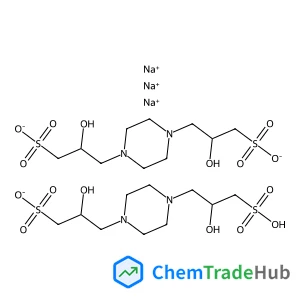
3,3'-(Piperazine-1,4-diyl)bis(2-hydroxypropane-1-sulfonic acid) Sodium Salt
CAS Number:
108321-08-0
Molecular Formula:
C20H41N4Na3O16S4
Recommended Suppliers




Disclaimer
This page provides academic journal information for reference and research purposes only. We are not affiliated with any journal publishers and do not handle publication submissions. For publication-related inquiries, please contact the respective journal publishers directly.
If you notice any inaccuracies in the information displayed, please contact us at support@chemtradehub.com. We will promptly review and address your concerns.