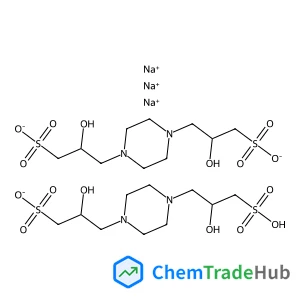
3,3'-(Piperazine-1,4-diyl)bis(2-hydroxypropane-1-sulfonic acid) Sodium Salt
CAS Number:
108321-08-0
Molecular Formula:
C20H41N4Na3O16S4
Niels Boon, Peter Schurtenberger
A heterogeneous distribution of crosslinker in micro-hydrogels (microgels) results in a non-uniform polymer density inside the particles. Identifying the morphology of the hydrogel backbone enables a bottom-up approach towards the structural and rheological properties of microgel systems. On a local level we use a Flory–Rehner inspired model that focuses on highly swollen networks, characterized by a Poisson's ratio of 1/4. Our ab initio calculations take account for the nonuniform distribution of crosslinker species during the synthesis of poly(N-isopropylacylamide) (PNIPAM) microgels, yet the method is also applicable to other microgel architectures. We recover a single-particle density profile that is in close agreement with SAXS data. Comparison with experimental data confirms that the surface of the cross-linked particle is decorated with dangling polymers ends of considerable size.

Journal of Peptide Science

Russian Journal of General Chemistry

Saudi Pharmaceutical Journal

Russian Chemical Bulletin

New Journal of Chemistry

Acta Materialia

Russian Journal of Applied Chemistry

Russian Journal of Coordination Chemistry

Current Opinion in Solid State & Materials Science

Current Opinion in Colloid & Interface Science
Junwen Peng, Junli Xu, Zhaoyu Wang, Zhengxin Ding, Sibo Wang
DOI: 10.1039/C7CP05147F
Marie-Paule Pileni
DOI: 10.1039/C7CP02649H
Zongyuan Liu, Carl O. Trindle, Quanli Gu, Wei Wu, Peifeng Su
DOI: 10.1039/C7CP03491A
Oleg I. Gnezdilov, Nicklas Hjalmarsson, Oleg N. Antzutkin, István Furó
DOI: 10.1039/C7CP01772C
Niels Boon, Peter Schurtenberger
DOI: 10.1039/C7CP02434G
Mo-Ran Wang, Xiang-Yang Ren, Nian-Ke Chen, Hong-Bo Sun
DOI: 10.1039/C7CP05034H
Shiyan Wang, Xilin Zhang, Yanxing Zhang, Jianjun Mao
DOI: 10.1039/C7CP05756C
Miguel de Abreu, Lyndsey J. Ferguson, Derek J. Quinn, Thomas S. Moody, Meilan Huang
DOI: 10.1039/C7CP03640J
Huiyun Zhang, Guixian Liu, Yanqiang Cao, Jing Chen, Kai Shen, Ashwini Kumar, Mingxiang Xu, Qi Li
DOI: 10.1039/C7CP03470A
Adam Czajka, Christopher Hill, Jocelyn Peach, Jonathan C. Pegg, Isabelle Grillo, Frédéric Guittard, Sarah E. Rogers, Masanobu Sagisaka, Julian Eastoe
DOI: 10.1039/C7CP02570J
3-Fluoro-2-methylbenzylamine is an organic compound with the CAS number 771573-3...
Tert-butyl 2-(oxetan-3-ylidene)acetate is considered safe for its intended uses ...
Proper personal protective equipment (PPE) such as gloves, goggles, and a lab co...
2-Ethyl-4-methyl-1,3-thiazole is commonly synthesized via the reaction of thiour...
This compound should be stored in a cool, dry place away from direct sunlight an...
L-Lysine Acetate Salt (CAS: 52315-92-1) is subject to various regulatory guideli...
6-Fluoro-3-hydroxy-2-pyrazinecarboxamide (CAS: 259793-96-9) is generally conside...
1,1'-Sulfonylbis(1H-imidazole) is a crystalline solid with a molecular weight of...
4-Methyl-7-nitro-1H-indole-3-carbonitrile (CAS: 289483-82-5) is primarily used i...
Waste containing 5-Bromo-3-indolyl-beta-galactoside (CAS: 97753-82-7) should be ...

Physical Chemistry Chemical Physics (PCCP) is an international journal co-owned by 19 physical chemistry and physics societies from around the world. This journal publishes original, cutting-edge research in physical chemistry, chemical physics and biophysical chemistry. To be suitable for publication in PCCP, articles must include significant innovation and/or insight into physical chemistry; this is the most important criterion that reviewers and Editors will judge against when evaluating submissions. The journal has a broad scope and welcomes contributions spanning experiment, theory, computation and data science. Topical coverage includes spectroscopy, dynamics, kinetics, statistical mechanics, thermodynamics, electrochemistry, catalysis, surface science, quantum mechanics, quantum computing and machine learning. Interdisciplinary research areas such as polymers and soft matter, materials, nanoscience, energy, surfaces/interfaces, and biophysical chemistry are welcomed if they demonstrate significant innovation and/or insight into physical chemistry. Joined experimental/theoretical studies are particularly appreciated when complementary and based on up-to-date approaches.
![trans,trans-4-n-Propyl-4-[4-(trifluoromethoxy)phenyl]bicyclohexyl structure](https://static.chemtradehub.com/structs/133/133937-72-1-25ef.webp "trans,trans-4-n-Propyl-4-[4-(trifluoromethoxy)phenyl]bicyclohexyl structure")
![5-(2-Phenylpyrazolo[1,5-a]pyridin-3-yl)-2H-pyrazolo[3,4-c]pyridazin-3-amine structure](https://static.chemtradehub.com/structs/865/865362-74-9-0091.webp "5-(2-Phenylpyrazolo[1,5-a]pyridin-3-yl)-2H-pyrazolo[3,4-c]pyridazin-3-amine structure")