


Unified elucidation of the entropy-driven and -opposed hydrophobic effects
Literature Information
Publication Date
2017-09-05
DOI
10.1039/C7CP05160C
Impact Factor
3.676
Authors
Masahiro Kinoshita, Tomohiko Hayashi
View Original
Abstract
The association of nonpolar solutes is generally believed to be entropy driven, which has been shown to be true for the contact of small molecules, ellipsoids, and plates. However, it has been reported with surprise that a model cavity–ligand binding is entropy opposed. How can these apparently conflicting behaviors be elucidated? Here, we calculate the potential of mean force between hard-sphere solutes with various diameters in water and its entropic and enthalpic components using a statistical–mechanical theory for molecular liquids. It is shown that there is a very wide region where both of the two components are negative and large with the entropy–enthalpy compensation. Even for spheres, their contact is weakly entropy opposed when they are medium-sized. The entropic component (EC) is decomposed into physically insightful constituents with the aid of our morphometric approach. They provide us with useful information on the signs and magnitudes of contributions from the structural difference between the water near a single solute surface and that within the space confined between two solute surfaces and from the total volume available for the translational displacement of water molecules in the system. The decomposition enables us to identify the essential factors for discussing the EC: the hydrogen-bonding properties and density structure of the water within the confined space and the degree of water crowding in the bulk. These are largely dependent on the geometric characteristics of the solute pair such as solute shape, size, and intersolute distance. Both of the entropy-driven and -opposed hydrophobic effects can be explained within the same theoretical framework.
Recommended Journals

New Journal of Chemistry

Current Opinion in Solid State & Materials Science

Russian Journal of Bioorganic Chemistry

Saudi Pharmaceutical Journal

Russian Chemical Bulletin

Russian Journal of General Chemistry

Crystallography Reports

Journal of Peptide Science

Russian Journal of Coordination Chemistry

Russian Journal of Applied Chemistry
Related Literature
The emergent intramolecular hydrogen bonding effect on the electronic structures of organic electron acceptors
Takashi Takeda, Yasutaka Suzuki, Jun Kawamata, Shin-ichiro Noro, Takayoshi Nakamura, Tomoyuki Akutagawa
2017-08-07
Communication
DOI: 10.1039/C7CP04402J
The influence of polyanion molecular weight on polyelectrolyte multilayers at surfaces: elasticity and susceptibility to saloplasticity of strongly dissociated synthetic polymers at fluid–fluid interfaces
Wen-Fei Dong, James K. Ferri
2017-06-30
Paper
DOI: 10.1039/C7CP02614E
The magnetic and adsorption properties of ZnO1−xSx nanoparticles
Huiyun Zhang, Guixian Liu, Yanqiang Cao, Jing Chen, Kai Shen, Ashwini Kumar, Mingxiang Xu, Qi Li
2017-09-12
Paper
DOI: 10.1039/C7CP03470A
Unravelling hydrogen bonding interactions of tryptamine–water dimer from neutral to cation
Zongyuan Liu, Carl O. Trindle, Quanli Gu, Wei Wu, Peifeng Su
2017-08-04
Paper
DOI: 10.1039/C7CP03491A
Developing an efficient NiCo2S4 cocatalyst for improving the visible light H2 evolution performance of CdS nanoparticles
Junwen Peng, Junli Xu, Zhaoyu Wang, Zhengxin Ding, Sibo Wang
2017-09-11
Paper
DOI: 10.1039/C7CP05147F
Redistribution of valence and conduction band states depending on the method of modification of SiO2 structure
A. S. Konashuk, E. O. Filatova
2017-09-07
Paper
DOI: 10.1039/C7CP04914E
Probing the solvation structure and dynamics in ionic liquids by time-resolved infrared spectroscopy of 4-(dimethylamino)benzonitrile
Rômulo A. Ando, Samantha E. Brown-Xu, Lisa N. Q. Nguyen, Terry L. Gustafson
2017-09-04
Paper
DOI: 10.1039/C7CP04961G
A study on the electronic and interfacial structures of monolayer ReS2–metal contacts
Guofeng Yang, Rui Sun, Pengfei Yan, Yanan Lu, Junjun Xue, Guoqing Chen
2017-09-14
Paper
DOI: 10.1039/C7CP05386J
One-step formulation of nonionic surfactant bicelles (NSBs) by a double-tailed polyglycerol-type nonionic surfactant
Kenji Aramaki, Chikahiro Iwata, Jitendra Mata, Tetsuya Maehara, Daisuke Aburano, Yuichi Sakanishi, Kyuhei Kitao
2017-05-09
Paper
DOI: 10.1039/C7CP02585H
You might also like
Compound Q&A
What is 3-Fluoro-2-methylbenzylamine (CAS: 771573-36-5)?
3-Fluoro-2-methylbenzylamine is an organic compound with the CAS number 771573-3...
771573-36-53-Fluoro-2-methylben...
Compound Q&A
Is Tert-butyl 2-(oxetan-3-ylidene)acetate (CAS: 1207175-03-8) safe?
Tert-butyl 2-(oxetan-3-ylidene)acetate is considered safe for its intended uses ...
1207175-03-8Tert-butyl 2-(oxetan...
Compound Q&A
What precautions should be taken when handling 4-Acetyl-2-fluorobenzonitrile (CAS: 214760-18-6)?
Proper personal protective equipment (PPE) such as gloves, goggles, and a lab co...
214760-18-64-Acetyl-2-fluoroben...
Compound Q&A
How is 2-Ethyl-4-methyl-1,3-thiazole (CAS: 15679-12-6) typically synthesized?
2-Ethyl-4-methyl-1,3-thiazole is commonly synthesized via the reaction of thiour...
15679-12-62-Ethyl-4-methyl-1,3...
Compound Q&A
How should 5',5''-([2,2'-Bithiophene]-5,5'-diyl)bis(([1,1':3',1''-terphenyl]-4,4''-dicarboxylic acid)) (CAS: 1227780-71-3) be stored?
This compound should be stored in a cool, dry place away from direct sunlight an...
1227780-71-35',5''''-([2,2'-Bith...
Compound Q&A
What regulatory guidelines apply to L-Lysine Acetate Salt (CAS: 52315-92-1)?
L-Lysine Acetate Salt (CAS: 52315-92-1) is subject to various regulatory guideli...
52315-92-1L-LYSINE ACETATE SAL...
Compound Q&A
Is 6-Fluoro-3-hydroxy-2-pyrazinecarboxamide (CAS: 259793-96-9) safe?
6-Fluoro-3-hydroxy-2-pyrazinecarboxamide (CAS: 259793-96-9) is generally conside...
259793-96-96-Fluoro-3-hydroxy-2...
Compound Q&A
What are the physical and chemical properties of 1,1'-Sulfonylbis(1H-imidazole) (CAS: 7189-69-7)?
1,1'-Sulfonylbis(1H-imidazole) is a crystalline solid with a molecular weight of...
7189-69-71,1'-Sulfonylbis(1H-...
Compound Q&A
What industries use 4-methyl-7-nitro-1H-indole-3-carbonitrile (CAS: 289483-82-5)?
4-Methyl-7-nitro-1H-indole-3-carbonitrile (CAS: 289483-82-5) is primarily used i...
289483-82-54-methyl-7-nitro-1H-...
Compound Q&A
How should waste containing 5-Bromo-3-indolyl-beta-galactoside (CAS: 97753-82-7) be handled?
Waste containing 5-Bromo-3-indolyl-beta-galactoside (CAS: 97753-82-7) should be ...
97753-82-75-Bromo-3-indolyl-be...
Source Journal
Physical Chemistry Chemical Physics

CiteScore:
5.5
Self-citation Rate:
10.3%
Articles per Year:
3036
Physical Chemistry Chemical Physics (PCCP) is an international journal co-owned by 19 physical chemistry and physics societies from around the world. This journal publishes original, cutting-edge research in physical chemistry, chemical physics and biophysical chemistry. To be suitable for publication in PCCP, articles must include significant innovation and/or insight into physical chemistry; this is the most important criterion that reviewers and Editors will judge against when evaluating submissions. The journal has a broad scope and welcomes contributions spanning experiment, theory, computation and data science. Topical coverage includes spectroscopy, dynamics, kinetics, statistical mechanics, thermodynamics, electrochemistry, catalysis, surface science, quantum mechanics, quantum computing and machine learning. Interdisciplinary research areas such as polymers and soft matter, materials, nanoscience, energy, surfaces/interfaces, and biophysical chemistry are welcomed if they demonstrate significant innovation and/or insight into physical chemistry. Joined experimental/theoretical studies are particularly appreciated when complementary and based on up-to-date approaches.
Recommended Compounds
![(1S,4aR,5R,7S,7aS)-1-(beta-D-Glucopyranosyloxy)-5-hydroxy-7-methyl-1,4a,5,6,7,7a-hexahydrocyclopenta[c]pyran-7-yl alpha-D-galactopyranoside structure](https://static.chemtradehub.com/structs/817/81720-07-2-4ffd.webp "(1S,4aR,5R,7S,7aS)-1-(beta-D-Glucopyranosyloxy)-5-hydroxy-7-methyl-1,4a,5,6,7,7a-hexahydrocyclopenta[c]pyran-7-yl alpha-D-galactopyranoside structure")
(1S,4aR,5R,7S,7aS)-1-(beta-D-Glucopyranosyloxy)-5-hydroxy-7-methyl-1,4a,5,6,7,7a-hexahydrocyclopenta[c]pyran-7-yl alpha-D-galactopyranoside
CAS Number:
81720-07-2
Molecular Formula:
C21H34O14
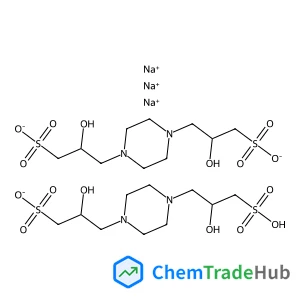
3,3'-(Piperazine-1,4-diyl)bis(2-hydroxypropane-1-sulfonic acid) Sodium Salt
CAS Number:
108321-08-0
Molecular Formula:
C20H41N4Na3O16S4
![2,4,5-Trichloro-7H-pyrrolo[2,3-d]pyrimidine structure](https://static.chemtradehub.com/structs/105/1053228-28-6-fba3.webp "2,4,5-Trichloro-7H-pyrrolo[2,3-d]pyrimidine structure")
Recommended Suppliers






Disclaimer
This page provides academic journal information for reference and research purposes only. We are not affiliated with any journal publishers and do not handle publication submissions. For publication-related inquiries, please contact the respective journal publishers directly.
If you notice any inaccuracies in the information displayed, please contact us at support@chemtradehub.com. We will promptly review and address your concerns.