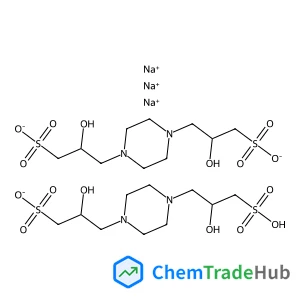
3,3'-(Piperazine-1,4-diyl)bis(2-hydroxypropane-1-sulfonic acid) Sodium Salt
CAS Number:
108321-08-0
Molecular Formula:
C20H41N4Na3O16S4
Georg Ehlers, Joerg C. Neuefeind, Souleymane O. Diallo, Christopher B. Stanley, Luke Daemen
In liquids, the ability of neighboring molecules to rearrange and jostle past each other is directly related to viscosity, the property which describes the propensity to flow. The presence of hydrogen bonds (H-bonds) complicates the molecular scale picture of viscosity. H-Bonds are attractive, directional interactions between molecules which, in some cases, result in transient network structures. In this work, we use experimental and computational methods to demonstrate that the timescale of H-bond network reorganization is the dominant dynamical timescale associated with viscosity for the case of the model H-bonding liquid n-methylacetamide (NMA). This molecule is a peptide analog which forms a transient linear H-bond network. Individual H-bond lifetimes and dynamical fluctuations were observed on the timescale of 1.5 ps, while collective motions and the longest lived population of H-bond partner lifetimes were observed on the order of 20 ps, in agreement with the Maxwell relaxation time. This identifies a mechanism which may aid in understanding the emergence of various complex phenomena arising from transient molecular structures, with implications ranging from the internal dynamics of proteins, to the glass transition, to better understanding the origins of the unique properties of H-bonding liquids.
Markus Doerr, Martha C. Daza
DOI: 10.1039/C7CP03930A
Oleg I. Gnezdilov, Nicklas Hjalmarsson, Oleg N. Antzutkin, István Furó
DOI: 10.1039/C7CP01772C
David Biedermann, Kateřina Valentová, Vladimír Křen, Martin Kubala
DOI: 10.1039/C7CP03845C
Kenji Aramaki, Chikahiro Iwata, Jitendra Mata, Tetsuya Maehara, Daisuke Aburano, Yuichi Sakanishi, Kyuhei Kitao
DOI: 10.1039/C7CP02585H
Junbai Li, Krister Holmberg
DOI: 10.1039/C7CP90152F
DOI: 10.1039/C7CP04068G
Adam Czajka, Christopher Hill, Jocelyn Peach, Jonathan C. Pegg, Isabelle Grillo, Frédéric Guittard, Sarah E. Rogers, Masanobu Sagisaka, Julian Eastoe
DOI: 10.1039/C7CP02570J
Mireia Via-Nadal
DOI: 10.1039/C7CP03349D
Sebastian Krickl, Thomas Buchecker, Andreas Uwe Meyer, Isabelle Grillo, Didier Touraud, Pierre Bauduin, Burkhard König, Arno Pfitzner, Werner Kunz
DOI: 10.1039/C7CP02134H
3-Fluoro-2-methylbenzylamine is an organic compound with the CAS number 771573-3...
Tert-butyl 2-(oxetan-3-ylidene)acetate is considered safe for its intended uses ...
Proper personal protective equipment (PPE) such as gloves, goggles, and a lab co...
2-Ethyl-4-methyl-1,3-thiazole is commonly synthesized via the reaction of thiour...
This compound should be stored in a cool, dry place away from direct sunlight an...
L-Lysine Acetate Salt (CAS: 52315-92-1) is subject to various regulatory guideli...
6-Fluoro-3-hydroxy-2-pyrazinecarboxamide (CAS: 259793-96-9) is generally conside...
1,1'-Sulfonylbis(1H-imidazole) is a crystalline solid with a molecular weight of...
4-Methyl-7-nitro-1H-indole-3-carbonitrile (CAS: 289483-82-5) is primarily used i...
Waste containing 5-Bromo-3-indolyl-beta-galactoside (CAS: 97753-82-7) should be ...

Physical Chemistry Chemical Physics (PCCP) is an international journal co-owned by 19 physical chemistry and physics societies from around the world. This journal publishes original, cutting-edge research in physical chemistry, chemical physics and biophysical chemistry. To be suitable for publication in PCCP, articles must include significant innovation and/or insight into physical chemistry; this is the most important criterion that reviewers and Editors will judge against when evaluating submissions. The journal has a broad scope and welcomes contributions spanning experiment, theory, computation and data science. Topical coverage includes spectroscopy, dynamics, kinetics, statistical mechanics, thermodynamics, electrochemistry, catalysis, surface science, quantum mechanics, quantum computing and machine learning. Interdisciplinary research areas such as polymers and soft matter, materials, nanoscience, energy, surfaces/interfaces, and biophysical chemistry are welcomed if they demonstrate significant innovation and/or insight into physical chemistry. Joined experimental/theoretical studies are particularly appreciated when complementary and based on up-to-date approaches.