













Pattern transitions in a compressible floating elastic sheet
Literature Information
Publication Date
2017-06-14
DOI
10.1039/C7CP03239K
Impact Factor
3.676
Authors
Haim Diamant
View Original
Abstract
Thin rigid sheets floating on a liquid substrate appear, for example, in coatings and surfactant monolayers. Upon uniaxial compression the sheet undergoes transitions from a compressed flat state to a periodic wrinkled pattern to a localized folded pattern. The stability of these states is determined by the in-plane elasticity of the sheet, its bending rigidity, and the hydrostatics of the underlying liquid. Wrinkles and folds, and the wrinkle-to-fold transition, were previously studied for incompressible sheets. In the present work we extend the theory to include finite compressibility. We analyze the details of the flat-to-wrinkle transition, the effects of compressibility on wrinkling and folding, and the compression field associated with pattern formation. The state diagram of the floating sheet including all three states is presented.
Recommended Journals
Related Literature
Pattern transitions in a compressible floating elastic sheet
Haim Diamant
2017-06-14
Paper
DOI: 10.1039/C7CP03239K
Molecular dynamics investigations of an indicator displacement assay mechanism in a liquid crystal sensor
Qingyu Liu, Fang Zuo, Zhigang Zhao, Junxian Chen, Dingguo Xu
2017-08-11
Paper
DOI: 10.1039/C7CP02292A
Catalytic mechanism of phenylacetone monooxygenases for non-native linear substrates
Miguel de Abreu, Lyndsey J. Ferguson, Derek J. Quinn, Thomas S. Moody, Meilan Huang
2017-09-07
Paper
DOI: 10.1039/C7CP03640J
Enhanced interfacial activity of multi-arm poly(ethylene oxide) star polymers relative to linear poly(ethylene oxide) at fluid interfaces
Yun-Ru Huang, Melissa Lamson, Krzysztof Matyjaszewski
2017-07-10
Paper
DOI: 10.1039/C7CP02841E
Self-assembled mesoscopic surface domains of fluorocarbon–hydrocarbon diblocks can form at zero surface pressure: tilting of solid-like hydrocarbon moieties compensates for cross-section mismatch with fluorocarbon moieties
Christian Schwieger, Xianhe Liu, Marie Pierre Krafft
2017-05-30
Paper
DOI: 10.1039/C7CP02432K
Combined use of EPR and 23Na MAS NMR spectroscopy for assessing the properties of the mixed cobalt–nickel–manganese layers of P3-NayCo1−2xNixMnxO2
M. Kalapsazova, S. Ivanova, R. Kukeva, S. Simova, S. Wegner, E. Zhecheva, R. Stoyanova
2017-09-08
Paper
DOI: 10.1039/C7CP04849A
SO3 formation from the X-ray photolysis of SO2 astrophysical ice analogues: FTIR spectroscopy and thermodynamic investigations
Víctor de Souza Bonfim, Roberto Barbosa de Castilho, Leonardo Baptista
2017-09-19
Paper
DOI: 10.1039/C7CP03679E
The magnetic and adsorption properties of ZnO1−xSx nanoparticles
Huiyun Zhang, Guixian Liu, Yanqiang Cao, Jing Chen, Kai Shen, Ashwini Kumar, Mingxiang Xu, Qi Li
2017-09-12
Paper
DOI: 10.1039/C7CP03470A
You might also like
Compound Q&A
What is 3-Fluoro-2-methylbenzylamine (CAS: 771573-36-5)?
3-Fluoro-2-methylbenzylamine is an organic compound with the CAS number 771573-3...
771573-36-53-Fluoro-2-methylben...
Compound Q&A
Is Tert-butyl 2-(oxetan-3-ylidene)acetate (CAS: 1207175-03-8) safe?
Tert-butyl 2-(oxetan-3-ylidene)acetate is considered safe for its intended uses ...
1207175-03-8Tert-butyl 2-(oxetan...
Compound Q&A
What precautions should be taken when handling 4-Acetyl-2-fluorobenzonitrile (CAS: 214760-18-6)?
Proper personal protective equipment (PPE) such as gloves, goggles, and a lab co...
214760-18-64-Acetyl-2-fluoroben...
Compound Q&A
How is 2-Ethyl-4-methyl-1,3-thiazole (CAS: 15679-12-6) typically synthesized?
2-Ethyl-4-methyl-1,3-thiazole is commonly synthesized via the reaction of thiour...
15679-12-62-Ethyl-4-methyl-1,3...
Compound Q&A
How should 5',5''-([2,2'-Bithiophene]-5,5'-diyl)bis(([1,1':3',1''-terphenyl]-4,4''-dicarboxylic acid)) (CAS: 1227780-71-3) be stored?
This compound should be stored in a cool, dry place away from direct sunlight an...
1227780-71-35',5''''-([2,2'-Bith...
Compound Q&A
What regulatory guidelines apply to L-Lysine Acetate Salt (CAS: 52315-92-1)?
L-Lysine Acetate Salt (CAS: 52315-92-1) is subject to various regulatory guideli...
52315-92-1L-LYSINE ACETATE SAL...
Compound Q&A
Is 6-Fluoro-3-hydroxy-2-pyrazinecarboxamide (CAS: 259793-96-9) safe?
6-Fluoro-3-hydroxy-2-pyrazinecarboxamide (CAS: 259793-96-9) is generally conside...
259793-96-96-Fluoro-3-hydroxy-2...
Compound Q&A
What are the physical and chemical properties of 1,1'-Sulfonylbis(1H-imidazole) (CAS: 7189-69-7)?
1,1'-Sulfonylbis(1H-imidazole) is a crystalline solid with a molecular weight of...
7189-69-71,1'-Sulfonylbis(1H-...
Compound Q&A
What industries use 4-methyl-7-nitro-1H-indole-3-carbonitrile (CAS: 289483-82-5)?
4-Methyl-7-nitro-1H-indole-3-carbonitrile (CAS: 289483-82-5) is primarily used i...
289483-82-54-methyl-7-nitro-1H-...
Compound Q&A
How should waste containing 5-Bromo-3-indolyl-beta-galactoside (CAS: 97753-82-7) be handled?
Waste containing 5-Bromo-3-indolyl-beta-galactoside (CAS: 97753-82-7) should be ...
97753-82-75-Bromo-3-indolyl-be...
Source Journal
Physical Chemistry Chemical Physics

CiteScore:
5.5
Self-citation Rate:
10.3%
Articles per Year:
3036
Physical Chemistry Chemical Physics (PCCP) is an international journal co-owned by 19 physical chemistry and physics societies from around the world. This journal publishes original, cutting-edge research in physical chemistry, chemical physics and biophysical chemistry. To be suitable for publication in PCCP, articles must include significant innovation and/or insight into physical chemistry; this is the most important criterion that reviewers and Editors will judge against when evaluating submissions. The journal has a broad scope and welcomes contributions spanning experiment, theory, computation and data science. Topical coverage includes spectroscopy, dynamics, kinetics, statistical mechanics, thermodynamics, electrochemistry, catalysis, surface science, quantum mechanics, quantum computing and machine learning. Interdisciplinary research areas such as polymers and soft matter, materials, nanoscience, energy, surfaces/interfaces, and biophysical chemistry are welcomed if they demonstrate significant innovation and/or insight into physical chemistry. Joined experimental/theoretical studies are particularly appreciated when complementary and based on up-to-date approaches.
Recommended Compounds
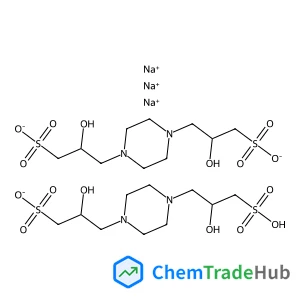
3,3'-(Piperazine-1,4-diyl)bis(2-hydroxypropane-1-sulfonic acid) Sodium Salt
CAS Number:
108321-08-0
Molecular Formula:
C20H41N4Na3O16S4

Recommended Suppliers





Disclaimer
This page provides academic journal information for reference and research purposes only. We are not affiliated with any journal publishers and do not handle publication submissions. For publication-related inquiries, please contact the respective journal publishers directly.
If you notice any inaccuracies in the information displayed, please contact us at support@chemtradehub.com. We will promptly review and address your concerns.