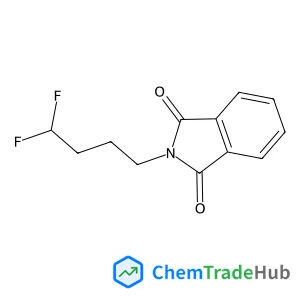
2-(4,4-Difluorobutyl)-1H-isoindole-1,3(2H)-dione
CAS Number:
1265341-14-7
Molecular Formula:
C12H11F2NO2
Julien Diharce, Jérôme Golebiowski, Sébastien Fiorucci, Serge Antonczak
In the course of metabolite formation, some multienzymatic edifices, the so-called metabolon, are formed and lead to a more efficient production of these natural compounds. One of the major features of these enzyme complexes is the facilitation of direct transfer of the metabolite between enzyme active sites by substrate channelling. Biophysical insights into substrate channelling remain scarce because the transient nature of these macromolecular complexes prevents the observation of high resolution structures. Here, using molecular modelling, we describe the substrate channelling of a flavonoid compound between DFR (dihydroflavonol-4-reductase) and LAR (leucoanthocyanidin reductase). The simulation presents crucial details concerning the kinetic, thermodynamic, and structural aspects of this diffusion. The formation of the DFR–LAR complex leads to the opening of the DFR active site giving rise to a facilitated diffusion, in about 1 μs, of the DFR product towards LAR cavity. The theoretically observed substrate channelling is supported experimentally by the fact that this metabolite, i.e. the product of the DFR enzyme, is not stable in the media. Moreover, along this path, the influence of the solvent is crucial. The metabolite remains close to the surface of the complex avoiding full solvation. In addition, when the dynamic behaviour of the system leads to a loss of interaction between the metabolite and the enzymes, water molecules through bridging H-bonds prevent the former from escaping to the bulk.
Magali Duvail, Jean-François Dufrêche, Lise Arleth, Thomas Zemb
DOI: 10.1039/C3CP43981J
Martin Thomas, Martin Brehm, Reinhold Fligg, Peter Vöhringer, Barbara Kirchner
DOI: 10.1039/C3CP44302G
Yimin Cui, Wei Liu, Rongming Wang
DOI: 10.1039/C3CP00132F
Yi Yang, Dan Xie, Tian-Ling Ren, Yi Shu, Hui Sun, Chang-Jian Zhou, Xuan Liu, Lu-Qi Tao, Jie Ge, Cang-Hai Zhang, Yuegang Zhang
DOI: 10.1039/C3CP50538C
Stephanie J. Harris, Daniel Murdock, Yuyuan Zhang, Thomas A. A. Oliver, Michael P. Grubb, Andrew J. Orr-Ewing, Gregory M. Greetham, Ian P. Clark, Michael Towrie, Stephen E. Bradforth, Michael N. R. Ashfold
DOI: 10.1039/C3CP50756D
Jie Jiang, Xinghui Wang, Qing Zhang, Jingqi Li, X. X. Zhang
DOI: 10.1039/C3CP50197C
Dominik Oschetzki, Xiaoqing Zeng, Helmut Beckers, Klaus Banert, Guntram Rauhut
DOI: 10.1039/C3CP50268F
Alex Domingo, Martin Vérot, Fernando Mota, Juan J. Novoa, Vincent Robert
DOI: 10.1039/C3CP44647F
Ryusuke Futamura, Miguel Jorge, José R. B. Gomes
DOI: 10.1039/C3CP50193K
N-(4-Methoxybenzyl)-2-pyridinamine (CAS: 52818-63-0) is increasingly being used ...
When handling Ethyl 4-(2-chlorophenyl)-1,3-thiazole-2-carboxylate, appropriate p...
Diethyldiselane (CAS: 628-39-7) is classified under the Globally Harmonized Syst...
The market for oxocopper (CAS: 12053-18-8) is primarily driven by its use in cat...
The market for 5-{[(2-Methyl-2-propanyl)oxy]carbonyl}-5-azaspiro[2.4]heptane-7-c...
2-(1-Pyrrolidinyl)-4-pyridinamine is a chemical compound with the CAS number 359...
2-(3-Pyridinyl)-1-azabicyclo[2.2.2]octane (CAS: 91556-75-1) is a crystalline sol...
(S)-Alpha-allyl-proline hydrochloride is usually synthesized via a Wittig reacti...
3-Methyl-1,2-oxazole-5-carboxylic acid (CAS: 4857-42-5) is an organic compound w...
Lys-SMCC-DM1 is synthesized via a multi-step process involving the coupling of S...

Physical Chemistry Chemical Physics (PCCP) is an international journal co-owned by 19 physical chemistry and physics societies from around the world. This journal publishes original, cutting-edge research in physical chemistry, chemical physics and biophysical chemistry. To be suitable for publication in PCCP, articles must include significant innovation and/or insight into physical chemistry; this is the most important criterion that reviewers and Editors will judge against when evaluating submissions. The journal has a broad scope and welcomes contributions spanning experiment, theory, computation and data science. Topical coverage includes spectroscopy, dynamics, kinetics, statistical mechanics, thermodynamics, electrochemistry, catalysis, surface science, quantum mechanics, quantum computing and machine learning. Interdisciplinary research areas such as polymers and soft matter, materials, nanoscience, energy, surfaces/interfaces, and biophysical chemistry are welcomed if they demonstrate significant innovation and/or insight into physical chemistry. Joined experimental/theoretical studies are particularly appreciated when complementary and based on up-to-date approaches.
![1-[6-(1H-Imidazol-1-yl)-3-pyridinyl]methanamine structure](https://static.chemtradehub.com/structs/914/914637-08-4-8825.webp "1-[6-(1H-Imidazol-1-yl)-3-pyridinyl]methanamine structure")