












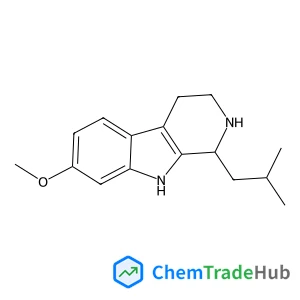
1-Isobutyl-7-methoxy-2,3,4,9-tetrahydro-1H-beta-carboline
CAS Number:
175975-76-5
Molecular Formula:
C16H22N2O
Alex Domingo, Martin Vérot, Fernando Mota, Juan J. Novoa, Vincent Robert
The mutual influence of electronic structure and environment of the constituent units of neutral organic radical-based materials (radical dimers) is analysed by means of wave function calculations (Difference Dedicated Configuration Interaction, DDCI). Focus is put on the magnetic property modulations of two classes of neutral organic materials by inspecting both short- and long-range effects. The exchange coupling constant J for the high-temperature phase of the 1,3,5-trithia-2,4,6-triazapentalenyl (TTTA) material is calculated to be J= −95 cm−1 at the DDCI level. The environmental electronic polarization is taken into account self-consistently using the individual polarizabilities of the atoms in a finite block of the crystal lattice (Discrete Reaction Field, DRF) and accounts for less than 5% of the calculated J value in TTTA. Furthermore, taking advantage of the chemical flexibility of the verdazyl radical family, the contribution of strong electron-withdrawing groups is analysed by extracting the J, U, t and K parameters from pairs of substituted verdazyl-based radicals. Our ab initio calculations of verdazyl radical pairs suggest that the addition of NO2 groups cause (i) the variations of the ferromagnetic and antiferromagnetic contributions to cancel out, leaving an almost constant exchange coupling constant, ca. J ≈ 20 cm−1, and that (ii) enhanced conduction properties can be anticipated. In contrast to inorganic analogues, one may conclude that the magnetic behaviour of neutral organic radical-based materials is mostly governed by the supramolecular arrangement, whereas environmental effects have a lesser impact.
Anke Horneber, Anne-Laure Baudrion, Pierre-Michel Adam, Alfred J. Meixner, Dai Zhang
DOI: 10.1039/C3CP43349H
Sergey Sirotin, Philippe Bazin, Françoise Maugé, Arnaud Travert
DOI: 10.1039/C3CP51146D
Kwan Kim, Kyung Lock Kim, Kuan Soo Shin
DOI: 10.1039/C3CP51204E
Damien Thompson, Mateusz Sikora, Piotr Szymczak, Marek Cieplak
DOI: 10.1039/C3CP50523E
S. Sasanka Kumar, Manoj Komath, Manoj Raama Varma, M. K. Jayaraj, K. Rajeev Kumar
DOI: 10.1039/C3CP42648C
Ane K. di Gennaro, Leonid Gurevich, Esben Skovsen, Michael T. Overgaard, Peter Fojan
DOI: 10.1039/C3CP50742D
Gabriel J. Cuello, Shinji Kohara, Chris J. Benmore, David L. Price, Eugene Bychkov
DOI: 10.1039/C3CP50536G
Adrian H. Hill, Mattia Allieta
DOI: 10.1039/C3CP44322A
C. J. Benmore, M. C. Wilding, S. K. Tumber
DOI: 10.1039/C3CP44347G
N-(4-Methoxybenzyl)-2-pyridinamine (CAS: 52818-63-0) is increasingly being used ...
When handling Ethyl 4-(2-chlorophenyl)-1,3-thiazole-2-carboxylate, appropriate p...
Diethyldiselane (CAS: 628-39-7) is classified under the Globally Harmonized Syst...
The market for oxocopper (CAS: 12053-18-8) is primarily driven by its use in cat...
The market for 5-{[(2-Methyl-2-propanyl)oxy]carbonyl}-5-azaspiro[2.4]heptane-7-c...
2-(1-Pyrrolidinyl)-4-pyridinamine is a chemical compound with the CAS number 359...
2-(3-Pyridinyl)-1-azabicyclo[2.2.2]octane (CAS: 91556-75-1) is a crystalline sol...
(S)-Alpha-allyl-proline hydrochloride is usually synthesized via a Wittig reacti...
3-Methyl-1,2-oxazole-5-carboxylic acid (CAS: 4857-42-5) is an organic compound w...
Lys-SMCC-DM1 is synthesized via a multi-step process involving the coupling of S...

Physical Chemistry Chemical Physics (PCCP) is an international journal co-owned by 19 physical chemistry and physics societies from around the world. This journal publishes original, cutting-edge research in physical chemistry, chemical physics and biophysical chemistry. To be suitable for publication in PCCP, articles must include significant innovation and/or insight into physical chemistry; this is the most important criterion that reviewers and Editors will judge against when evaluating submissions. The journal has a broad scope and welcomes contributions spanning experiment, theory, computation and data science. Topical coverage includes spectroscopy, dynamics, kinetics, statistical mechanics, thermodynamics, electrochemistry, catalysis, surface science, quantum mechanics, quantum computing and machine learning. Interdisciplinary research areas such as polymers and soft matter, materials, nanoscience, energy, surfaces/interfaces, and biophysical chemistry are welcomed if they demonstrate significant innovation and/or insight into physical chemistry. Joined experimental/theoretical studies are particularly appreciated when complementary and based on up-to-date approaches.
![N-{15-[(2,5-Dioxo-1-pyrrolidinyl)oxy]-15-oxo-3,6,9,12-tetraoxapentadec-1-yl}-2-(2-propyn-1-yloxy)acetamide structure](https://static.chemtradehub.com/structs/210/2101206-92-0-2eb5.webp "N-{15-[(2,5-Dioxo-1-pyrrolidinyl)oxy]-15-oxo-3,6,9,12-tetraoxapentadec-1-yl}-2-(2-propyn-1-yloxy)acetamide structure")




