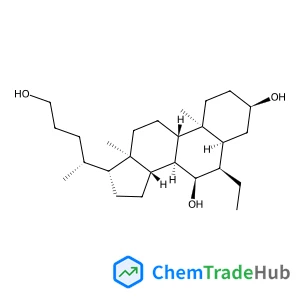
(3alpha,5beta,6alpha,7alpha)-6-Ethylcholane-3,7,24-triol
CAS Number:
1537866-49-1
Molecular Formula:
C26H46O3
Jian Wang, Ting Ting Wang, Peng Fei Gao, Cheng Zhi Huang
Biomolecules perform vital functions in biology. These functional biomolecules with diverse modifications hold great promise for further applications in bioanalysis and cancer therapy. However, these functional biomolecules face challenges, especially in the field of drug delivery for cancer therapy. For example, functional biomolecules are typically unstable when taken up by cells, as they are easily digested by enzymes. To address this obstacle, nanomaterials have been employed as drug carriers or vehicles, which are powerful nanoplatforms for imaging and cancer treatment. Multifunctionality of these nanoplatforms offers great advantages over conventional reagents, including targeting to a diseased site to minimize systemic toxicity, and the ability to solubilize hydrophobic or labile drugs to improved pharmacokinetics. In this review, we summarize typical functional biomolecule-conjugated nanomaterials for targeting drug delivery. Under the appropriate conditions, targeted drug delivery can be achieved from a high density of biomolecules that are bound to the surface of nanomaterials, resulting in a high affinity for the targets. The high density of biomolecules then leads to a high local concentration, being able to prevent degradation by enzymes. Furthermore, biomolecule–nanomaterial conjugates have been identified to enter cells more easily than free biomolecules, and controllable drug release can then be obtained by a response to a stimulus, such as redox, pH, light, thermal, enzyme-trigged strategies. Now and in the future, with the development of artificial biomolecules as well as nanomaterials, targeted drug delivery based on elegant biomolecule–nanomaterial conjugation approaches is expected to achieve great versatility, additional functions, and further advances.
Yang Zou, Wenlong Liu, Song Gao, Jingli Xie, Qingjin Meng
DOI: 10.1039/B308474D
Mark L. Hlavinka, John R. Hagadorn
DOI: 10.1039/B309732C
Yan Zhao, Bryce Sadtler, Min Lin, Gregory H. Hockerman, Alexander Wei
DOI: 10.1039/B317061F
Tatsuo Ishiyama, Yusuke Nobuta, John F. Hartwig, Norio Miyaura
DOI: 10.1039/B311103B
Ferdinando Bruno, Virinder S. Parmar, Jayant Kumar, Arthur C. Watterson, Kethinni G. Chittibabu, Lynne A. Samuelson
DOI: 10.1039/B400404C
Heng Xu, Erin M. Hampe, Dmitry M. Rudkevich
DOI: 10.1039/B309580K
Nam-Keun Oh, Wang-Cheol Zin, Jun-Hwan Im, Ja-Hyoung Ryu, Myongsoo Lee
DOI: 10.1039/B317109D
Hideki Amii, Yutaka Ichihara, Takashi Nakagawa, Takeshi Kobayashi, Kenji Uneyama
DOI: 10.1039/B309696C
Jonathan M. Stoddard, Kenneth J. Shea
DOI: 10.1039/B311292F
G. D. Kishore Kumar, Sundarababu Baskaran
DOI: 10.1039/B402371D
N-(4-Methoxybenzyl)-2-pyridinamine (CAS: 52818-63-0) is increasingly being used ...
When handling Ethyl 4-(2-chlorophenyl)-1,3-thiazole-2-carboxylate, appropriate p...
Diethyldiselane (CAS: 628-39-7) is classified under the Globally Harmonized Syst...
The market for oxocopper (CAS: 12053-18-8) is primarily driven by its use in cat...
The market for 5-{[(2-Methyl-2-propanyl)oxy]carbonyl}-5-azaspiro[2.4]heptane-7-c...
2-(1-Pyrrolidinyl)-4-pyridinamine is a chemical compound with the CAS number 359...
2-(3-Pyridinyl)-1-azabicyclo[2.2.2]octane (CAS: 91556-75-1) is a crystalline sol...
(S)-Alpha-allyl-proline hydrochloride is usually synthesized via a Wittig reacti...
3-Methyl-1,2-oxazole-5-carboxylic acid (CAS: 4857-42-5) is an organic compound w...
Lys-SMCC-DM1 is synthesized via a multi-step process involving the coupling of S...
Journal of Materials Chemistry A, B & C cover high quality studies across all fields of materials chemistry. The journals focus on those theoretical or experimental studies that report new understanding, applications, properties and synthesis of materials. The journals have a strong history of publishing quality reports of interest to interdisciplinary communities and providing an efficient and rigorous service through peer review and publication. The journals are led by an international team of Editors-in-Chief and Associate Editors who are all active researchers in their fields. Journal of Materials Chemistry A, B & C are separated by the intended application of the material studied. Broadly, applications in energy and sustainability are of interest to Journal of Materials Chemistry A, applications in biology and medicine are of interest to Journal of Materials Chemistry B, and applications in optical, magnetic and electronic devices are of interest to Journal of Materials Chemistry C. More than one Journal of Materials Chemistry journal may be suitable for certain fields and researchers are encouraged to submit their paper to the journal that they feel best fits for their particular article. Example topic areas within the scope of Journal of Materials Chemistry B are listed below. This list is neither exhaustive nor exclusive. Antifouling coatings Biocompatible materials Bioelectronics Bioimaging Biomimetics Biomineralisation Bionics Biosensors Diagnostics Drug delivery Gene delivery Immunobiology Nanomedicine Regenerative medicine & Tissue engineering Scaffolds Soft robotics Stem cells Therapeutic devices image block All articles published in Journal of Materials Chemistry B from 2019 onwards will be indexed in MEDLINE®. Articles that primarily focus on providing insight into the underlying science and performance of biomaterials within a biological environment are more suited to our companion journal, Biomaterials Science.
![1-oxaspiro[4.4]nonan-6-one structure](https://static.chemtradehub.com/structs/134/134179-01-4-e051.webp "1-oxaspiro[4.4]nonan-6-one structure")