












Unusual reactions of N-allylic difluoroenamines under thermal conditions
Literature Information
Publication Date
2003-10-20
DOI
10.1039/B309696C
Impact Factor
6.222
Authors
Hideki Amii, Yutaka Ichihara, Takashi Nakagawa, Takeshi Kobayashi, Kenji Uneyama
View Original
Abstract
N-Allylic difluoroenamines exhibited unusual behaviors under thermal conditions; N-allyl difluoroenamines in refluxing xylene afforded not only aza-Claisen rearrangement products, but also 2-azabicyclo[2.1.1]hexanes, whose formation could be explained via intramolecular [2+2]-cycloaddition, whilst N-prenyl difluoroenamine underwent an ene reaction to give the pyrrolidine as a sole product.
Related Literature
Photoelectrochemical reduction of aqueous protons with a CuO|CuBi2O4 heterojunction under visible light irradiation
Hyun S. Park, Chong-Yong Lee, Erwin Reisner
2014-09-05
Communication
DOI: 10.1039/C4CP03883E
Understanding the adsorption mechanism of noble gases Kr and Xe in CPO-27-Ni, CPO-27-Mg, and ZIF-8
O. V. Magdysyuk, F. Adams, H.-P. Liermann, I. Spanopoulos, P. N. Trikalitis, M. Hirscher, R. E. Morris, M. J. Duncan, L. J. McCormick, R. E. Dinnebier
2014-09-17
Paper
DOI: 10.1039/C4CP03298E
Atomic charge transfer-counter polarization effects determine infrared CH intensities of hydrocarbons: a quantum theory of atoms in molecules model
Arnaldo F. Silva, Wagner E. Richter, Helen G. C. Meneses, Roy E. Bruns
2014-09-25
Paper
DOI: 10.1039/C4CP02922D
Electron spin-polarization and spin lattices in the boron- and nitrogen-doped organic framework COF-5
Xiaobiao Liu, Jie Tan, Aizhu Wang, Xiaoming Zhang, Mingwen Zhao
2014-09-10
Paper
DOI: 10.1039/C4CP03478C
On subthreshold ionization of helium droplets, ejection of He+, and the role of anions
Michael Renzler, Matthias Daxner, Nikolaus Weinberger, Stephan Denifl, Paul Scheier
2014-09-12
Communication
DOI: 10.1039/C4CP03236E
Interfacial structure and orientation of confined ionic liquids on charged quartz surfaces
Yong-Lei Wang
2014-09-09
Paper
DOI: 10.1039/C4CP03077J
The catalytic reactions in the Cu–Li–Mg–H high capacity hydrogen storage system
M. H. Braga, A. El-Azab
2014-09-09
Paper
DOI: 10.1039/C4CP01815J
Hydrogen bonding, halogen bonding and lithium bonding: an atoms in molecules and natural bond orbital perspective towards conservation of total bond order, inter- and intra-molecular bonding
Abhishek Shahi, Elangannan Arunan
2014-08-05
Perspective
DOI: 10.1039/C4CP02585G
Molecular dynamics in azobenzene liquid crystal polymer films measured by time-resolved techniques
T. Fujii, S. Kuwahara, K. Katayama, T. Ube, T. Ikeda
2014-02-28
Paper
DOI: 10.1039/C4CP00457D
You might also like
Compound Q&A
What is the market or research trend for N-(4-Methoxybenzyl)-2-pyridinamine (CAS: 52818-63-0)?
N-(4-Methoxybenzyl)-2-pyridinamine (CAS: 52818-63-0) is increasingly being used ...
52818-63-0N-(4-Methoxybenzyl)-...
Compound Q&A
What precautions should be taken when handling Ethyl 4-(2-chlorophenyl)-1,3-thiazole-2-carboxylate (CAS: 1050507-06-6)?
When handling Ethyl 4-(2-chlorophenyl)-1,3-thiazole-2-carboxylate, appropriate p...
1050507-06-6Ethyl 4-(2-chlorophe...
Compound Q&A
What regulatory guidelines apply to diethyldiselane (CAS: 628-39-7)?
Diethyldiselane (CAS: 628-39-7) is classified under the Globally Harmonized Syst...
628-39-7Diethyldiselane
Compound Q&A
What is the market or research trend for oxocopper (CAS: 12053-18-8)?
The market for oxocopper (CAS: 12053-18-8) is primarily driven by its use in cat...
12053-18-8oxocopper; oxo-(oxoc...
Compound Q&A
What is the market or research trend for 5-{[(2-Methyl-2-propanyl)oxy]carbonyl}-5-azaspiro[2.4]heptane-7-carboxylic acid?
The market for 5-{[(2-Methyl-2-propanyl)oxy]carbonyl}-5-azaspiro[2.4]heptane-7-c...
1268519-54-55-{[(2-Methyl-2-prop...
Compound Q&A
What is 2-(1-Pyrrolidinyl)-4-pyridinamine (CAS: 35981-63-6)?
2-(1-Pyrrolidinyl)-4-pyridinamine is a chemical compound with the CAS number 359...
35981-63-62-(1-Pyrrolidinyl)-4...
Compound Q&A
What are the physical and chemical properties of 2-(3-Pyridinyl)-1-azabicyclo[2.2.2]octane (CAS: 91556-75-1)?
2-(3-Pyridinyl)-1-azabicyclo[2.2.2]octane (CAS: 91556-75-1) is a crystalline sol...
91556-75-12-(3-Pyridinyl)-1-az...
Compound Q&A
How is (S)-Alpha-allyl-proline hydrochloride (CAS: 129704-91-2) typically synthesized?
(S)-Alpha-allyl-proline hydrochloride is usually synthesized via a Wittig reacti...
129704-91-2(S)-Alpha-allyl-prol...
Compound Q&A
What is 3-Methyl-1,2-oxazole-5-carboxylic acid (CAS: 4857-42-5)?
3-Methyl-1,2-oxazole-5-carboxylic acid (CAS: 4857-42-5) is an organic compound w...
4857-42-53-Methyl-1,2-oxazole...
Compound Q&A
How is Lys-SMCC-DM1 (CAS: 1281816-04-3) typically synthesized?
Lys-SMCC-DM1 is synthesized via a multi-step process involving the coupling of S...
1281816-04-3Lys-SMCC-DM1
Source Journal
Chemical Communications

CiteScore:
8.6
Self-citation Rate:
4.7%
Articles per Year:
2458
ChemComm publishes urgent research which is of outstanding significance and interest to experts in the field, while also appealing to the journal’s broad chemistry readership. Our communication format is ideally suited to short, urgent studies that are of such importance that they require accelerated publication. Our scope covers all topics in chemistry, and research at the interface of chemistry and other disciplines (such as materials science, nanoscience, physics, engineering and biology) where there is a significant novelty in the chemistry aspects. Major topic areas covered include: Analytical Chemistry Catalysis Chemical Biology and medicinal chemistry Computational Chemistry and Machine Learning Energy and sustainable chemistry Environmental Chemistry Green Chemistry Inorganic Chemistry Materials Chemistry Nanoscience Organic Chemistry Physical Chemistry Polymer Chemistry Supramolecular Chemistry
Recommended Compounds
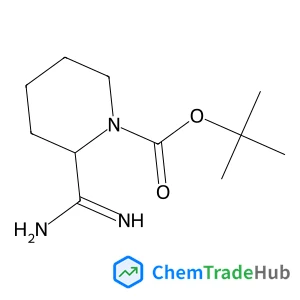
2-Methyl-2-propanyl 2-carbamimidoyl-1-piperidinecarboxylate
CAS Number:
1258640-98-0
Molecular Formula:
C11H21N3O2
Recommended Suppliers





Disclaimer
This page provides academic journal information for reference and research purposes only. We are not affiliated with any journal publishers and do not handle publication submissions. For publication-related inquiries, please contact the respective journal publishers directly.
If you notice any inaccuracies in the information displayed, please contact us at support@chemtradehub.com. We will promptly review and address your concerns.