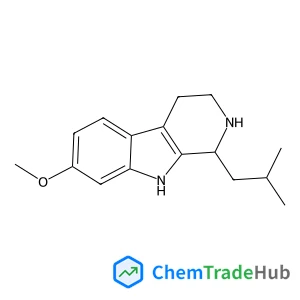
1-Isobutyl-7-methoxy-2,3,4,9-tetrahydro-1H-beta-carboline
CAS Number:
175975-76-5
Molecular Formula:
C16H22N2O
Yan Zhao, Bryce Sadtler, Min Lin, Gregory H. Hockerman, Alexander Wei
Submicron-sized Au particles and Au/SiO2 nanocomposites (superparticles) as large as 670 nm have been introduced into tsA201 cells with minimal cell trauma by cationic transfection systems. Successful implantations can be characterized by the expression of co-transfected DNA.
Mahesh R. Neupane, M. M. Sigalas, N. Aravantinos-Zafiris, Roger K. Lake
DOI: 10.1039/C4CP02328E
G. Raggi, A. J. Stace, E. Bichoutskaia
DOI: 10.1039/C4CP02672A
Marie Humbert-Droz, Patric Oulevey, Latévi Max Lawson Daku, Sandra Luber, Hans Hagemann, Thomas Bürgi
DOI: 10.1039/C4CP02145B
Tianshan Zhao, Shunhong Zhang, Yoshiyuki Kawazoe, Puru Jena
DOI: 10.1039/C4CP02758B
Dorit Shemesh, Sandra L. Blair, Sergey A. Nizkorodov
DOI: 10.1039/C4CP03130J
Isabel Peña, Lucie Kolesniková, Carlos Cabezas, Celina Bermúdez, Matías Berdakin, Alcides Simão, José L. Alonso
DOI: 10.1039/C4CP03593C
Joey D. Ocon, Jin Won Kim, Graniel Harne A. Abrenica, Jae Kwang Lee
DOI: 10.1039/C4CP02134G
Dao-Bo Li, Yuan-Yuan Cheng, Ling-Li Li, Wen-Wei Li, Yu-Xi Huang, Dan-Ni Pei, Zhong-Hua Tong, Yang Mu, Han-Qing Yu
DOI: 10.1039/C4CP04065A
Gulbagh Singh, V. Divakar Botcha, D. S. Sutar, Pavan K. Narayanam, S. S. Talwar, R. S. Srinivasa, S. S. Major
DOI: 10.1039/C4CP00875H
N-(4-Methoxybenzyl)-2-pyridinamine (CAS: 52818-63-0) is increasingly being used ...
When handling Ethyl 4-(2-chlorophenyl)-1,3-thiazole-2-carboxylate, appropriate p...
Diethyldiselane (CAS: 628-39-7) is classified under the Globally Harmonized Syst...
The market for oxocopper (CAS: 12053-18-8) is primarily driven by its use in cat...
The market for 5-{[(2-Methyl-2-propanyl)oxy]carbonyl}-5-azaspiro[2.4]heptane-7-c...
2-(1-Pyrrolidinyl)-4-pyridinamine is a chemical compound with the CAS number 359...
2-(3-Pyridinyl)-1-azabicyclo[2.2.2]octane (CAS: 91556-75-1) is a crystalline sol...
(S)-Alpha-allyl-proline hydrochloride is usually synthesized via a Wittig reacti...
3-Methyl-1,2-oxazole-5-carboxylic acid (CAS: 4857-42-5) is an organic compound w...
Lys-SMCC-DM1 is synthesized via a multi-step process involving the coupling of S...

ChemComm publishes urgent research which is of outstanding significance and interest to experts in the field, while also appealing to the journal’s broad chemistry readership. Our communication format is ideally suited to short, urgent studies that are of such importance that they require accelerated publication. Our scope covers all topics in chemistry, and research at the interface of chemistry and other disciplines (such as materials science, nanoscience, physics, engineering and biology) where there is a significant novelty in the chemistry aspects. Major topic areas covered include: Analytical Chemistry Catalysis Chemical Biology and medicinal chemistry Computational Chemistry and Machine Learning Energy and sustainable chemistry Environmental Chemistry Green Chemistry Inorganic Chemistry Materials Chemistry Nanoscience Organic Chemistry Physical Chemistry Polymer Chemistry Supramolecular Chemistry