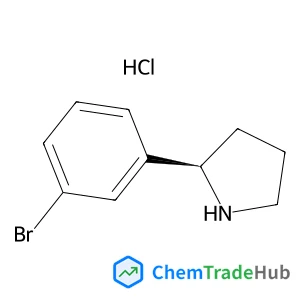
(2R)-2-(3-Bromophenyl)pyrrolidine hydrochloride (1:1)
CAS Number:
1391550-13-2
Molecular Formula:
C10H13BrClN
Diana Yepes, Oscar Donoso-Tauda, Patricia Pérez, Pablo Jaque
A variety of experimental and computational analyses support the concept that a chemical reaction has a transition region, in which the system changes from distorted states of the reactants to distorted states of the products. The boundaries of this region along the intrinsic reaction coordinate ξ, which includes the traditional transition state, are defined unambiguously by the minimum and maximum of the reaction force F(ξ), which is the negative gradient of the potential energy V(ξ). The transition region is characterized by the reaction force constant κ(ξ), the second derivative of V(ξ), being negative throughout. It has recently been demonstrated that the profile of κ(ξ) in the transition region is a sensitive indicator of the degree of synchronicity of a concerted reaction: a single κ(ξ) minimum is associated with full or nearly full synchronicity, while a κ(ξ) maximum (negative) between two minima is a sign of considerable nonsynchronicity, i.e. a two-stage concerted process. We have now applied reaction force analysis to the Diels–Alder cycloadditions of the various cyanoethylenes to cyclopentadiene. We examine the relative energy requirements of the structurally- and electronically-intensive phases of the activation processes. We demonstrate that the variation of κ(ξ) in the transition region is again indicative of the level of synchronicity. The fully synchronous cycloadditions are those in which the cyanoethylenes are symmetrically substituted. Unsymmetrical substitution leads to minor nonsynchronicity for monocyanoethylene but much more – i.e. two stages – for 1,1-dicyano- and 1,1,2-tricyanoethylene. We also show that the κ(ξ) tend to become less negative as the activation energies decrease.
Z. Y. Li, Roy L. Johnston
DOI: 10.1039/C3CP50978H
S. Hensel-Bielowka, J. R. Sangoro, Z. Wojnarowska, M. Paluch
DOI: 10.1039/C3CP50975C
Florian Löw, Katrin Amann-Winkel, Thomas Loerting, Franz Fujara, Burkhard Geil
DOI: 10.1039/C3CP50818H
Reshma Sultana, Naser Reza, Helena Woodvine, Jonathan G. Terry, Anthony J. Walton, Charlotte L. Brady, Ilka Schmueser, Andrew R. Mount
DOI: 10.1039/C3CP50759A
Yuma Matsumoto, Mai Tsubamoto, Ryoji Sugimura, Masatoshi Kozaki, Kenshi Kimoto, Munetaka Iwamura, Koichi Nozaki, Naoki Senju, Chiasa Uragami, Yohei Muramatsu, Akinori Konno
DOI: 10.1039/C3CP50182E
Marjo C. Mittelmeijer-Hazeleger, Miguel Angelo Granato, Vanessa F. Duarte Martins, Alírio E. Rodrigues, Gadi Rothenberg
DOI: 10.1039/C3CP44381G
Ting Liao, Ziqi Sun, Aijun Du, Sean Smith
DOI: 10.1039/C3CP50654A
Gianluca Di Profio, Mika T. Reijonen, Rocco Caliandro, Antonietta Guagliardi, Efrem Curcio, Enrico Drioli
DOI: 10.1039/C3CP50664A
Masatoshi Nakatani, Atsushi Nobuhiro, Nobuhiko Yokoshi, Hajime Ishihara
DOI: 10.1039/C3CP43834A
Katleen Korthout, Anthony B. Parmentier, Philippe F. Smet, Dirk Poelman
DOI: 10.1039/C3CP44334E
N-(4-Methoxybenzyl)-2-pyridinamine (CAS: 52818-63-0) is increasingly being used ...
When handling Ethyl 4-(2-chlorophenyl)-1,3-thiazole-2-carboxylate, appropriate p...
Diethyldiselane (CAS: 628-39-7) is classified under the Globally Harmonized Syst...
The market for oxocopper (CAS: 12053-18-8) is primarily driven by its use in cat...
The market for 5-{[(2-Methyl-2-propanyl)oxy]carbonyl}-5-azaspiro[2.4]heptane-7-c...
2-(1-Pyrrolidinyl)-4-pyridinamine is a chemical compound with the CAS number 359...
2-(3-Pyridinyl)-1-azabicyclo[2.2.2]octane (CAS: 91556-75-1) is a crystalline sol...
(S)-Alpha-allyl-proline hydrochloride is usually synthesized via a Wittig reacti...
3-Methyl-1,2-oxazole-5-carboxylic acid (CAS: 4857-42-5) is an organic compound w...
Lys-SMCC-DM1 is synthesized via a multi-step process involving the coupling of S...

Physical Chemistry Chemical Physics (PCCP) is an international journal co-owned by 19 physical chemistry and physics societies from around the world. This journal publishes original, cutting-edge research in physical chemistry, chemical physics and biophysical chemistry. To be suitable for publication in PCCP, articles must include significant innovation and/or insight into physical chemistry; this is the most important criterion that reviewers and Editors will judge against when evaluating submissions. The journal has a broad scope and welcomes contributions spanning experiment, theory, computation and data science. Topical coverage includes spectroscopy, dynamics, kinetics, statistical mechanics, thermodynamics, electrochemistry, catalysis, surface science, quantum mechanics, quantum computing and machine learning. Interdisciplinary research areas such as polymers and soft matter, materials, nanoscience, energy, surfaces/interfaces, and biophysical chemistry are welcomed if they demonstrate significant innovation and/or insight into physical chemistry. Joined experimental/theoretical studies are particularly appreciated when complementary and based on up-to-date approaches.