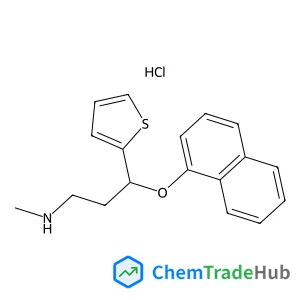
N-Methyl-3-(1-naphthyloxy)-3-(2-thienyl)-1-propanamine hydrochloride (1:1)
CAS Number:
1188266-11-6
Molecular Formula:
C18H20ClNOS
Ting Liao, Ziqi Sun, Aijun Du, Sean Smith
First-principles computational studies indicate that (B, N, or O)-doped graphene ribbon edges can substantially reduce the energy barrier for H2 dissociative adsorption. The low barrier is competitive with many widely used metal or metal oxide catalysts. This suggests that suitably functionalized graphene architectures are promising metal-free alternatives for low-cost catalytic processes.
Zhiling Luo, Changhong Liu, Shoushan Fan, Enchong Liu
DOI: 10.1039/C9TA04105B
Juan Ouyang, Lihe Sun, Fang Zeng, Shuizhu Wu
DOI: 10.1039/D1AN02183D
Liling Lu, Xiao Han, Jingwen Lin, Yingxin Zhang, Minghao Qiu, Ying Chen, Meijin Li, Dianping Tang
DOI: 10.1039/D1AN00178G
Zhi-Gang Gu, Salma Mirza, Shu-Hua Zhang, Jian Zhang
DOI: 10.1039/C8TA01034J
I. A. J. van Hengel, M. W. A. M. Tierolf, V. P. M. Valerio, M. Minneboo, A. C. Fluit, L. E. Fratila-Apachitei, I. Apachitei, A. A. Zadpoor
DOI: 10.1039/C9TB02434D
Stefanie Kirschbaum-Harriman, Michael Mayer, Axel Duerkop, Thomas Hirsch
DOI: 10.1039/C7AN00261K
T. L. Palama, I. Canard, G. J. P. Rautureau, C. Mirande, S. Chatellier, B. Elena-Herrmann
DOI: 10.1039/C6AN00393A
N-(4-Methoxybenzyl)-2-pyridinamine (CAS: 52818-63-0) is increasingly being used ...
When handling Ethyl 4-(2-chlorophenyl)-1,3-thiazole-2-carboxylate, appropriate p...
Diethyldiselane (CAS: 628-39-7) is classified under the Globally Harmonized Syst...
The market for oxocopper (CAS: 12053-18-8) is primarily driven by its use in cat...
The market for 5-{[(2-Methyl-2-propanyl)oxy]carbonyl}-5-azaspiro[2.4]heptane-7-c...
2-(1-Pyrrolidinyl)-4-pyridinamine is a chemical compound with the CAS number 359...
2-(3-Pyridinyl)-1-azabicyclo[2.2.2]octane (CAS: 91556-75-1) is a crystalline sol...
(S)-Alpha-allyl-proline hydrochloride is usually synthesized via a Wittig reacti...
3-Methyl-1,2-oxazole-5-carboxylic acid (CAS: 4857-42-5) is an organic compound w...
Lys-SMCC-DM1 is synthesized via a multi-step process involving the coupling of S...

Physical Chemistry Chemical Physics (PCCP) is an international journal co-owned by 19 physical chemistry and physics societies from around the world. This journal publishes original, cutting-edge research in physical chemistry, chemical physics and biophysical chemistry. To be suitable for publication in PCCP, articles must include significant innovation and/or insight into physical chemistry; this is the most important criterion that reviewers and Editors will judge against when evaluating submissions. The journal has a broad scope and welcomes contributions spanning experiment, theory, computation and data science. Topical coverage includes spectroscopy, dynamics, kinetics, statistical mechanics, thermodynamics, electrochemistry, catalysis, surface science, quantum mechanics, quantum computing and machine learning. Interdisciplinary research areas such as polymers and soft matter, materials, nanoscience, energy, surfaces/interfaces, and biophysical chemistry are welcomed if they demonstrate significant innovation and/or insight into physical chemistry. Joined experimental/theoretical studies are particularly appreciated when complementary and based on up-to-date approaches.
![1-{3-[4-Amino-3-(4-phenoxyphenyl)-1H-pyrazolo[3,4-d]pyrimidin-1-yl]-1-piperidinyl}-2,3-dihydroxy-1-propanone structure](https://static.chemtradehub.com/structs/122/1226872-27-0-e037.webp "1-{3-[4-Amino-3-(4-phenoxyphenyl)-1H-pyrazolo[3,4-d]pyrimidin-1-yl]-1-piperidinyl}-2,3-dihydroxy-1-propanone structure")