











Acetone photolysis at 248 nm revisited: pressure dependence of the CO and CO2 quantum yields
Literature Information
Publication Date
2009-07-29
DOI
10.1039/B906751E
Impact Factor
3.676
Authors
H. Somnitz, T. Ufer, R. Zellner
View Original
Abstract
Pressure dependent CO and CO2 quantum yields in the laser pulse photolysis of acetone at 248 nm and T = 298 K have been measured directly using quantitative infrared diode laser absorption. The experiments cover the pressure range from 50 to 900 mbar. It is found that the quantum yields show a significant dependence on total pressure, with ΦCO decreasing from around 0.5 at 20 mbar to approximately 0.3 at 900 mbar. The corresponding CO2 yields as observed when O2 exists in the reaction mixture, exhibit exactly the opposite behaviour. For the sum of both a value of 1.05+0.02−0.05 independent of pressure is obtained, showing that the sum of (ΦCO + ΦCO2) is a measure for the primary quantum yield in the photolysis of acetone. In addition, CO quantum yields and corresponding pressure dependences were measured in experiments using different bath gases including He, Ar, Kr, SF6, and O2 as third body colliders. The theoretical framework in which we discuss these data is based on our previous findings that the pressure dependence of the CO yield is a consequence of a stepwise fragmentation mechanism during which acetone decomposes initially into methyl and a vibrationally ‘hot’ acetyl radical, with the latter being able to decompose promptly into methyl plus CO. The pressure dependence of the CO yield then originates from the second step and is modelled quantitatively via statistical dynamical calculations using a combination of RRKM theory with a time-dependent master equation (ME) approach. From a comparison of experiment with theory the amount of excess energy in the vibrationally hot acetyl radicals (E* ≈ 65 kJ mol−1) as well as the characteristic collision parameters for interaction of acetyl with the different bath gases were derived. Values of 90, 280, 310, 545, 550 and 1800 cm−1 for the average energy transferred per downward collision for the bath gases He, Ar, Kr, O2, N2, and SF6, respectively, are obtained. The calculations also considered different models for the energy transfer kernel P(E,E′) and best fits were obtained with a ρ-weighted exponential down model.
Related Literature
The origin of the conformational preference of N,N′-diaryl-N,N′-dimethyl ureas
Jonathan Clayden, Ulrich Hennecke, Mark A. Vincent, Ian H. Hillier, Madeleine Helliwell
2010-10-18
Paper
DOI: 10.1039/C0CP00571A
Correlating phase behaviour and diffusion in mesopores: perspectives revealed by pulsed field gradientNMR
Rustem Valiullin, Jörg Kärger, Roger Gläser
2009-03-16
Perspective
DOI: 10.1039/B822939B
A new battery-charging method suggested by molecular dynamics simulations
Ibrahim Abou Hamad, D. O. Wipf, P. A. Rikvold
2010-01-21
Paper
DOI: 10.1039/B920970K
Effects of bidirectional regulation on noises in gene networks
Yi Tao
2010-01-20
Paper
DOI: 10.1039/B912111K
Quantum-chemical study and FTIR jet spectroscopy of CHCl3–NH3 association in the gas phase
Michael Hippler, Susanne Hesse, Martin A. Suhm
2010-08-09
Paper
DOI: 10.1039/C0CP00530D
Symmetry forbidden vibronic spectra and internal conversion in benzene
Jun Li, Xiang Yuan Li, Chao Yuan Zhu
2010-10-14
Paper
DOI: 10.1039/C0CP00120A
Ionicity in ionic liquids: correlation with ionic structure and physicochemical properties
Kazuhide Ueno, Hiroyuki Tokuda, Masayoshi Watanabe
2010-01-12
Perspective
DOI: 10.1039/B921462N
An improved chemical model for the quantitative description of the front propagation in the tetrathionate–chlorite reaction
Gábor Peintler, György Csekő, Andrea Petz, Attila K. Horváth
2010-01-15
Paper
DOI: 10.1039/B920618C
Integrated experimental and computational spectroscopy study on π-stacking interaction: the anisole dimer
Nicola Schiccheri, Massimiliano Pasquini, Giovanni Piani, Giangaetano Pietraperzia, Maurizio Becucci, Vincenzo Barone
2010-09-27
Paper
DOI: 10.1039/C002992K
You might also like
Compound Q&A
Is 6-(3-Fluorophenyl)picolinic acid (CAS: 887982-40-3) safe?
6-(3-Fluorophenyl)picolinic acid is generally considered safe for laboratory use...
887982-40-36-(3-Fluorophenyl)pi...
Compound Q&A
What industries use (3R)-3-Pyrrolidinol (CAS: 2799-21-5)?
(3R)-3-Pyrrolidinol is used in the pharmaceutical industry as a precursor for dr...
2799-21-5(3R)-3-Pyrrolidinol
Compound Q&A
What precautions should be taken when handling (4R,5R)-4,5-Diethoxycarbonyl-2,2-dimethyldioxolane (CAS: 59779-75-8)?
When handling (4R,5R)-4,5-Diethoxycarbonyl-2,2-dimethyldioxolane (CAS: 59779-75-...
59779-75-8(4R,5R)-4,5-Diethoxy...
Compound Q&A
How is 1-(6-Chloroimidazo[1,2-b]pyridazin-3-yl)ethanone (CAS: 90734-71-7) typically synthesized?
1-(6-Chloroimidazo[1,2-b]pyridazin-3-yl)ethanone is often synthesized via a mult...
90734-71-71-(6-Chloroimidazo[1...
Compound Q&A
What is the market or research trend for N-Ethyl-3,4-dimethylbenzylamine (CAS: 39180-83-1)?
The market for N-Ethyl-3,4-dimethylbenzylamine (CAS: 39180-83-1) remains steady,...
39180-83-1N-Ethyl-3,4-dimethyl...
Compound Q&A
What is Tert-butyl 3-(pyrrolidin-1-yl)azetidine-1-carboxylate (CAS: 1019008-21-9)?
Tert-butyl 3-(pyrrolidin-1-yl)azetidine-1-carboxylate is a chemical compound wit...
1019008-21-9Tert-butyl 3-(pyrrol...
Compound Q&A
What regulatory guidelines apply to 1-Bromo-3-chloro-2,4-dimethoxybenzene (CAS: 1228956-93-1)?
1-Bromo-3-chloro-2,4-dimethoxybenzene (CAS: 1228956-93-1) falls under the classi...
1228956-93-11-Bromo-3-chloro-2,4...
Compound Q&A
Is 8-Bromo-2-methyl-3,4-dihydroisoquinolin-1(2H)-one (CAS: 1368622-07-4) safe?
The safety of 8-Bromo-2-methyl-3,4-dihydroisoquinolin-1(2H)-one (CAS: 1368622-07...
1368622-07-48-Bromo-2-methyl-3,4...
Compound Q&A
Is Benzyl [(3S)-2,6-dioxo-3-piperidinyl]carbamate (CAS: 22785-43-9) safe?
Benzyl [(3S)-2,6-dioxo-3-piperidinyl]carbamate is generally safe when handled wi...
22785-43-9Benzyl [(3S)-2,6-dio...
Compound Q&A
How should 1-{[4-(4,4,5,5-Tetramethyl-1,3,2-dioxaborolan-2-yl)phenyl]sulfonyl}pyrrolidine (CAS: 928657-21-0) be stored?
1-{[4-(4,4,5,5-Tetramethyl-1,3,2-dioxaborolan-2-yl)phenyl]sulfonyl}pyrrolidine s...
928657-21-01-{[4-(4,4,5,5-Tetra...
Source Journal
Physical Chemistry Chemical Physics

CiteScore:
5.5
Self-citation Rate:
10.3%
Articles per Year:
3036
Physical Chemistry Chemical Physics (PCCP) is an international journal co-owned by 19 physical chemistry and physics societies from around the world. This journal publishes original, cutting-edge research in physical chemistry, chemical physics and biophysical chemistry. To be suitable for publication in PCCP, articles must include significant innovation and/or insight into physical chemistry; this is the most important criterion that reviewers and Editors will judge against when evaluating submissions. The journal has a broad scope and welcomes contributions spanning experiment, theory, computation and data science. Topical coverage includes spectroscopy, dynamics, kinetics, statistical mechanics, thermodynamics, electrochemistry, catalysis, surface science, quantum mechanics, quantum computing and machine learning. Interdisciplinary research areas such as polymers and soft matter, materials, nanoscience, energy, surfaces/interfaces, and biophysical chemistry are welcomed if they demonstrate significant innovation and/or insight into physical chemistry. Joined experimental/theoretical studies are particularly appreciated when complementary and based on up-to-date approaches.
Recommended Compounds
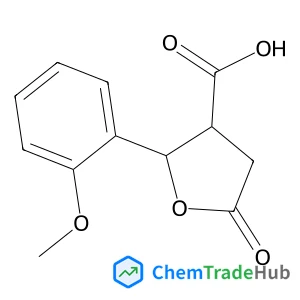
trans-2-(2-Methoxyphenyl)-5-oxotetrahydrofuran-3-carboxylic acid
CAS Number:
99226-02-5
Molecular Formula:
C12H12O5
Recommended Suppliers



Disclaimer
This page provides academic journal information for reference and research purposes only. We are not affiliated with any journal publishers and do not handle publication submissions. For publication-related inquiries, please contact the respective journal publishers directly.
If you notice any inaccuracies in the information displayed, please contact us at support@chemtradehub.com. We will promptly review and address your concerns.