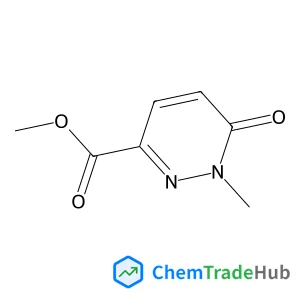
Methyl 1-methyl-6-oxo-1,6-dihydro-3-pyridazinecarboxylate
CAS Number:
74173-58-3
Molecular Formula:
C7H8N2O3
Ana Borba, Merwe Albrecht, Leszek Lapinski, Maciej J. Nowak, Martin A. Suhm, Rui Fausto
Aggregation of nicotinamide (3-pyridine-carboxamide; NA) and picolinamide (2-pyridine-carboxamide; PA) has been investigated by matrix-isolation, supersonic jet and neat solid state infrared spectroscopy, complemented by DFT(B3LYP)/6-311++G(d,p) calculations. For both compounds, the most stable dimeric structure was shown to be the centrosymmetric dimer where two monomers in their most stable forms establish two NH⋯OC hydrogen bonds. The most stable structures of monomers of NA and PA were characterized in detail experimentally by matrix-isolation spectroscopy and theoretically (at both the DFT(B3LYP)/6-311++G(d,p) and MP2/6-311++G(d,p) levels). For nicotinamide, two conformers were found in the matrices, with ca. 80% of the total population adopting the E form. The monomers and dimers of PA and NA were also investigated by infrared spectroscopy of the studied compounds seeded in supersonic jet expansions. These studies revealed that the constraints on the vibrational dynamics in the PA dimer are different from those in the NA dimer. In the PA dimer, the vibrational energy flow out of the N–H stretching mode was shown to be accelerated substantially by the presence of a secondary intramolecular hydrogen bond. In the glassy state of both compounds, the centrosymmetric dimer seems to be the prevalent structure. In the neat crystalline state (KBr pellet), picolinamide keeps this type of dimeric structure as the constituting unit, whereas nicotinamide molecules assume a different arrangement where one of the NH⋯OC bonds is replaced by an NH⋯N(ring) bond. The different crystallograpic structures which were formed by the compounds are reflected in the vibrational spectra of the solids. These observations are correlated with the molecular properties of NA and PA, in particular with the greater conformational mobility of NA compared with PA. This is ascribable to the absence in the NA molecule of the intramolecular NH⋯N(ring) interaction, which exists in PA.
Seth Olsen
DOI: 10.1039/C8CP04160A
Subha Pratihar, Maria Carolina Nicola Barbosa Muniz, Xinyou Ma, Itamar Borges, Jr., William L. Hase
DOI: 10.1039/C8CP06198J
Atul D. Sontakke, Jean-Marie Mouesca, Victor Castaing, Mathieu Salaün, Isabelle Gautier-Luneau, Vincent Maurel, Alain Ibanez, Bruno Viana
DOI: 10.1039/C8CP03952F
L. Del Bianco, F. Spizzo, Tian Li, R. Adhikari, A. Bonanni
DOI: 10.1039/C8CP04475A
Anton J. Stasyuk
DOI: 10.1039/C8CP03764G
Simón Saint-André, Federico Albanese
DOI: 10.1039/C8CP07192F
DOI: 10.1039/C8CP05027A
Sergey Y. Ketkov, Elena A. Rychagova, Sheng-Yuan Tzeng, Wen-Bih Tzeng
DOI: 10.1039/C8CP04845B
Shun-ichi Ishiuchi, Yuta Sasaki, Masaaki Fujii
DOI: 10.1039/C8CP05839C
Tao Sun, Yu-Sen Yang, Pan Yin, Min Pu, Hong Yan, Min Wei
DOI: 10.1039/C8CP06032K
3-(2-Bromoimidazo[2,1-b]thiazol-6-yl)propanoic acid hydrochloride is typically s...
2-Isopropyl-1,3-dioxane-5-carboxylic acid is typically synthesized by the carbox...
Alisporivir (CAS: 254435-95-5) is an antiviral medication used in the treatment ...
[1,2,4]triazolo[3,4-a]phthalazine (CAS: 234-80-0) is a crystalline compound with...
Regulatory guidelines for (2S)-5-Hydroxy-2-(4-hydroxyphenyl)-4-oxo-3,4-dihydro-2...
2,2-Difluorocyclohexanamine hydrochloride is generally safe when handled under p...
3-Nitro-2-phenylthiophene is primarily used in the synthesis of other organic co...
1-(Trifluoroacetyl)-4-piperidinecarbonitrile (CAS: 77940-79-5) is a colorless to...
Research and market trends for 1,3,6,8-Tetranitro-9H-carbazole (CAS: 4543-33-3) ...
Waste containing Dibenzo[b,d]thiophen-1-ylboronic acid (CAS: 1245943-60-5) shoul...

Physical Chemistry Chemical Physics (PCCP) is an international journal co-owned by 19 physical chemistry and physics societies from around the world. This journal publishes original, cutting-edge research in physical chemistry, chemical physics and biophysical chemistry. To be suitable for publication in PCCP, articles must include significant innovation and/or insight into physical chemistry; this is the most important criterion that reviewers and Editors will judge against when evaluating submissions. The journal has a broad scope and welcomes contributions spanning experiment, theory, computation and data science. Topical coverage includes spectroscopy, dynamics, kinetics, statistical mechanics, thermodynamics, electrochemistry, catalysis, surface science, quantum mechanics, quantum computing and machine learning. Interdisciplinary research areas such as polymers and soft matter, materials, nanoscience, energy, surfaces/interfaces, and biophysical chemistry are welcomed if they demonstrate significant innovation and/or insight into physical chemistry. Joined experimental/theoretical studies are particularly appreciated when complementary and based on up-to-date approaches.