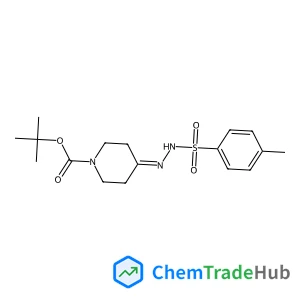
tert-Butyl 4-(2-(p-Tolylsulfonyl)hydrazono)piperidine-1-carboxylate
CAS Number:
1046478-89-0
Molecular Formula:
C17H25N3O4S
Tao Sun, Yu-Sen Yang, Pan Yin, Min Pu, Hong Yan, Min Wei
Recently, Ni–Sn intermetallic compounds (IMCs) with unique geometric structures have been proved to be selective catalysts for acetylene hydrogenation to ethylene, but the origin of the selectivity remains unclear. In this work, a density functional theory (DFT) study has been carried out to investigate the mechanism of acetylene hydrogenation on six surfaces of Ni–Sn IMCs, and the geometric effects towards ethylene selectivity were revealed. Two key parameters (adsorption energy and the hydrogenation barrier of ethylene), which determine the ethylene selectivity, were studied quantitatively. The adsorption sites for C2Hy (y = 2, 3, 4) can be classified into three types: Type 1 (Ni3Sn(111) and Ni3Sn2(101)-2) with Ni trimers, Type 2 (Ni3Sn(001) and Ni3Sn2(001)) with Ni monomers, and Type 3 (Ni3Sn2(101) and Ni3Sn2(001)-2) with reconstructed metal trimers. The adsorption energy (Ead) decreases following the order: Type 1 > Type 3 > Type 2, which indicates that the adsorption strength depends significantly on site ensemble: a more isolated Ni site would facilitate the desorption of ethylene. However, the surface roughness mainly dominates the hydrogenation barrier of ethylene. Either low or high roughness decreases the interactions between H and C2H4 (Eint), resulting in an enhanced energy barrier for over-hydrogenation of C2H4 (Ea,hydr); while moderate roughness benefits Eint and lowers Ea,hydr. The selectivity to ethylene is denoted as ΔEa = Ea,hydr − |Ead|, thus depending on the interplay of site ensemble effects and surface roughness. From this point of view, Ni3Sn(001) and Ni3Sn2(101) surfaces with well-isolated Ni ensembles and low (or high) surface roughness exhibit decreased |Ead| and increased Ea,hydr, giving rise to excellent selectivity to ethylene. This work provides significant understanding of the origin of ethylene selectivity in terms of geometric effects, which gives helpful instruction for the design and preparation of intermetallic catalysts for acetylene semi-hydrogenation.

Journal of Saudi Chemical Society

Crystallography Reports

Current Opinion in Solid State & Materials Science

Chemistry Education Research and Practice

Journal of Peptide Science

Journal of Natural Medicines

Russian Journal of Coordination Chemistry

Saudi Pharmaceutical Journal

Current Opinion in Colloid & Interface Science

Russian Journal of Organic Chemistry
Kohei Tada, Yasutaka Kitagawa
DOI: 10.1039/D3CP04187E
Liying Yang, Tingyu Liu, Jinsong Jiang, Wenqi Song
DOI: 10.1039/D3CP04600A
Peng Liao, Jian Song, Zenghui Qiu, Cheng Wen, Xin Zhang, Lin Guo, Haijun Xu
DOI: 10.1039/D3CP01965A
Maxime Hodée, Julien Massue, Sylvain Achelle, Arnaud Fihey, Gilles Ulrich, Françoise Robin-le Guen, Claudine Katan
DOI: 10.1039/D3CP03705C
When considering alternatives to 1-(4-Chlorophenyl)-N-hydroxymethanimine (CAS: 3...
This compound should be stored in a cool, dry place away from direct sunlight. I...
3-(4-Bromophenyl)-5-(2-fluorophenyl)-1,2,4-oxadiazole is synthesized through a m...
5-Chloro-2-(4-chlorophenyl)-4-methyl-6-[3-(1-piperidinyl)propoxy]pyrimidine (CAS...
2-Chloro-4-(difluoromethoxy)pyridine is used in the pharmaceutical industry for ...
3-Chloro-6-methylpyridazine (CAS: 1121-79-5) is classified under the Globally Ha...
Several alternatives can be used in the synthesis of Methyl 4,5-dimethyl-2-nitro...
Alternatives to (2E,2'E)-3,3'-(1,4-Phenylene)bisacrylaldehyde include other acry...
3-Amino-5-chloropyridin-2-ol hydrochloride is an organic compound with the CAS n...
When handling 6,7-Difluoro-2,3-dihydro-4H-chromen-4-one, it is essential to wear...

Physical Chemistry Chemical Physics (PCCP) is an international journal co-owned by 19 physical chemistry and physics societies from around the world. This journal publishes original, cutting-edge research in physical chemistry, chemical physics and biophysical chemistry. To be suitable for publication in PCCP, articles must include significant innovation and/or insight into physical chemistry; this is the most important criterion that reviewers and Editors will judge against when evaluating submissions. The journal has a broad scope and welcomes contributions spanning experiment, theory, computation and data science. Topical coverage includes spectroscopy, dynamics, kinetics, statistical mechanics, thermodynamics, electrochemistry, catalysis, surface science, quantum mechanics, quantum computing and machine learning. Interdisciplinary research areas such as polymers and soft matter, materials, nanoscience, energy, surfaces/interfaces, and biophysical chemistry are welcomed if they demonstrate significant innovation and/or insight into physical chemistry. Joined experimental/theoretical studies are particularly appreciated when complementary and based on up-to-date approaches.
![2-{[(1R,2S)-2-Aminocyclohexyl]amino}-4-{[3-(2H-1,2,3-triazol-2-yl)phenyl]amino}-5-pyrimidinecarboxamide structure](https://static.chemtradehub.com/structs/137/1370261-96-3-40df.webp "2-{[(1R,2S)-2-Aminocyclohexyl]amino}-4-{[3-(2H-1,2,3-triazol-2-yl)phenyl]amino}-5-pyrimidinecarboxamide structure")