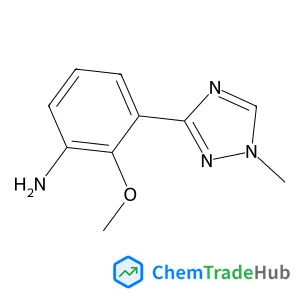
2-Methoxy-3-(1-methyl-1H-1,2,4-triazol-3-yl)aniline
CAS Number:
1609394-10-6
Molecular Formula:
C10H12N4O
Katlin Ivon Barrios Eguiluz, Giancarlo Richard Salazar-Banda, Maribel Elizabeth Funes-Huacca, Juliana Vieira Alberice, Emanuel Carrilho, Sergio Antonio Spinola Machado, Luis Alberto Avaca
This study outlines the quantification of low levels of Alicyclobacillus acidoterrestris in pure cultures, since this bacterium is not inactivated by pasteurization and may remain in industrialized foods and beverages. Electroconductive polymer-modified fluorine tin oxide (FTO) electrodes and multiple nanoparticle labels were used for biosensing. The detection ofA. acidoterrestris in pure cultures was performed by reverse transcription polymerase chain reaction (RT-PCR) and the sensitivity was further increased by asymmetric nested RT-PCR using electrochemical detection for quantification of the amplicon. The quantification of nested RT-PCR products by Ag/Au-based electrochemical detection was able to detect 2 colony forming units per mL (CFU mL−1) of spores in pure culture and low detection and quantification limits (7.07 and 23.6 nM, respectively) were obtained for the target A. acidoterrestris on the electrochemical detection bioassay.
Chenzhen Zhang, Hengli Zhang, Héctor A. Millán Cotto, Timothy L. Boyer, Matthew R. Warren, Chia-Ming Wang, Joshua Luchan, Pradeep K. Dhal, Rebecca L. Carrier, Ambika G. Bajpayee
DOI: 10.1039/D3BM01089A
Wanxin Li, Jiaxin Sun, Yao Xin, Yu Han, Yanyang Sun, Aijun Li, Zhi Wang
DOI: 10.1039/D3AY01666H
Sabina Susmel, Federico Figueredo
DOI: 10.1039/D3AY01448G
Mahdi Golsanamlou
DOI: 10.1039/D3AY00828B
Daiki Asakawa, Ryoma Yamamoto, Nobuyasu Hanari, Kazumi Saikusa
DOI: 10.1039/D3AY01450A
Shanshan Zhou, Zongxin Li, Yan Li, Xiaoyao Wang, Kun Deng
DOI: 10.1039/D3AY01938A
Jie Huang, Xiaojing Chen, Zhonghao Xie, Shujat Ali, Xi Chen, Leiming Yuan, Chengxi Jiang, Guangzao Huang, Wen Shi
DOI: 10.1039/D3AY01411H
Fangwei Qi, Huixing Li, Xiuwen Gao, Yifeng Wang, Hongyi Qian, Wei Li, Shuling Liu, Huarui Zhou, Shuping Peng
DOI: 10.1039/D3BM01283B
Sudhanshu Naithani, Nidhi Goswami, Sain Singh, Vikas Yadav, Pramod Kumar, Amit Kumar, Tapas Goswami, Sushil Kumar
DOI: 10.1039/D3AY01534C
Liuwei Gu, Yinghao Li, Xiaojie Kong, Ke Zhang, Yuling Qin, Xiaobo Zhou, Haiwei Ji, Guo Li, Li Wu
DOI: 10.1039/D3BM01576A
6-Bromo-2-methylimidazo[1,2-a]pyrimidine (CAS: 1111638-05-1) falls under various...
While there are no direct alternatives, similar compounds like 1-Pyrrolidineetha...
4-Methyl-2,6-bis(2-methyl-2-propanyl)phenyl methylcarbamate (CAS: 1918-11-2) is ...
2-(3-Bromo-4-fluorophenyl)-1,3-dioxolane (CAS: 77771-04-1) should be stored in a...
4,5,6,7-Tetrahydro-1H-indazole hydrochloride is a white crystalline solid with a...
(2R)-1-Methoxy-3-phenyl-2-propanamine is a chiral organic compound with the CAS ...
Ethyl 1-(1-phenylethyl)-1H-imidazole-5-carboxylate is used in various industries...
4-[(1E,3S)-1-(4-Hydroxyphenyl)-1,4-pentadien-3-yl]phenol (CAS: 17676-24-3) falls...
(S)-3-Amino-5-phenylpentanoic acid hydrochloride is primarily used in the pharma...
7-Methoxy-1-benzothiophene-2-carboxylic acid is typically synthesized by reactin...

Analyst publishes analytical and bioanalytical research that reports premier fundamental discoveries and inventions, and the applications of those discoveries, unconfined by traditional discipline barriers.
![(3R)-4-(4-Chlorophenyl)-3-({[(2-methyl-2-propanyl)oxy]carbonyl}amino)butanoic acid structure](https://static.chemtradehub.com/structs/218/218608-96-9-f871.webp "(3R)-4-(4-Chlorophenyl)-3-({[(2-methyl-2-propanyl)oxy]carbonyl}amino)butanoic acid structure")