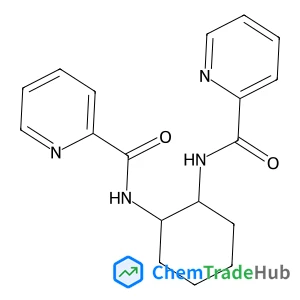
N,N'-(1R,2R)-1,2-Cyclohexanediyldi(2-pyridinecarboxamide)
CAS Number:
218290-24-5
Molecular Formula:
C18H20N4O2
Jürgen Fritz
This review will provide a general introduction to the field of cantilever biosensors by discussing the basic principles and the basic technical background necessary to understand and evaluate this class of sensors. Microfabricated cantilever sensors respond to changes in their environment or changes on their surface with a mechanical bending in the order of nanometers which can easily be detected. They are able to detect pH and temperature changes, the formation of self-assembled monolayers, DNA hybridization, antibody–antigen interactions, or the adsorption of bacteria. The review will focus on the surface stress mode of microfabricated cantilever arrays and their application as biosensors in molecular life science. A general background on biosensors, an overview of the different modes of operation of cantilever sensors and some details on sensor functionalization will be given. Finally, key experiments and current theoretical efforts to describe the surface stress mode of cantilever sensors will be discussed.

Photochemical & Photobiological Sciences

Green Chemistry

Molecular Diversity

European Journal of Organic Chemistry

Current Pharmaceutical Biotechnology

Coloration Technology

Nature Reviews Drug Discovery

Advanced Engineering Materials

Journal of Enzyme inhibition and Medicinal Chemistry

Mini-Reviews in Medicinal Chemistry
Andreas Hüther, Bernd Schäfer, Xiaoping Xu, Gerd Maurer
DOI: 10.1039/B108496H
Yide Gao, Changjin Hu, Qin Ran, Yang Chen, Xingxiao Ma, Congxiang Chen
DOI: 10.1039/B105728F
Sergei Blagov, Hans Hasse
DOI: 10.1039/B109541B
Ilya Polishuk, Jaime Wisniak, Hugo Segura
DOI: 10.1039/B108834N
DOI: 10.1039/B107478B
Gui-xia Liu, Yi-hong Ding, Ze-sheng Li, Qiang Fu, Xu-ri Huang, Chia-chung Sun, Au-chin Tang
DOI: 10.1039/B109758J
Masaharu Okazaki, Kazumi Toriyama, Kiichi Oda, Toshio Kasai
DOI: 10.1039/B110851D
Pierre Borckmans, Guy Dewel
DOI: 10.1039/B109389B
Gamil A. Guirgis, Stephen Bell, Chao Zheng, James R. Durig
DOI: 10.1039/B109222G
DOI: 10.1039/B108703G
6-Bromo-2-methylimidazo[1,2-a]pyrimidine (CAS: 1111638-05-1) falls under various...
While there are no direct alternatives, similar compounds like 1-Pyrrolidineetha...
4-Methyl-2,6-bis(2-methyl-2-propanyl)phenyl methylcarbamate (CAS: 1918-11-2) is ...
2-(3-Bromo-4-fluorophenyl)-1,3-dioxolane (CAS: 77771-04-1) should be stored in a...
4,5,6,7-Tetrahydro-1H-indazole hydrochloride is a white crystalline solid with a...
(2R)-1-Methoxy-3-phenyl-2-propanamine is a chiral organic compound with the CAS ...
Ethyl 1-(1-phenylethyl)-1H-imidazole-5-carboxylate is used in various industries...
4-[(1E,3S)-1-(4-Hydroxyphenyl)-1,4-pentadien-3-yl]phenol (CAS: 17676-24-3) falls...
(S)-3-Amino-5-phenylpentanoic acid hydrochloride is primarily used in the pharma...
7-Methoxy-1-benzothiophene-2-carboxylic acid is typically synthesized by reactin...

Analyst publishes analytical and bioanalytical research that reports premier fundamental discoveries and inventions, and the applications of those discoveries, unconfined by traditional discipline barriers.

![(3aS,6aS)-1-Methyloctahydropyrrolo[3,4-b]pyrrole structure](https://static.chemtradehub.com/structs/877/877212-98-1-9157.webp "(3aS,6aS)-1-Methyloctahydropyrrolo[3,4-b]pyrrole structure")