


Investigation of collisional quenching of CCl2( 1B1 and ã 3B1) by some inorganic molecules
Literature Information
Publication Date
2002-02-26
DOI
10.1039/B105728F
Impact Factor
3.676
Authors
Yide Gao, Changjin Hu, Qin Ran, Yang Chen, Xingxiao Ma, Congxiang Chen
View Original
Abstract
CCl2 free radicals were produced by a pulsed dc discharge of CCl4 in Ar. The radicals were electronically excited from the ground electronic state to the à 1B1 (0,4,0) state with Nd:YAG laser pumped dye laser at 541.52 nm in the rR subband. Experimental quenching data of CCl2(à 1B1) and CCl2(ã 3B1) by O2, N2, NO, NH3, H2O, CO2, CS2, SO2, and SF6 molecules were monitored by observing the time-resolved total fluorescence signals of the excited CCl2 in a cell where the total pressure was 200 Pa. The observed profiles showed a superposition of two exponential decay components in the presence of the quencher. The quenching rate constants kA of CCl2(Ã) and ka of CCl2(ã) were derived by analyzing the experimental data according to a proposed three-level-model to deal with the CCl2( 1A1, à 1B1, ã 3B1) system. The order of magnitude for the rate constant of the quenching of the à state (kA) is 10−10 cm3 s−1, while for the quenching rate constant of the ã state (ka) is 30–50% of kA. By changing the excitation wavelength, the radicals of the ground electronic state CCl2() were electronically excited to a different vibronic state, i.e. (0,3,0), (0,4,0), (1,3,0), (0,6,0), (1,4,0) and (2,2,0), of CCl2(à 1B1). We studied the kinetics of the collisional quenching by H2O and NH3 molecules of CCl2(à 1B1) in different vibronic states. It is found that the total quenching rate constant kA is little dependent on the vibronic state. It is possible that the reaction between the quencher molecule and CCl2(à 1B1) undergoes a process without a barrier. An explanation for the measured quenching data using the complex model based on attractive forces between the collision partners is presented.
Recommended Journals

Acta Materialia

Journal of Saudi Chemical Society

New Journal of Chemistry

Russian Journal of Coordination Chemistry

Russian Journal of Organic Chemistry

Current Opinion in Colloid & Interface Science

Crystallography Reports

Organic Process Research & Development

Chemical Communications

Russian Journal of Applied Chemistry
Related Literature
Synergistic multi-selective photocatalysis and real-time optical thermometry of CsPbBr3/BiOI/TiO2@PAN flexible nanofibers
Yanyan Li, Edwin Yue Bun Pun
2023-10-25
Paper
DOI: 10.1039/D3TA04964G
Development of highly conductive anion exchange membranes based on crosslinked PIM-SEBS with high free volume
2023-11-06
Paper
DOI: 10.1039/D3TA05044K
Multistate switching of scanning tunnelling microscopy machined polyoxovanadate–dysprosium–phthalocyanine nanopatterns on graphite
Marco Moors, Irina Werner, Jens Bauer, Jonas Lorenz, Kirill Yu. Monakhov
2023-12-12
Communication
DOI: 10.1039/D3NH00345K
Dual carbon engineering enabling 1T/2H MoS2 with ultrastable potassium ion storage performance
Rong Hu, Yanqi Tong, Jinling Yin, Junxiong Wu, Jing Zhao, Dianxue Cao, Guiling Wang, Kai Zhu
2023-12-20
Communication
DOI: 10.1039/D3NH00404J
A solely biobased strain sensor with an ultra-precision response via a surface graphitization strategy
Zhihao Yang, Ying Yuan, Bin Wang, Xiaojun Shen, Xiluan Wang, Tong-Qi Yuan
2023-11-02
Paper
DOI: 10.1039/D3TA04872A
MnP4 electrode for Na-ion batteries: a complex and effective electrochemical mechanism
Julien Fullenwarth, Bernard Fraisse, Nicolas Dupré
2023-10-02
Paper
DOI: 10.1039/D3TA02329J
Amorphous C/SbSx composites from natural stibnite as low cost and high performance lithium/sodium-ion battery anodes
Shuonan Wang, Kai Zhang, Hao Liu, Libing Liao
2023-10-26
Paper
DOI: 10.1039/D3TA05355E
Stability and synthesis across barium tin sulfide material space
Andriy Zakutayev
2023-11-10
Paper
DOI: 10.1039/D3TA04431A
Ultrahigh-quality graphene resonators by liquid-based strain-engineering
Mario Hofmann, Chi-Te Liang, Ya-Ping Hsieh
2023-11-02
Communication
DOI: 10.1039/D3NH00420A
You might also like
Compound Q&A
What regulatory guidelines apply to 6-Bromo-2-methylimidazo[1,2-a]pyrimidine (CAS: 1111638-05-1)?
6-Bromo-2-methylimidazo[1,2-a]pyrimidine (CAS: 1111638-05-1) falls under various...
1111638-05-16-Bromo-2-methylimid...
Compound Q&A
Are there alternatives to 1-Pyrrolidineethanol, β-methyl-α-phenyl-, (αS,βR) (CAS: 123620-80-4) in synthesis?
While there are no direct alternatives, similar compounds like 1-Pyrrolidineetha...
123620-80-41-Pyrrolidineethanol...
Compound Q&A
Is 4-Methyl-2,6-bis(2-methyl-2-propanyl)phenyl methylcarbamate (CAS: 1918-11-2) safe?
4-Methyl-2,6-bis(2-methyl-2-propanyl)phenyl methylcarbamate (CAS: 1918-11-2) is ...
1918-11-24-Methyl-2,6-bis(2-m...
Compound Q&A
How should 2-(3-Bromo-4-fluorophenyl)-1,3-dioxolane (CAS: 77771-04-1) be stored?
2-(3-Bromo-4-fluorophenyl)-1,3-dioxolane (CAS: 77771-04-1) should be stored in a...
77771-04-12-(3-Bromo-4-fluorop...
Compound Q&A
What are the physical and chemical properties of 4,5,6,7-Tetrahydro-1H-indazole hydrochloride (CAS: 18161-11-0)?
4,5,6,7-Tetrahydro-1H-indazole hydrochloride is a white crystalline solid with a...
18161-11-04,5,6,7-Tetrahydro-1...
Compound Q&A
What is (2R)-1-Methoxy-3-phenyl-2-propanamine (CAS: 59919-07-2)?
(2R)-1-Methoxy-3-phenyl-2-propanamine is a chiral organic compound with the CAS ...
59919-07-2(2R)-1-Methoxy-3-phe...
Compound Q&A
What industries use Ethyl 1-(1-phenylethyl)-1H-imidazole-5-carboxylate (CAS: 56649-47-9)?
Ethyl 1-(1-phenylethyl)-1H-imidazole-5-carboxylate is used in various industries...
56649-47-9Ethyl 1-(1-phenyleth...
Compound Q&A
What regulatory guidelines apply to 4-[(1E,3S)-1-(4-Hydroxyphenyl)-1,4-pentadien-3-yl]phenol (CAS: 17676-24-3)?
4-[(1E,3S)-1-(4-Hydroxyphenyl)-1,4-pentadien-3-yl]phenol (CAS: 17676-24-3) falls...
17676-24-34-[(1E,3S)-1-(4-Hydr...
Compound Q&A
What industries use (S)-3-Amino-5-phenylpentanoic acid hydrochloride (CAS: 331846-97-0)?
(S)-3-Amino-5-phenylpentanoic acid hydrochloride is primarily used in the pharma...
331846-97-0(S)-3-Amino-5-phenyl...
Compound Q&A
How is 7-methoxy-1-benzothiophene-2-carboxylic acid (CAS: 88791-07-5) typically synthesized?
7-Methoxy-1-benzothiophene-2-carboxylic acid is typically synthesized by reactin...
88791-07-57-methoxy-1-benzothi...
Source Journal
Physical Chemistry Chemical Physics

CiteScore:
5.5
Self-citation Rate:
10.3%
Articles per Year:
3036
Physical Chemistry Chemical Physics (PCCP) is an international journal co-owned by 19 physical chemistry and physics societies from around the world. This journal publishes original, cutting-edge research in physical chemistry, chemical physics and biophysical chemistry. To be suitable for publication in PCCP, articles must include significant innovation and/or insight into physical chemistry; this is the most important criterion that reviewers and Editors will judge against when evaluating submissions. The journal has a broad scope and welcomes contributions spanning experiment, theory, computation and data science. Topical coverage includes spectroscopy, dynamics, kinetics, statistical mechanics, thermodynamics, electrochemistry, catalysis, surface science, quantum mechanics, quantum computing and machine learning. Interdisciplinary research areas such as polymers and soft matter, materials, nanoscience, energy, surfaces/interfaces, and biophysical chemistry are welcomed if they demonstrate significant innovation and/or insight into physical chemistry. Joined experimental/theoretical studies are particularly appreciated when complementary and based on up-to-date approaches.
Recommended Compounds
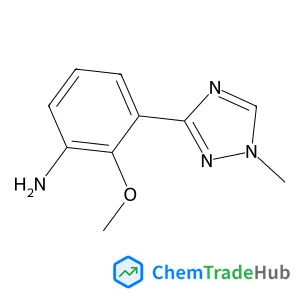
2-Methoxy-3-(1-methyl-1H-1,2,4-triazol-3-yl)aniline
CAS Number:
1609394-10-6
Molecular Formula:
C10H12N4O
Recommended Suppliers






Disclaimer
This page provides academic journal information for reference and research purposes only. We are not affiliated with any journal publishers and do not handle publication submissions. For publication-related inquiries, please contact the respective journal publishers directly.
If you notice any inaccuracies in the information displayed, please contact us at support@chemtradehub.com. We will promptly review and address your concerns.