


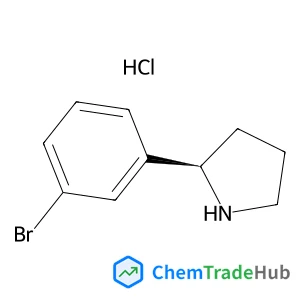
(2R)-2-(3-Bromophenyl)pyrrolidine hydrochloride (1:1)
CAS Number:
1391550-13-2
Molecular Formula:
C10H13BrClN
James A. Elliott, Stephen J. Paddison
Computational modelling studies of the structure of perfluorosulfonic acid (PFSA) ionomer membranes consistently exhibit a nanoscopic phase-separated morphology in which the ionic side chains and aqueous counterions segregate from the fluorocarbon backbone to form clusters or channels. Although these investigations do not unambiguously predict the size or shape of the clusters, and whether or not the channels percolate the matrix or if the connections between them are more transient, the sequence of co-monomers along the main chain appears strongly to influence the domain size of the ionic regions, with more blocky sequences giving rise to larger domain sizes. The fundamental insight that substantial rearrangement of the sulfonic acid terminated side chains and fluorocarbon backbone takes place during swelling or shrinkage is borne out by both molecular and mesoscale simulations of model PFSA polymers, along with ab initio electronic structure calculations of minimally hydrated oligomeric fragments. Molecular-level modelling of proton transport in PFSA membranes attests to the complexity of the underlying mechanisms and the need to examine the chemical and physical processes at several distinct time and length scales. These investigations have revealed that the conformation of the fluorocarbon backbone, flexibility of the sidechains, and degree of aggregation and association of the sulfonic acid groups under minimally hydrated conditions collectively control the dissociation of the protons and the formation of Zundel and Eigen cations. The former appear to be the dominant charge carriers when the limiting water content allows only for the formation of a contact ion pair with the tethered sulfonate anion. As the water content increases, solvent-separated Eigen ions begin to appear, indicating that the dominant mechanism for diffusion of protons occurs over a region approximately 4 Å away from the sulfonate groups. Finally, both the vehicular and Grotthuss shuttling mechanisms contribute to the mobility of the protons but, surprisingly, they are not always correlated, resulting in a lower overall diffusion coefficient. In summary, as the preceding observations indicate, the state of computational modelling of PFSA membranes has progressed sufficiently over the last decade to enable its use as a powerful predictive tool with which to guide the process of designing novel membrane materials for fuel cell applications.

Current Opinion in Solid State & Materials Science

Nature Medicine

Organic Process Research & Development

Journal of Peptide Science

Russian Journal of Organic Chemistry

Current Opinion in Colloid & Interface Science

Chemical Communications

Drug Discovery Today

New Journal of Chemistry

Crystallography Reports
Jirui Zhang, Evelina Liarou, James Town, Yongguang Li, Alan M. Wemyss, David M. Haddleton
DOI: 10.1039/D0PY00555J
Matthias Rohmer, Özgün Ucak, Rahul Fredrick, Wolfgang H. Binder
DOI: 10.1039/D1PY01021B
Fang Guo, Ming Deng, Fan Li, Shoulong Chen
DOI: 10.1039/D1PY00938A
Amalie Solberg, Ingrid V. Mo, Finn L. Aachmann, Christophe Schatz, Bjørn E. Christensen
DOI: 10.1039/D1PY00727K
Yi-Cong Wang, Pei-Yi Cheng, Zhi-Qian Zhang, Ke-Xin Fan, Rui-Qi Lu, Shu Zhang, Yi-Xian Wu
DOI: 10.1039/D1PY01140E
Katelyn M. Lindenmeyer, R. Daniel Johnson, Kevin M. Miller
DOI: 10.1039/D0PY00016G
Ru Dong, Qi Chen, Xuediao Cai, Qi Zhang, Zhike Liu
DOI: 10.1039/D0PY00680G
Hong-Mei Yang, Zhi-Hao Chen, Jun-Fang Li, Xiu-Li Sun, Xiao-Yan Wang, Yong Tang
DOI: 10.1039/D1PY01273H
Daniel A. Corbin, Blaine G. McCarthy, Garret M. Miyake
DOI: 10.1039/D0PY00643B
Reid A. Gilsdorf, Matthew A. Nicki, Eugene Y.-X. Chen
DOI: 10.1039/D0PY00786B
N-(4-Methoxybenzyl)-2-pyridinamine (CAS: 52818-63-0) is increasingly being used ...
When handling Ethyl 4-(2-chlorophenyl)-1,3-thiazole-2-carboxylate, appropriate p...
Diethyldiselane (CAS: 628-39-7) is classified under the Globally Harmonized Syst...
The market for oxocopper (CAS: 12053-18-8) is primarily driven by its use in cat...
The market for 5-{[(2-Methyl-2-propanyl)oxy]carbonyl}-5-azaspiro[2.4]heptane-7-c...
2-(1-Pyrrolidinyl)-4-pyridinamine is a chemical compound with the CAS number 359...
2-(3-Pyridinyl)-1-azabicyclo[2.2.2]octane (CAS: 91556-75-1) is a crystalline sol...
(S)-Alpha-allyl-proline hydrochloride is usually synthesized via a Wittig reacti...
3-Methyl-1,2-oxazole-5-carboxylic acid (CAS: 4857-42-5) is an organic compound w...
Lys-SMCC-DM1 is synthesized via a multi-step process involving the coupling of S...

Physical Chemistry Chemical Physics (PCCP) is an international journal co-owned by 19 physical chemistry and physics societies from around the world. This journal publishes original, cutting-edge research in physical chemistry, chemical physics and biophysical chemistry. To be suitable for publication in PCCP, articles must include significant innovation and/or insight into physical chemistry; this is the most important criterion that reviewers and Editors will judge against when evaluating submissions. The journal has a broad scope and welcomes contributions spanning experiment, theory, computation and data science. Topical coverage includes spectroscopy, dynamics, kinetics, statistical mechanics, thermodynamics, electrochemistry, catalysis, surface science, quantum mechanics, quantum computing and machine learning. Interdisciplinary research areas such as polymers and soft matter, materials, nanoscience, energy, surfaces/interfaces, and biophysical chemistry are welcomed if they demonstrate significant innovation and/or insight into physical chemistry. Joined experimental/theoretical studies are particularly appreciated when complementary and based on up-to-date approaches.
![1-oxaspiro[4.4]nonan-6-one structure](https://static.chemtradehub.com/structs/134/134179-01-4-e051.webp "1-oxaspiro[4.4]nonan-6-one structure")




