












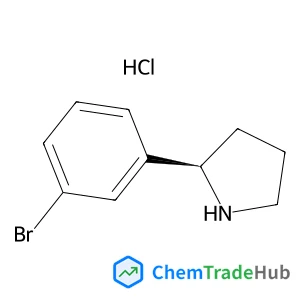
(2R)-2-(3-Bromophenyl)pyrrolidine hydrochloride (1:1)
CAS Number:
1391550-13-2
Molecular Formula:
C10H13BrClN
Jirui Zhang, Evelina Liarou, James Town, Yongguang Li, Alan M. Wemyss, David M. Haddleton
Copper-mediated reversible deactivation radical polymeriation (Cu-RDRP) in aqueous media has been employed to synthesize temperature-responsive block copolymers, utilizing both hydrophobic and hydrophilic amide functional macroinitiators derived from polyetheramines (Jeffamines™). The in situ and rapid diproportionation of Cu(I)Br/Me6TREN in water is exploited for the efficient homopolymerization of N-isopropyl acrylamide (NIPAM) and dimethyl acrylamide (DMA), at near full conversions (>99%), with low dispersity (Đ < 1.18) and with a range of molar masses. The Jeffamine™-derived macroinitiators were used for both the synthesis of homopolymer and for one-pot chain extensions and block copolymerizations (i.e. Jeffamine™-PNIPAM-b-PDMA). The obtained polymers exhibit controlled thermoresponsive aggregation behaviour which varies depending on the hydrophilicity/hydrophobicity of the macroinitiators and the composition of the block copolymers. Thermal analysis and dynamic light scattering (DLS) give an insight into the effect of these macroinitiators on the thermoresponsive aggregation behaviour of the synthesized polymers.
Mirela Sarbu, Željka Vukelić, David E. Clemmer
DOI: 10.1039/C8AN01118D
Arthur Schönhals, Hans Tholl, Mathias Glasmacher, Niels Kröger-Lui, Annemarie Pucci, Wolfgang Petrich
DOI: 10.1039/C6AN01757F
DOI: 10.1039/C8AN01270A
Guobin Mao, Mingyuan Du, Xinxin Wang, Xinghu Ji, Zhike He
DOI: 10.1039/C8AN01640B
Oliver Jonas, Jeon Woong Kang, Surya P. Singh, Alex Lammers, Freddy T. Nguyen, Ramachandra R. Dasari, Peter T. C. So, Robert Langer
DOI: 10.1039/C8AN00913A
Kaiyuan Zheng, Chuantao Zheng, Zidi Liu, Qixin He, Qiaoling Du, Yu Zhang, Yiding Wang, Frank K. Tittel
DOI: 10.1039/C8AN01290C
Xuan-Xuan Chen, Yun-Bao Jiang
DOI: 10.1039/C7AN00439G
D. Willingham, E. E. Groopman, K. S. Grabowski, L. Sangely
DOI: 10.1039/C8AN01451E
DOI: 10.1039/C8AN01120F
N-(4-Methoxybenzyl)-2-pyridinamine (CAS: 52818-63-0) is increasingly being used ...
When handling Ethyl 4-(2-chlorophenyl)-1,3-thiazole-2-carboxylate, appropriate p...
Diethyldiselane (CAS: 628-39-7) is classified under the Globally Harmonized Syst...
The market for oxocopper (CAS: 12053-18-8) is primarily driven by its use in cat...
The market for 5-{[(2-Methyl-2-propanyl)oxy]carbonyl}-5-azaspiro[2.4]heptane-7-c...
2-(1-Pyrrolidinyl)-4-pyridinamine is a chemical compound with the CAS number 359...
2-(3-Pyridinyl)-1-azabicyclo[2.2.2]octane (CAS: 91556-75-1) is a crystalline sol...
(S)-Alpha-allyl-proline hydrochloride is usually synthesized via a Wittig reacti...
3-Methyl-1,2-oxazole-5-carboxylic acid (CAS: 4857-42-5) is an organic compound w...
Lys-SMCC-DM1 is synthesized via a multi-step process involving the coupling of S...

Polymer Chemistry welcomes submissions in all areas of polymer science that have a strong focus on macromolecular chemistry. Manuscripts may cover a broad range of fields, yet no direct application focus is required.

![1-(1-Benzyl-1,2,3,6-tetrahydropyridin-4-yl)-1H-benzo[d]imidazol-2(3H)-one structure](https://static.chemtradehub.com/structs/603/60373-71-9-7dfb.webp "1-(1-Benzyl-1,2,3,6-tetrahydropyridin-4-yl)-1H-benzo[d]imidazol-2(3H)-one structure")




